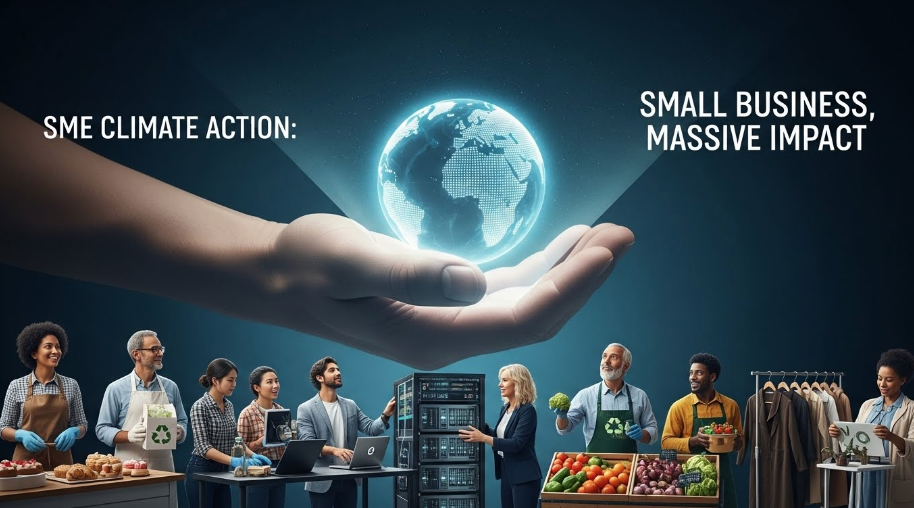
How Small & Medium Enterprises Are Becoming Climate Entrepreneurs
Here’s what the big corporations don’t want you to know:
Small and medium-sized enterprises (SMEs) collectively have MORE impact on climate than all the Fortune 500 companies combined.
The numbers tell the story:
- SMEs = 90% of businesses globally
- SMEs = 50% of global GDP
- SMEs = 60-70% of employment
- SMEs = More total emissions than large corporations
Translation: When SMEs move, markets transform. When SMEs stay still, nothing changes.
But here’s the opportunity nobody talks about: Climate action isn’t a burden for small businesses—it’s the ultimate competitive advantage.
While big companies drown in bureaucracy and committees, SMEs can pivot on a dime. While corporations need board approval for every decision, you can start tomorrow. While large businesses optimize existing models, you can invent entirely new ones.
The small businesses winning today? They’re not following climate regulations—they’re building climate solutions.
Why SMEs Are the Secret Weapon of Climate Action
The SME Advantage:
1. Agility
- Decision-making speed: days, not months
- Can test new approaches quickly
- Pivot when something doesn’t work
- Scale winners without bureaucracy
2. Customer Connection
- Know your customers personally
- Can educate and influence them
- Build loyalty through shared values
- Word-of-mouth is your superpower
3. Innovation Freedom
- Not locked into old business models
- Can experiment with circular economy
- Create entirely new product categories
- Partner flexibly with other innovators
4. Community Trust
- Local businesses are trusted institutions
- Personal relationships with suppliers and customers
- Visible impact in community
- Can lead by example
5. Lower Overhead
- Smaller changes have bigger impact proportionally
- Energy efficiency savings matter more
- Don’t need massive R&D budgets
- Can bootstrap green innovation
6. First-Mover Opportunity
- Large competitors are slow
- Capture conscious consumers first
- Build brand as sustainable option
- Become acquisition target for bigger players
The SME Climate Opportunity: Real Numbers
The Market Reality:
The Conscious Consumer Shift:
- 73% of consumers prefer sustainable brands
- 68% willing to pay premium for sustainable products
- Millennials and Gen Z (largest consumer segments) actively seek green options
- B2B buyers increasingly require supplier sustainability
The Cost Savings:
- Energy efficiency: 15-30% immediate cost reduction
- Waste reduction: 20-40% material cost savings
- Circular models: New revenue from “waste”
- Efficiency improvements: 10-25% productivity gains
The Access to Capital:
- Green business loans: Often lower interest rates
- Impact investors seeking SME opportunities
- Crowdfunding success for sustainable businesses
- B Corp certification attracts conscious investors
The Competitive Moats:
- Sustainable businesses have 2x customer retention
- Employee retention 30% higher
- Premium pricing accepted by conscious consumers
- Protected from race-to-bottom price competition
The Market Growth:
- Green economy growing 3x faster than traditional
- Circular economy: $4.5 trillion opportunity
- Climate tech: $1+ trillion in annual investment
- Local/sustainable food: Double-digit growth annually
Real Example: Patagonia (started as small business)
- Built on sustainability
- Grown to $1+ billion revenue
- Maintains premium pricing
- Customers evangelize brand
- Competitors can’t compete on price alone
The 60-Day SME Climate Sprint
This is your fast-track to transforming your business into a profitable, climate-positive enterprise.
Week 1-2: Know Your Numbers
Activity 1: Calculate Your Carbon Footprint (Day 1-2)
Your Emissions Come From:
- Scope 1: Direct (vehicles, on-site fuel)
- Scope 2: Purchased electricity
- Scope 3: Everything else (suppliers, shipping, waste, employee commutes)
Quick Calculation:
- Use free SME carbon calculator (many available online)
- Focus on the big stuff first
- Don’t get paralyzed by precision
- Goal: Know rough order of magnitude
Deliverable: Your carbon baseline in tons CO₂ annually
Activity 2: Track Your Top 5 Costs (Day 3-4)
List Your Biggest Operating Expenses:
- Energy (electricity, heating, fuel)
- Materials/inventory
- Waste disposal
- Transportation/shipping
- Water
Why This Matters: These are also your climate impact AND your savings opportunities
Deliverable: Spreadsheet showing monthly costs for each category
Activity 3: Audit Your Waste (Day 5-7)
For One Week, Track:
- What goes in trash?
- What goes in recycling?
- What could be composted?
- What could be reduced/reused?
- What’s returned/unsold inventory?
Take Photos: Seeing waste piles is motivating
Deliverable: Waste analysis showing opportunities
Week 3-4: Execute Quick Wins
Activity 4: Energy Efficiency Blitz (Day 8-12)
No-Cost/Low-Cost Actions:
- LED Lighting: Replace all bulbs (typical payback: 1-2 years)
- Cost: $2-10 per bulb
- Savings: 75% less energy, last 25x longer
- Smart Power Strips: Eliminate vampire power
- Cost: $25-50 each
- Savings: $100-200 annually per strip
- Thermostat Adjustment: 68°F winter, 78°F summer
- Cost: $0
- Savings: 10% on heating/cooling
- Seal Air Leaks: Weather stripping, caulk
- Cost: $50-100
- Savings: 5-20% on heating/cooling
- Equipment Maintenance: Clean filters, tune-up HVAC
- Cost: $100-300
- Savings: 5-15% efficiency improvement
Expected Total Savings: 15-25% on energy bills
Deliverable: Energy action plan with ROI for each item
Activity 5: Switch to Renewable Energy (Day 13-15)
Three Options:
Option 1: Renewable Energy Plan
- Call your utility or use comparison site
- Often same price or cheaper than standard electricity
- Immediate switch, no installation
- Time: 15 minutes
- Cost: $0 extra (sometimes cheaper)
Option 2: Community Solar
- Subscribe to off-site solar farm
- Get credits on your bill
- No upfront cost
- Savings: Typically 5-15% vs. utility rates
Option 3: On-Site Solar
- Get 3 quotes (takes 2 weeks)
- Typical payback: 5-8 years for businesses
- Tax credits available (30% federal ITC)
- Adds property value
- Consider if: You own your building
Deliverable: Renewable energy contract signed OR solar quotes in hand
Activity 6: Waste Reduction (Day 16-20)
Implement 3 Waste Fixes:
- Recycling/Composting Setup
- Labeled bins for recycling, compost, trash
- Partner with waste hauler or local composting service
- Train staff on proper sorting
- Cost: $100-500 for bins and service
- Savings: 30-50% reduction in trash fees
- Eliminate Single-Use
- Reusable mugs, plates, utensils in break room
- Eliminate plastic bags/packaging where possible
- Reusable shipping materials
- Cost: $200-500 upfront
- Savings: $500-2,000 annually
- Inventory Optimization
- Better demand forecasting = less waste
- First-in-first-out (FIFO) for perishables
- Discount near-expiration items
- Donate unsold goods (tax deduction)
- Savings: 10-30% reduction in waste losses
Deliverable: Waste reduction plan implemented
Week 5-6: Optimize Operations
Activity 7: Transportation & Logistics (Day 21-27)
Reduce Fuel Costs:
Option A: Route Optimization
- Use route planning software (many free options)
- Combine deliveries/pickups
- Optimize delivery schedules
- Savings: 10-20% on fuel and time
Option B: Vehicle Efficiency
- Proper tire inflation (3% better MPG)
- Regular maintenance
- Remove excess weight
- Smooth acceleration/braking
- Savings: 10-15% on fuel
Option C: Electrify (If Replacing Vehicle)
- Electric vehicles now available in all sizes
- Lower total cost of ownership than gas
- Consider for local delivery, service vehicles
- Federal tax credits available
- Savings: 50-70% on fuel costs
Option D: Alternative Transportation
- Cargo bikes for urban deliveries (yes, really)
- Public transit for staff
- Remote work where possible
- Carpool incentives
- Savings: Varies, but substantial for urban businesses
Deliverable: Transportation optimization plan
Activity 8: Sustainable Procurement (Day 28-35)
Green Your Supply Chain:
- Survey Key Suppliers
- Ask about their sustainability practices
- Prioritize suppliers with commitments
- Request emissions data
- Consider switching if big gap
- Buy Less, Buy Better
- Higher quality = longer lasting
- Reduces replacement frequency
- Often cheaper lifecycle cost
- Less waste
- Buy Local When Possible
- Lower transportation emissions
- Support local economy
- Often fresher/better quality
- Builds community relationships
- Sustainable Packaging
- Recycled content
- Minimal packaging
- Reusable containers
- Compostable where appropriate
Deliverable: Updated supplier list prioritizing sustainability
Week 7-8: Market Your Impact
Activity 9: Get Certified (Day 36-45)
Green Business Certifications:
B Corp Certification:
- Most rigorous and respected
- Free to start assessment
- $1,000-50,000 annual fee (based on revenue)
- Demonstrates triple bottom line (profit, people, planet)
- Marketing gold: customers trust B Corps
Green Business Certification (Local):
- Many cities/regions have programs
- Often free or low-cost
- Provides local visibility
- Connects you with other green businesses
Industry-Specific Certifications:
- Organic, Fair Trade, Energy Star, etc.
- Choose what’s relevant to your business
- Customers recognize and value these
Carbon Neutral Certification:
- Calculate emissions
- Reduce what you can
- Offset remainder (temporarily)
- Can claim “carbon neutral” business
Deliverable: At least one certification in progress
Activity 10: Tell Your Story (Day 46-55)
Create Your Climate Marketing:
- Website Update
- “Our Commitment” or “Sustainability” page
- Specific actions you’ve taken
- Metrics (tons CO₂ reduced, waste diverted, etc.)
- Certifications displayed prominently
- Social Media Campaign
- Share your journey (before/after)
- Behind-the-scenes of changes
- Employee and customer testimonials
- Regular updates on progress
- Key: Authenticity over perfection
- In-Store/Office Signage
- “We’re powered by solar”
- “Zero waste to landfill”
- “Carbon neutral business”
- Educate customers about your choices
- Local Media Outreach
- Press release about your transformation
- Offer to be case study
- Participate in green business events
- Host tours of your sustainable operations
Deliverable: Marketing materials showcasing your climate action
Week 9+: Innovate Your Business Model
Activity 11: Circular Economy Opportunities (Ongoing)
Transform Your Business Model:
Option 1: Product-as-Service
- Instead of selling products, lease them
- You maintain ownership and responsibility
- Incentivized to make products last
- Customers get always-updated products
- Example: Philips “lighting as a service” – you pay for light, they own bulbs
Option 2: Take-Back Programs
- Customers return used products
- You refurbish and resell
- Or recycle materials for new products
- Creates customer loyalty loop
- Example: Patagonia Worn Wear program
Option 3: Repair Services
- Offer repair instead of replacement
- New revenue stream
- Builds customer relationships
- Extends product life
- Example: Local shoe repair shops thriving vs. cheap disposable shoes
Option 4: Waste-to-Product
- Your waste becomes someone else’s input
- Partner with complementary businesses
- Industrial symbiosis
- Example: Brewery waste → animal feed or compost
Option 5: Sharing Platform
- Facilitate sharing of underutilized assets
- Platform revenue without inventory
- Maximizes resource efficiency
- Example: Tool libraries, equipment sharing
Deliverable: Circular business model pilot launched
Real SME Success Stories
Case Study 1: Frogbike, Denver (Cargo Bike Delivery Service)
Business Model:
- Electric cargo bike delivery for local businesses
- Replaces delivery vans in urban core
- Started with 2 bikes, now 15
Climate Action:
- Zero direct emissions
- Faster than cars in dense urban areas
- Lower costs than traditional delivery
- Impact: Eliminated 50 tons CO₂ annually
Business Results:
- Revenue growth: 40% annually
- Premium pricing accepted (same-day, zero-emission)
- Clients include restaurants, breweries, retailers
- Attracted $500K investment to scale
- Featured in national media
Key Lesson: “The constraint (no cars) became our competitive advantage.”
Case Study 2: Renewal Workshop, Oregon (Clothing Repair/Resale)
Business Model:
- Partners with apparel brands
- Repairs returned/damaged clothing
- Resells as “renewed” products
- Shares revenue with brands
Climate Action:
- Keeps clothing out of landfills
- Reduces need for new production
- Employs repair technicians (good jobs)
- Impact: 100,000+ garments saved annually
Business Results:
- $10M+ in funding raised
- Partnerships with major brands (The North Face, Carhartt, etc.)
- Profitable circular business model
- Scaled to multiple facilities
Key Lesson: “We created a new revenue stream from what was previously waste.”
Case Study 3: Impact Bioenergy, Oregon (Food Waste to Energy)
Business Model:
- Collects food waste from businesses
- Converts to renewable natural gas and compost
- Sells energy and compost
Climate Action:
- Diverts waste from landfills (prevents methane)
- Produces renewable energy
- Creates nutrient-rich compost
- Impact: 130,000 tons of organic waste processed annually
Business Results:
- $20M+ in revenue
- Serves 400+ businesses
- Created 50+ jobs
- Expanding to new markets
Key Lesson: “Solving a waste problem created three revenue streams: tipping fees, energy sales, compost sales.”
Case Study 4: Local Coffee Shop (Your Town, USA)
What They Did:
- Switched to renewable energy ($0 extra cost)
- Eliminated disposable cups (customers bring reusables, get discount)
- Composted all food waste
- Sourced local pastries, reduced packaging
- LED lighting and efficiency upgrades
Costs:
- One-time: $2,000 (LED bulbs, efficiency measures, signage)
- Ongoing: $0 (renewable energy same price)
Savings:
- Energy: $1,500 annually
- Waste: $500 annually (less trash pickup)
- Materials: $1,000 annually (fewer disposables)
- Total: $3,000 annually = payback in 8 months
Business Impact:
- Increased customer loyalty
- Media coverage in local paper
- Attracted new customers who seek sustainable businesses
- Employees more proud to work there
Key Lesson: “Small changes, zero sacrifice, measurable savings, better business.”
The Pricing Strategy: Turning Green Into Gold
How to Charge Premium Without Losing Customers:
The Conscious Consumer Reality:
- 73% prefer sustainable brands
- 68% willing to pay premium
- Especially strong among millennials and Gen Z
- B2B buyers increasingly require sustainability
Pricing Tactics:
1. Transparency Pricing
- Show cost breakdown
- Explain premium: “Extra $5 supports organic farming and living wages”
- Customers appreciate honesty
- Result: Higher acceptance of premium
2. Quality Justification
- Position as premium quality (which it often is)
- Longer lasting, better materials, superior performance
- Price reflects total value, not just production cost
- Example: “Our shirt costs more because it’s built to last 10 years, not 1”
3. Bundled Value
- Include additional services
- Free repair, lifetime warranty, take-back program
- Total package worth the premium
- Example: “Buy once, own forever” vs. “buy cheap, replace yearly”
4. Tiered Options
- Offer sustainable option alongside conventional
- Let customers choose
- Many will opt for sustainable
- Result: Revenue increase without losing price-sensitive customers
5. Carbon-Neutral Add-On
- Offer carbon offset at checkout
- Voluntary, small fee ($1-5)
- Many customers opt-in
- Benefit: You demonstrate leadership, customer feels good
The Marketing Advantage: Standing Out in a Crowded Market
How to Win Customers With Your Climate Story:
1. Lead With Benefits, Not Sacrifice
- Don’t say: “Buy our expensive eco-friendly product”
- Do say: “Built to last a lifetime, never needs replacement, saves you money”
- Focus on superior performance, durability, health, taste
- Sustainability is the HOW, not the only WHY
2. Show, Don’t Tell
- Photos and videos of your operations
- Meet the team implementing sustainability
- Transparent about journey (including challenges)
- Authenticity >> Perfection
3. Quantify Your Impact
- “We’ve diverted 10 tons of waste from landfills this year”
- “Our solar panels generate 100% of our electricity”
- “We’ve reduced emissions by 60% since 2020”
- Numbers are credible and memorable
4. Make It Personal
- Owner/founder story: Why you care
- Employee stories: How they contribute
- Customer stories: Why they choose you
- People connect with people, not abstract concepts
5. Partner With Aligned Brands
- Co-marketing with other sustainable businesses
- Amplify each other’s reach
- Build ecosystem of conscious commerce
- Network effects
6. Get Media Coverage
- Local media loves local business sustainability stories
- “Small business tackles climate change” is newsworthy
- Offer to be featured, write op-eds
- Free marketing
Overcoming SME-Specific Challenges
“I Can’t Afford Big Changes”
Response:
- Start with no-cost/low-cost actions (energy efficiency)
- Savings from early actions fund bigger investments
- Green loans often have better rates
- Crowdfund specific projects
- Phase changes over time
- Reality: Inaction costs more long-term
“I’m Too Small to Matter”
Response:
- SMEs collectively = majority of emissions
- Your customers care and will choose you
- Other small businesses follow your example
- Local impact is visible and inspires others
- Truth: Every business matters
“I Don’t Have Time”
Response:
- 60-day sprint requires 2-4 hours/week
- Many actions are one-time setup
- Efficiency improvements save time long-term
- Hire part-time sustainability coordinator (often students)
- ROI: Time invested pays off in savings and growth
“My Customers Don’t Care”
Response:
- 73% of consumers prefer sustainable brands
- You might be underestimating demand
- Marketing your efforts attracts new customers who DO care
- B2B buyers increasingly require supplier sustainability
- Test: Try it and measure response
“My Industry Can’t Be Sustainable”
Response:
- Every industry has leaders figuring it out
- Your “constraint” could be your innovation opportunity
- Partner with others in industry to share solutions
- Be the first = capture market share
- Reality: Industries that don’t adapt get disrupted
Your Next Steps (This Week)
Day 1: Calculate your current carbon footprint (30 minutes)
Day 2: List your top 5 costs and energy bills (30 minutes)
Day 3: Switch to renewable energy plan (15 minutes)
Day 4: Replace 10 light bulbs with LEDs ($30, 1 hour)
Day 5: Start waste tracking for one week (15 min/day)
Day 6: Research one green certification relevant to your business (1 hour)
Day 7: Draft “Our Climate Commitment” page for your website (1 hour)
Total time this week: 5 hours Total cost: $30 Expected annual savings: $500-2,000+
Resources for SME Climate Action
Carbon Footprint Tools:
- Small Business Carbon Calculator (SME Climate Hub)
- EPA SME Carbon Calculator
- Industry-specific calculators
Certifications:
- B Corp Assessment (free to start)
- Green Business Bureau
- Local green business programs
- Industry-specific certifications
Financing:
- Green America Green Business Network
- Local green business lending programs
- Crowdfunding platforms for sustainable businesses
- SBA resources for energy efficiency
Community:
- SME Climate Hub (UN-backed)
- Local green business associations
- Chamber of commerce sustainability committees
- Industry-specific climate networks
Education:
- Coursera/edX sustainability business courses
- Circular economy resources
- Sustainable Business Network webinars
- Local workshops (often free)
The Bottom Line
SMEs are the sleeping giant of climate action.
Individually small. Collectively massive. Nimble enough to transform quickly. Connected enough to influence communities.
The SMEs winning today aren’t waiting for regulations or subsidies.
They’re seeing the opportunity:
- Lower costs through efficiency
- Customer loyalty through values
- Premium pricing through quality
- Competitive advantage through innovation
- Future-proofing through adaptation
Climate action for SMEs isn’t corporate social responsibility.
It’s smart business strategy.
You don’t need a Chief Sustainability Officer. You don’t need a big budget. You don’t need to wait.
You need 60 days and a commitment to start.
The small business that takes climate seriously today?
That’s the big business of tomorrow.
Your move.