Why the Next 25 Years Will See More Change Than the Last 250
ACTIVITY: The Technology Time Travel Test
Think about your grandparents’ world in 1950. No internet. No smartphones. No GPS. No ATMs. Computers filled entire rooms. International calls cost a fortune. Space travel was science fiction. AI didn’t exist.
Now fast forward 75 years to 2025. Everything changed. The impossible became ordinary. Science fiction became daily life.
Now here’s the mind-bending part: The next 25 years (2026-2050) will see MORE technological change than the past 75 years. Not the same pace of change. Not double. 10-100x faster.
Time to complete: 2 minutes
Cost: Free
What you learned: The 2050 world will be as unrecognizable from today as today is from 1950
Welcome to the Technology Revolution. It’s not coming gradually. It’s exploding exponentially.
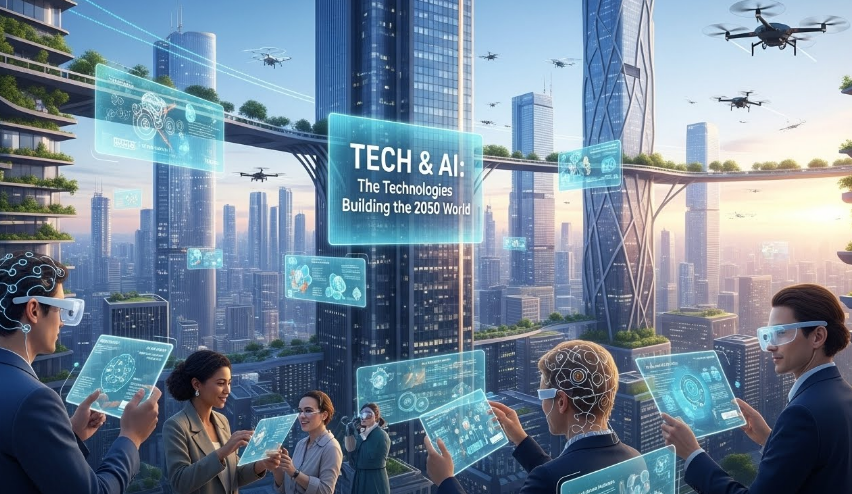
Robots aren’t future anymore—they’re manufacturing your products, delivering your packages, and serving your food in Tokyo, Shanghai, and San Francisco today. Humanoids that look and move like humans are walking assembly lines in BMW factories and Tesla facilities right now. Wearable AI is on 500+ million wrists globally tracking health, answering questions, and predicting needs. Brain-computer interfaces are letting paralyzed people walk and blind people see in 2026. Automation is eliminating 85 million jobs while creating 97 million new ones by 2030. And humans are building a permanent lunar base creating the first off-world economy.
This isn’t science fiction. This is the 2026-2050 roadmap being built today.
Why TECH & AI Changes Everything
The Exponential Difference
Previous Industrial Revolutions Were Linear:
First Industrial Revolution (1760-1840): Steam power, mechanization. Took 80 years to transform manufacturing. Changed how goods were made.
Second Industrial Revolution (1870-1914): Electricity, assembly lines. Took 44 years to electrify cities. Changed where goods were made.
Third Industrial Revolution (1960-2000s): Computers, internet. Took 40 years to digitize information. Changed how information moved.
Fourth Industrial Revolution (2020-2050): AI, robotics, biotech, quantum computing. Taking 30 years to automate intelligence itself. Changing what humans do.
The Pattern: Each revolution happens faster and transforms more.
But Here’s What’s Different About AI:
Previous technologies augmented human capability. Steam engines were stronger than horses. Computers calculated faster than humans. But they still required humans to direct them.
AI is different. AI learns. AI improves itself. AI creates new AI.
This creates exponential growth. Not 10% better per year. Not 2x better every few years. 10x better every 18-24 months in capability across vision, language, reasoning, creativity.
What AI couldn’t do in 2020, it did in 2022. What it couldn’t do in 2022, it mastered in 2024. What it can’t do in 2026, it will dominate by 2028.
Translation: The 2050 world won’t just have better technology. It will have technology that thinks, learns, and creates—probably better than humans in most domains.
ACTIVITY 2: The AI Skills Test
Test if you can tell the difference between human and AI work:
Go to ChatGPT or Claude (free versions). Ask them to:
- Write a poem about your city
- Explain quantum computing like you’re 5 years old
- Debug a simple code error (if you code)
- Generate a business idea for your neighborhood
Now be honest: Could you tell this was AI? Could you do it faster? Better?
Results most people find:
- AI writes faster than you (seconds vs. minutes/hours)
- AI quality is “good enough” for 80% of tasks
- AI never gets tired, takes breaks, or has bad days
- AI costs €20/month instead of €40,000+ salary
Time to complete: 10 minutes
Cost: Free (basic versions)
What you learned: AI is already better than you at many tasks, and it’s improving daily
The Six Technologies Reshaping 2050
Robots: The Physical Workers
Current Reality (2026): 3.5 million industrial robots operating globally. Amazon deploys 750,000+ robots in warehouses. Boston Dynamics robots navigate complex terrain autonomously. Surgical robots perform 2+ million procedures annually worldwide with better outcomes than human surgeons.
By 2030: 5+ million industrial robots. Service robots in millions of homes globally. Agricultural robots harvesting crops autonomously. Construction robots building structures 24/7. Delivery robots common in cities worldwide.
By 2050: Robots perform most dangerous, repetitive, and precision-required work globally. Human workers collaborate with robots rather than competing. Robot-to-human ratio in manufacturing reaches 10:1 in developed countries. Global robotics market exceeds $500 billion annually.
Impact: Manufacturing reshores to developed countries (robots eliminate labor cost advantage). Dangerous jobs disappear (mining, high-rise construction, deep-sea work). Precision work improves dramatically (surgery, manufacturing, assembly).
Humanoids: The Human-Like Assistants
Current Reality (2026): Tesla Optimus prototypes working in factories. Figure 01 humanoids deployed in BMW plants. Sanctuary AI humanoids in logistics. Prototypes cost $20,000-50,000, declining rapidly.
By 2030: Humanoids cost $10,000-20,000, affordable for businesses globally. Deployed in warehouses, retail, hospitality, elder care worldwide. Capable of complex physical tasks in human environments. First consumer humanoids for home assistance.
By 2050: Humanoids cost $2,000-5,000, common in homes globally like appliances today. Perform household tasks (cleaning, cooking, laundry, maintenance). Provide elder care and companionship. Assist in every industry needing physical human-like interaction. Global humanoid market approaches $1 trillion annually.
Impact: Labor shortages solved in aging societies (Japan, Europe, China). Elder care accessible and affordable globally. Dangerous and repetitive work eliminated. Human work shifts to creativity, strategy, and interpersonal connection.
Wearable AI: The Personal Intelligence
Current Reality (2026): 500+ million smartwatches and fitness trackers globally. Apple Watch, Samsung Galaxy Watch, Fitbit tracking health metrics, answering questions via AI, predicting health issues. Ray-Ban Meta smart glasses with cameras and AI assistants. Continuous glucose monitors for diabetics.
By 2030: 1+ billion AI wearables globally. Smart glasses mainstream with augmented reality overlays. Health monitoring becomes predictive (AI warns of heart attack days before). Brain-sensing headbands track mental state and productivity. Clothing with embedded sensors monitors everything.
By 2050: Wearable AI universal like smartphones today. Augmented reality contact lenses overlay information on vision. Neural lace-style interfaces blur line between human and AI. Health monitoring prevents disease before symptoms. AI personal assistant knows you better than you know yourself.
Impact: Healthcare shifts from reactive to predictive (treating disease before it manifests). Productivity explodes (AI eliminates cognitive friction). Privacy concerns intensify (constant monitoring). Human capabilities augmented dramatically (memory, language translation, information access instant).
Brain-Computer Interfaces: The Direct Connection
Current Reality (2026): Neuralink, Synchron, Blackrock Neurotech human trials ongoing. Paralyzed patients controlling computers and robotic limbs with thoughts. Blind patients seeing through camera-to-brain interfaces. Non-invasive BCI headsets for gaming and focus.
By 2030: Medical BCIs approved for paralysis, blindness, deafness globally. Thousands with implants. Non-invasive BCIs for productivity and gaming widespread. First consumer-grade thought-to-text interfaces. Costs drop from $100,000+ to $20,000-50,000.
By 2050: BCIs common for medical conditions (millions with implants globally). Consumer BCIs for productivity and enhancement widespread (10-50 million users). Thought-to-text faster than typing. Memory augmentation available. Direct brain-to-brain communication experimental. Costs drop to $1,000-5,000.
Impact: Disabilities transformed or eliminated (paralysis, blindness, deafness addressable). Human-computer interaction revolutionized (thought faster than typing or voice). Cognitive enhancement possible (memory, focus, learning speed). Philosophical questions about consciousness and identity intensify.
Automation: The Invisible Revolution
Current Reality (2026): 85 million jobs displaced by automation by 2025 (already happened). 97 million new jobs created. AI writing code, generating images, translating languages, analyzing data, writing content. Autonomous vehicles in testing globally. Automated warehouses and factories expanding.
By 2030: Most routine cognitive work automated (data entry, basic analysis, scheduling, customer service). 40% of work activities automatable with current technology. New jobs emerge in AI training, oversight, creativity, strategy. Self-driving trucks operating on highways globally. Automated factories producing customized goods on demand.
By 2050: Majority of current jobs transformed or eliminated by automation. Human work concentrated in creativity, strategy, interpersonal connection, and tasks requiring general intelligence. Universal Basic Income or similar programs widespread as automation eliminates traditional employment. Economy shifts from labor-based to capital-based. Global productivity increases 10-50x from 2025 levels.
Impact: Unemployment crisis or leisure society (depending on policy response). Wealth inequality potentially explosive or redistributed. Education transformed (teaching skills AI can’t replicate). Society reorganizes around post-scarcity economy in developed nations.
ACTIVITY 3: The Career Future-Proofing Test
Which skills should you develop for automation age? Rate yourself (1-10):
AI-Vulnerable Skills (Develop less of these):
- Data entry/processing: ___/10
- Following procedures: ___/10
- Routine analysis: ___/10
- Basic coding: ___/10
AI-Resistant Skills (Develop more of these):
- Creative thinking: ___/10
- Emotional intelligence: ___/10
- Complex strategy: ___/10
- Building relationships: ___/10
Action Plan: If your AI-vulnerable score is higher than AI-resistant score, you MUST start developing human skills NOW.
Quick Wins:
- Take improv/creativity class
- Join Toastmasters (communication)
- Lead a team project (leadership)
- Volunteer (empathy/connection)
Time to complete: 5 minutes
Cost: Free
What you learned: Which skills to develop to stay relevant
—### Lunar Base: The Off-World Economy
Current Reality (2026): Artemis program planning permanent lunar base. China and Russia collaborating on International Lunar Research Station. SpaceX developing Starship for lunar cargo delivery. Multiple countries planning lunar missions. Commercial lunar landers being tested.
By 2030: First permanent lunar habitats constructed. Small crews (10-20 people) living on Moon for extended periods. Lunar resource extraction beginning (water ice, regolith). Cost to reach Moon drops 90% from 2020s via reusable spacecraft. Commercial lunar tourism begins ($1-5 million per seat).
By 2050: Permanent lunar settlement with 200-1,000 residents. Lunar mining, manufacturing, and science operations. Helium-3 extraction for fusion energy on Earth. Lunar telescope arrays. Tourism industry (10,000+ visitors annually). Launch platform for Mars missions. Lunar economy worth $500 billion-$1 trillion annually.
Impact: Humanity becomes multi-planetary species (reducing existential risk). Resources from space supplement Earth’s depleting resources. New industries and jobs in space sector. Scientific discoveries from lunar research. Inspiration effect drives STEM education globally.
The Interconnected Tech Revolution
Why These Technologies Amplify Each Other
Robots + AI = Autonomous Systems
Robots without AI are pre-programmed machines. Robots with AI learn, adapt, and make decisions. This enables robots to handle unpredictable environments (homes, outdoor spaces, complex tasks).
Humanoids + AI = General Purpose Assistants
Humanoids with advanced AI can learn any task humans can do in human environments. This eliminates need for specialized robots for every task. One humanoid platform can clean, cook, care for elderly, assist in factories, work in retail.
Wearable AI + Health Data = Predictive Medicine
Continuous monitoring plus AI analysis predicts health issues before symptoms. This shifts healthcare from treatment to prevention, saving millions of lives and trillions in costs globally.
Brain-Computer Interfaces + AI = Augmented Intelligence
Direct brain-AI connection removes interface bottleneck. Thinking becomes as fast as typing. Memory augmentation possible. Learning accelerated. Human intelligence merged with AI intelligence creating capabilities neither has alone.
Automation + Universal Basic Income = Post-Scarcity Society
Automation eliminates need for most human labor. UBI or similar provides income. People freed to pursue creativity, learning, relationships, passions. Society shifts from survival-focused to fulfillment-focused.
Lunar Base + Asteroid Mining = Resource Abundance
Off-world resources (rare earths, platinum group metals, water) supplement Earth’s depleting supplies. Space-based solar power (proposed) provides unlimited clean energy. Resource scarcity becomes resource abundance changing economic fundamentals.
The Pattern: Each technology enables others. Combined impact exceeds sum of parts.
The Timeline: 2026-2050
2026-2030: Deployment Phase
Robots: Industrial adoption accelerates. Service robots enter homes and businesses. Surgical robots standard in hospitals worldwide.
Humanoids: First commercial deployments in logistics and manufacturing. Costs drop to $10,000-20,000. Thousands deployed globally.
Wearable AI: Smartwatches and fitness trackers ubiquitous in developed countries. AR glasses go mainstream. Health monitoring becomes predictive.
BCI: Medical applications approved and scaling. Non-invasive BCI for productivity and gaming widespread. Costs drop from $100,000+ to $20,000-50,000.
Automation: 40% of work activities automatable. Job displacement accelerates. New jobs in AI-related fields boom. Policy debates about UBI intensify.
Lunar Base: First permanent habitats constructed. Small crews living on Moon. Resource extraction begins. Commercial lunar industry launches.
2030-2040: Integration Phase
Robots: 10+ million industrial robots operating globally. Service robots in millions of homes. Agricultural and construction robots widespread.
Humanoids: Cost drops to $2,000-5,000. Deployed in millions across industries. Enter consumer market for home assistance.
Wearable AI: AR contact lenses emerge. Neural interfaces for productivity common. Health monitoring prevents most disease.
BCI: Medical BCIs restore function to millions with disabilities. Consumer BCIs for enhancement widespread. Costs drop to $5,000-10,000.
Automation: Majority of routine work automated. Society adapts to high unemployment or implements UBI. Human work shifts to creativity and strategy.
Lunar Base: Settlement grows to 50-200 residents. Mining and manufacturing operations. Tourism industry established. Launch platform for Mars missions.
2040-2050: Transformation Phase
Robots: Robot-to-human ratio 10:1 in manufacturing. Most dangerous and repetitive work eliminated globally. Humans collaborate with robots ubiquitously.
Humanoids: Common in homes like appliances. Elder care revolution (humanoids provide affordable 24/7 care). Labor shortages solved in aging societies.
Wearable AI: Augmented intelligence universal. Brain-wearable interfaces blur human-AI boundary. Productivity and capability transformed.
BCI: Direct brain-to-brain communication experimental. Cognitive enhancement mainstream. Memory and learning augmented. Costs drop to $1,000-5,000.
Automation: Post-scarcity economics in developed nations. Human purpose redefined beyond labor. Society organized around fulfillment rather than survival.
Lunar Base: Settlement reaches 200-1,000 residents. Thriving off-world economy ($500B-$1T annually). Humanity firmly multi-planetary. Mars missions launching from Moon.
The Value Proposition: Why Tech Matters to You
Personal Opportunities
Career: Millions of high-paying jobs in robotics, AI, automation, space industries. Software engineers, AI trainers, robot technicians, data scientists, BCI developers all in extreme demand with 6-figure salaries globally.
Investment: Tech sector growing 15-30% annually versus 7% for overall market. Early investors in robotics, AI, BCI, space companies seeing 10-100x returns. $10,000 invested in leading tech companies in 2026 could be worth $100,000-1,000,000 by 2050.
Health: Wearable AI and BCI technology extending lifespan and healthspan. Diseases caught and treated before symptoms. Disabilities transformed or eliminated. Quality of life improved dramatically.
Productivity: AI augmentation makes everyone 2-10x more productive. Tasks taking hours now take minutes. Learning accelerated. Creative output explodes. Income potential increases proportionally.
Lifestyle: Humanoids and robots eliminate household drudgery. Cleaning, cooking, laundry, maintenance automated. Time freed for relationships, creativity, learning, leisure. Quality of life transformed.
Global Opportunities
Economic Growth: Tech sector adding $10+ trillion to global economy annually by 2050. Productivity gains enable higher living standards worldwide. Automation eliminates scarcity (in developed countries initially, globally eventually).
Healthcare Revolution: AI and wearable tech detecting disease early saves millions of lives annually. BCI restores function to millions with disabilities. Healthcare costs drop as prevention replaces treatment.
Environmental Impact: Automation enables precision agriculture (using 50% less water and fertilizer). Robots build renewable energy infrastructure faster and cheaper. Space resources supplement Earth’s depleting supplies. Technology enables sustainability.
Education Transformation: AI tutors provide personalized education to billions. VR/AR enable immersive learning. BCI accelerates knowledge acquisition. Education becomes accessible and effective globally.
Space Economy: Lunar and asteroid resources worth $1+ trillion annually by 2050. Space solar power could provide unlimited clean energy. Off-world manufacturing enables new materials and products. Humanity’s economic sphere expands beyond Earth.
ACTIVITY 4: The Tech Investment Portfolio Builder
You don’t need to be rich to invest in the tech revolution. Build a simple tech portfolio:
Scenario: You have €1,000 to invest in tech:
Option A – Conservative (Lower risk, moderate growth):
- €400: Tech index fund (QQQ, VGT) – diversified tech stocks
- €300: AI/Robotics ETF (ROBO, BOTZ) – focused on automation
- €300: Keep cash for opportunities
Option B – Aggressive (Higher risk, higher potential):
- €300: Individual AI leaders (NVIDIA, Microsoft, Google)
- €300: Robotics companies (Tesla, ABB, surgical robot companies)
- €200: BCI/wearable startups (higher risk, huge potential)
- €200: Cash reserve
Option C – No Money (Start with skills):
- €0: Learn AI tools (ChatGPT, Claude) – free
- €0: Take free online courses (Coursera, YouTube)
- €0: Build AI-enhanced portfolio showcasing skills
- Result: Skills worth €40,000-80,000 salary
Track quarterly. Tech typically grows 15-30% annually.
Time to complete: 15 minutes to set up
Cost: €0-1,000 depending on budget
Potential: 10-30x returns by 2050 if sector continues growth
What You Can Do: The Tech Advantage Plan
Positioning Yourself for the Tech Revolution
1. Learn AI Skills (Even Basic Ones)
You don’t need to be AI researcher. But basic AI literacy (how to use AI tools, prompt engineering, understanding capabilities/limitations) will be as important as computer literacy today. Free resources: ChatGPT, Claude, Gemini, online courses, YouTube tutorials.
Time Investment: 10-20 hours to become functionally literate. ROI: Massive competitive advantage in any field.
2. Invest in Tech Sector
Allocate 20-40% of investment portfolio to technology sector focusing on AI, robotics, automation, space. Options: Index funds (QQQ, VGT), individual stocks (Tesla, NVIDIA, SpaceX when public, etc.), VC funds if accredited investor.
Investment: $10,000 in 2026. Potential Return: $100,000-1,000,000 by 2050 if sector maintains growth.
3. Prepare for Automation
Develop skills AI can’t replicate: Creativity, emotional intelligence, strategic thinking, complex problem-solving, leadership, interpersonal connection. Avoid careers centered on routine cognitive or physical tasks (will be automated by 2035).
Career Strategy: Continuous learning, adaptability, human-centered skills. Focus on managing AI rather than competing with it.
4. Embrace Wearable Tech
Start using smartwatch or fitness tracker now. Monitor health metrics. Use AI assistants. When AR glasses and BCI become available, early adoption provides advantage. Health monitoring can literally save your life by catching issues early.
Investment: $200-500 for quality smartwatch. ROI: Priceless if it prevents health crisis.
5. Follow Space Industry
Even if not working in space directly, space economy will create terrestrial opportunities (materials, manufacturing, energy, tourism, support services). Stay informed. Consider space-adjacent careers or investments.
Time Investment: 1-2 hours monthly staying current. Opportunity: Position yourself for $1+ trillion space economy.
ACTIVITY 5: The 30-Day Tech Challenge
Transform yourself from tech-anxious to tech-advantaged in 30 days:
Week 1 – AI Literacy:
- Day 1-2: Create free ChatGPT and Claude accounts, experiment with questions
- Day 3-4: Use AI to help with real work tasks (writing, research, analysis)
- Day 5-7: Take free AI course on YouTube or Coursera, learn prompt engineering
Week 2 – Skill Assessment:
- Day 8-10: Complete Activity 3 (Career Future-Proofing Test)
- Day 11-12: Identify 3 human skills to develop (creativity, EQ, strategy)
- Day 13-14: Sign up for one human-skill course (improv, leadership, communication)
Week 3 – Investment Setup:
- Day 15-17: Open investment account if you don’t have one
- Day 18-20: Complete Activity 4 (Tech Investment Portfolio)
- Day 21: Make first tech investment (even if just €50-100)
Week 4 – Health Tech:
- Day 22-24: Research smartwatches/fitness trackers, read reviews
- Day 25-27: Purchase basic wearable (€100-300)
- Day 28-30: Set up health tracking, establish baseline metrics
Results after 30 days:
- AI skills making you 2-5x more productive
- Investment portfolio positioned for tech growth
- Health monitoring started (potentially life-saving)
- Human skills development underway
- Competitive advantage over 95% of people
Time commitment: 30-60 minutes daily for 30 days
Financial investment: €150-500 total
Potential ROI: Career advancement worth €10,000-50,000+ annually
The Bottom Line: Tech Is Destiny
The 2050 world will be fundamentally different from 2026. Not incrementally better. Fundamentally transformed.
Robots and humanoids will eliminate most physical labor. Wearable AI will augment human intelligence ubiquitously. Brain-computer interfaces will blur the line between human and machine. Automation will transform work itself. And humanity will be building permanent settlements beyond Earth.
This isn’t speculative future. This is the roadmap being executed today by Tesla, SpaceX, Neuralink, Google, OpenAI, and hundreds of other companies globally.
The winners in the 2050 world will be those who embraced technology early:
Learned to use AI tools (becoming 10x more productive). Invested in tech sector (capturing 15-30% annual returns). Developed AI-resistant skills (creativity, strategy, emotional intelligence). Adopted health tech early (preventing disease, extending lifespan). Positioned themselves in tech-adjacent careers (millions of high-paying jobs).
The losers will be those who resisted:
Ignored AI hoping it would go away (it won’t). Avoided tech sector (missing massive returns). Stayed in automatable careers (unemployment or underemployment). Missed health tech benefits (preventable health crises). Failed to adapt (left behind by exponential change).
The technology revolution is happening. The only question is whether you’ll lead it or be disrupted by it.
Start today. Learn AI. Invest in tech. Prepare for automation. Embrace augmentation. Position for the space economy.
The 2050 world belongs to those who build it.