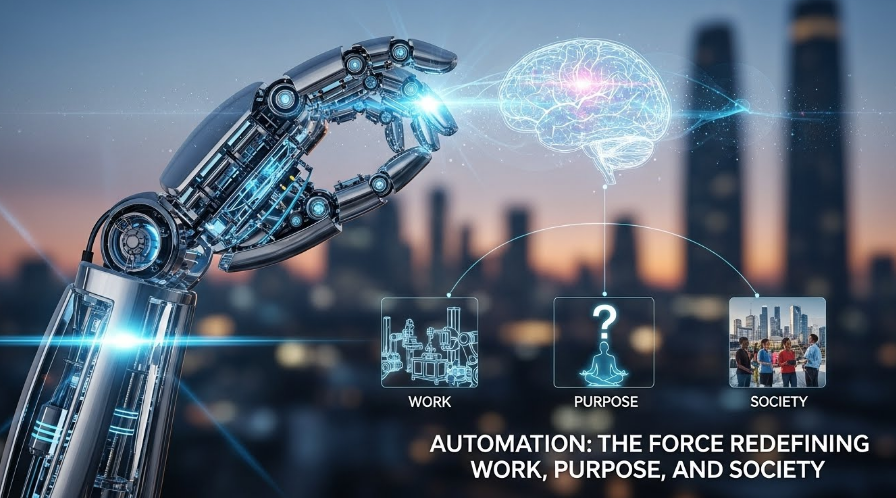
Why 85 Million Jobs Disappear While 97 Million New Ones Emerge by 2030
ACTIVITY: The Job Mortality Test
Think about your current job or career. Now answer these questions honestly:
- What percentage of your work is routine and repetitive? (Entering data, scheduling, processing paperwork, following procedures, basic analysis)
- What percentage requires genuine creativity, complex problem-solving, emotional intelligence, or strategic thinking?
If routine tasks exceed 50% of your work, automation will significantly transform or eliminate your role by 2035. If routine tasks exceed 70%, your current job likely won’t exist in recognizable form by 2040.
Now here’s the uncomfortable truth: Most jobs are 50-80% routine tasks. That includes doctors (diagnosis is pattern matching AI excels at), lawyers (document review and research), accountants (number processing), programmers (code generation), writers (content creation), designers (image generation), and nearly every other “knowledge work” profession.
Time to complete: 3 minutes
Cost: Free (but could cost you your career if you ignore it)
What you learned: Automation isn’t coming for other people’s jobs—it’s coming for yours
Here’s the automation reality in one number: 85 million jobs eliminated by 2025 (already happened). But also: 97 million new jobs created by 2025.
The World Economic Forum’s prediction proved remarkably accurate. Automation didn’t create unemployment apocalypse. It transformed employment. Old jobs disappeared, new jobs emerged. But here’s the crucial detail everyone misses: The 85 million jobs eliminated were mostly lower-skill routine positions. The 97 million jobs created are mostly higher-skill technology-adjacent positions.
Translation: Automation is happening. Job quantity increases. But job quality bifurcates: High-skill high-paying jobs expand. Low-skill low-paying jobs shrink. Middle-skill middle-paying jobs disappear. This creates the challenge of our generation: Upskill or downshift.
The Automation Reality: What’s Happening Right Now (2026)
The Jobs Already Being Automated
Manufacturing and Warehouse Work:
Robots assemble cars, pack boxes, move inventory. Amazon’s 750,000+ warehouse robots eliminated hundreds of thousands of human picking jobs while creating tens of thousands of robot technician and engineer jobs. Car manufacturing employs 80% fewer workers per vehicle than 1980 while producing far more vehicles. The jobs didn’t disappear—they transformed from assembly line workers to robot supervisors, maintenance technicians, and engineers.
Textile manufacturing returning to developed countries but automated. Adidas opened “Speedfactory” in Germany producing shoes with robots and 3D printers employing 160 people instead of thousands in Asian factory. While Asian jobs were lost, high-skill German jobs were created. This reshoring-through-automation pattern repeating across industries.
Customer Service:
Chatbots handle millions of customer inquiries daily. Bank customer service, tech support, e-commerce assistance, travel booking—all increasingly automated. Remaining human customer service agents handle complex issues chatbots can’t resolve (for now). This eliminated hundreds of thousands of basic customer service jobs while creating tens of thousands of chatbot trainer, quality assurance, and specialist positions.
Modern AI assistants like ChatGPT, Claude, and others dramatically accelerated this. What previously required scripted chatbots now uses language models understanding natural conversation. Customer satisfaction often higher with AI than human agents for routine issues (faster, always available, no wait times, no attitude).
Data Entry and Processing:
Optical character recognition (OCR) and AI eliminate manual data entry. Documents automatically scanned, parsed, and entered into databases. Accounting software automates bookkeeping. Expense reporting automated. Invoice processing automated. Millions of administrative jobs eliminated over past decade. Those positions now “administrative specialists” using AI tools rather than manually entering data.
Transportation (The Next Wave):
Self-driving trucks tested on highways globally. First deployments targeting long-haul routes (highway driving easier than city navigation). This threatens 3.5 million truck driving jobs globally. Similarly, taxi and ride-share drivers face automation from autonomous vehicles though timeline uncertain (city driving much harder than highways).
However, new jobs emerge: Remote vehicle monitors (one person supervising multiple autonomous vehicles), maintenance technicians (self-driving vehicles need service), fleet managers (coordinating autonomous fleets), and routing optimization specialists. Fewer jobs total, but higher-skill higher-pay jobs.
Legal and Accounting Work:
AI performs document review, legal research, contract analysis, tax preparation, auditing, and financial analysis at fraction of human cost. Junior lawyer or accountant tasks (grinding through documents, citations, or numbers) being automated. This eliminates entry-level positions traditionally used for training, creating crisis in professional development.
Remaining legal and accounting work requires judgment, strategy, client relations—skills harder to automate. But fewer total positions needed. Law firms hiring 30% fewer associates than decade ago while maintaining or increasing senior partner headcount. Accounting firms similar pattern.
Content Creation:
AI writes articles, generates images, creates music, produces videos. Roles like stock photography, basic journalism, simple graphic design, and music composition for media facing dramatic automation. Getty Images and Shutterstock seeing revenue pressure from AI image generators. News organizations using AI for earnings reports and sports summaries. Marketing agencies using AI for ad copy and visuals.
Yet demand for high-quality creative work remains. AI generates adequacy easily but excellence rarely. Human creators producing exceptional work thrive. But “adequate” creative work market collapsing affecting hundreds of thousands of entry and mid-level creators.
The Technology Driving Automation
Three Converging Forces Accelerating Automation
1. Artificial Intelligence (The Brain)
AI reached inflection point 2022-2024 with large language models (ChatGPT, Claude, GPT-4) demonstrating human-level performance on wide range of cognitive tasks. AI now writes, codes, analyzes, designs, and reasons at professional level for many applications.
What previously required specialized AI for each task now uses general AI adapting to many tasks. This dramatically lowers automation cost and complexity. Any company can deploy AI assistants without building custom AI systems. This democratizes automation accelerating adoption across all industries and company sizes.
2. Robotics (The Body)
As discussed in Robots and Humanoids articles, physical automation advanced dramatically. Industrial robots are sophisticated, affordable, and easy to deploy. Humanoid robots entering market 2027-2030 enabling automation of any human physical task. Combined with AI providing “brain,” robots become general-purpose workers.
3. Cloud Computing and Internet (The Infrastructure)
Cloud computing provides unlimited processing power on-demand. Companies don’t need massive infrastructure to deploy automation—they rent AI and computing as needed. 5G and fiber internet enable real-time remote operation and monitoring. This infrastructure makes automation accessible to any business anywhere.
These three forces converging creates automation explosion we’re experiencing now.
The Economic Impact: Winners and Losers
The Income Bifurcation
High-Skill Workers (Winners):
AI engineers, data scientists, robot technicians, automation specialists, AI trainers, system integrators earn €60,000-150,000+ globally. Demand vastly exceeds supply driving salaries higher. These workers manage AI and robots making them orders of magnitude more productive than previously possible. Their value skyrockets.
High-level creative workers (exceptional designers, writers, strategists), empathetic workers (therapists, nurses, teachers), and strategic thinkers (executives, entrepreneurs) remain in demand. AI augments rather than replaces them. Their productivity increases, their value increases, their compensation increases.
Middle-Skill Workers (Displaced):
Administrative assistants, data entry clerks, basic accounting, junior lawyers, customer service reps, assembly line workers—millions of middle-skill middle-income jobs automated. These workers must upskill into high-skill positions or downshift into service roles. Many struggle with transition creating significant economic and social stress.
Retraining programs exist but often inadequate. 45-year-old accountant automated out doesn’t easily become AI engineer. This displacement creates the central challenge of automation age: How do we help displaced workers transition successfully?
Low-Skill Service Workers (Complex Picture):
Jobs requiring physical presence and human touch harder to automate. Home health aides, restaurant servers, janitors, landscapers remain employed. However, these roles typically pay less than the middle-skill jobs being automated creating downward income pressure on displaced workers moving into these roles.
Paradoxically, some low-skill jobs become more valuable. Personal services (haircuts, massage, companionship) can’t be automated and benefit from higher average incomes of those who weren’t displaced. But overall, low-skill work remains low-pay.
The Pattern: Automation increases productivity and total wealth but concentrates gains among those who own or manage automation while displacing workers who previously performed automated tasks.
The Social Impact: Work Reimagined
The Meaning of Work Crisis
Humans derive identity, purpose, and social connection from work. “What do you do?” is often first question meeting someone. Automation threatens this psychological and social structure.
If AI and robots perform most productive work, what do humans do? Three emerging answers:
1. Post-Scarcity Economy (Optimistic View):
Automation dramatically increases productivity. More goods and services produced with less human labor. This creates abundance. Universal Basic Income (UBI) or similar programs distribute abundance to all. Humans freed from necessity to work pursue creativity, learning, relationships, passions. Work becomes optional pursuit of fulfillment rather than survival necessity.
Experiments: Kenya’s GiveDirectly provides UBI to villages (positive results on health, education, entrepreneurship). Alaska’s Permanent Fund Dividend provides annual payment to all residents (popular for decades). COVID stimulus payments demonstrated large-scale feasibility. Automation may make UBI economically necessary and socially beneficial.
2. Work Transformation (Pragmatic View):
Most jobs transform rather than disappear. Doctors use AI for diagnosis but provide human judgment and empathy. Teachers use AI for personalized instruction but provide motivation and mentorship. Lawyers use AI for research but provide strategy and advocacy. Workers who adapt using AI as tool rather than competing with it thrive.
This requires continuous learning. Your 2026 job skills obsolete by 2030. Your 2030 skills obsolete by 2035. Lifetime learning replaces one-time education. Those who embrace continuous adaptation succeed. Those who resist get left behind.
3. Bifurcated Society (Pessimistic View):
Small elite controlling automation captures most economic gains. Mass unemployment or underemployment. Wealth inequality explodes. Social unrest increases. Without intervention (UBI, wealth redistribution, etc.), automation creates dystopian wealth concentration.
Historical precedent worrying: Industrial Revolution created immense wealth but also brutal inequality, child labor, and worker exploitation before reforms (unions, labor laws, social programs) distributed gains more broadly. Automation may follow similar pattern.
The Actual Future: Probably combination of all three depending on country, industry, and policy choices.
What You Can Do: The Automation Survival Strategy
Skill Categories for Automation Age
AI-Resistant Skills (Develop These):
Creativity: Genuine creative thinking remains human domain. AI generates variations on patterns it’s seen. Humans create genuinely new ideas, approaches, and art. Jobs requiring innovation, artistic vision, or novel problem-solving remain valuable.
Emotional Intelligence: Understanding human emotion, building relationships, providing empathy, motivating people—all require human touch. Therapists, coaches, teachers, salespeople, managers with strong EQ remain valuable.
Complex Judgment: Strategic decisions with incomplete information, ethical dilemmas, political navigation, long-term planning—these require human judgment AI struggles with. Executive leadership, policy-making, and complex advisory roles remain human.
Physical Dexterity in Unstructured Environments: While robots automate factories, they struggle in unpredictable environments. Plumbers, electricians, handymen working in different homes daily face too much variability for current robots. These trades remain human-dominated for decades.
AI-Vulnerable Skills (Avoid Building Career Around These):
Routine data processing, simple analysis, basic writing, straightforward coding, document review, scheduling, bookkeeping, basic design—all rapidly automating. Building career primarily on these skills is high-risk strategy.
The Adaptation Playbook
Strategy 1: Learn to Manage AI
Don’t compete with AI—manage it. Learn to use ChatGPT, Claude, Midjourney, and other AI tools making you 10x more productive. Become expert at “prompt engineering” (communicating with AI effectively). Position yourself as bridge between AI capability and human needs.
Investment: 20-50 hours learning AI tools. Return: 10x productivity boost, massive competitive advantage.
Strategy 2: Develop Complementary Skills
Identify which aspects of your work AI handles well and which require human touch. Double down on human-required aspects. Accountant? Automate number-crunching, focus on strategic tax planning and client advisory. Lawyer? Automate research, focus on negotiation and strategy. Writer? Use AI for drafts, focus on unique voice and insight.
Strategy 3: Continuous Learning
Commit to learning new skills continuously. Take online courses, attend workshops, read extensively, experiment with new tools. The half-life of skills shrinking: skills learned today may be obsolete in 3-5 years. Continuous learning is no longer optional—it’s survival.
Strategy 4: Entrepreneurship and Ownership
Owners of automation capture gains. Employees of automation risk displacement. Consider entrepreneurship using AI and automation to build scalable businesses with minimal labor. Or invest in companies leading automation revolution capturing returns as shareholder.
Career Opportunities in Automation
AI/ML engineers: €80,000-160,000+. Data scientists: €70,000-140,000+. Automation specialists: €60,000-120,000+. Robot technicians: €45,000-80,000. AI trainers: €50,000-100,000. Change management consultants helping companies automate: €70,000-130,000.
These roles abundant through 2030s-2040s as automation expands globally.
The Timeline: When Automation Accelerates
2026-2030: Rapid Deployment
40% of work activities automatable with current technology. Companies rapidly deploying AI and robots. White-collar automation (AI) accelerates faster than expected. Knowledge work transformed dramatically. Programming, writing, analysis, design, research all augmented or partially automated. Job displacement accelerates but new jobs in AI-adjacent fields boom.
2031-2040: Transformation Phase
Majority of routine cognitive and physical work automated. Humanoid robots deployed at scale automating physical work in human environments. Self-driving vehicles widespread eliminating driving jobs. Universal Basic Income pilots expand in multiple countries. Society reorganizing around post-scarcity economics in developed nations. Massive retraining programs as displaced workers transition.
2041-2050: New Normal
Human work concentrated in creativity, strategy, empathy, and complex judgment. Routine work entirely automated. UBI or equivalent widespread in developed countries. Society adapted to most people not working in traditional sense. Purpose and identity derived from pursuits other than employment. Wealth inequality either addressed through redistribution or explosive creating social instability.
The Bottom Line: Automation Is Inevitable, Your Response Isn’t
Automation isn’t coming—it’s here. 85 million jobs already eliminated. 97 million new jobs already created. The transformation is underway.
The value proposition depends on your position: High-skill workers managing automation thrive with massive productivity gains and compensation increases. Displaced workers face difficult transitions requiring significant adaptation. Society benefits from increased productivity and abundance if gains are distributed broadly through policy.
The opportunity is clear: Learn AI skills, develop automation-resistant capabilities, position in high-growth automation-adjacent careers, invest in automation companies. Those who embrace automation as tool rather than threat capture enormous advantages.
The risk is equally clear: Ignore automation and face displacement. Resist upskilling and face downward income mobility. Fail to adapt and become economically obsolete.
The 2050 world will be automated. Humans will work differently, live differently, derive purpose differently. The question isn’t whether automation happens—it’s whether you’ll lead it, adapt to it, or be crushed by it.
Start today. Learn AI. Develop human skills AI can’t replicate. Position for the automated economy. Build wealth from automation rather than being displaced by it.
The choice is yours. The time is now.