Why REE Shortages Could Cripple the Green Transition
ACTIVITY 1: The Rare Earth Dependency Test
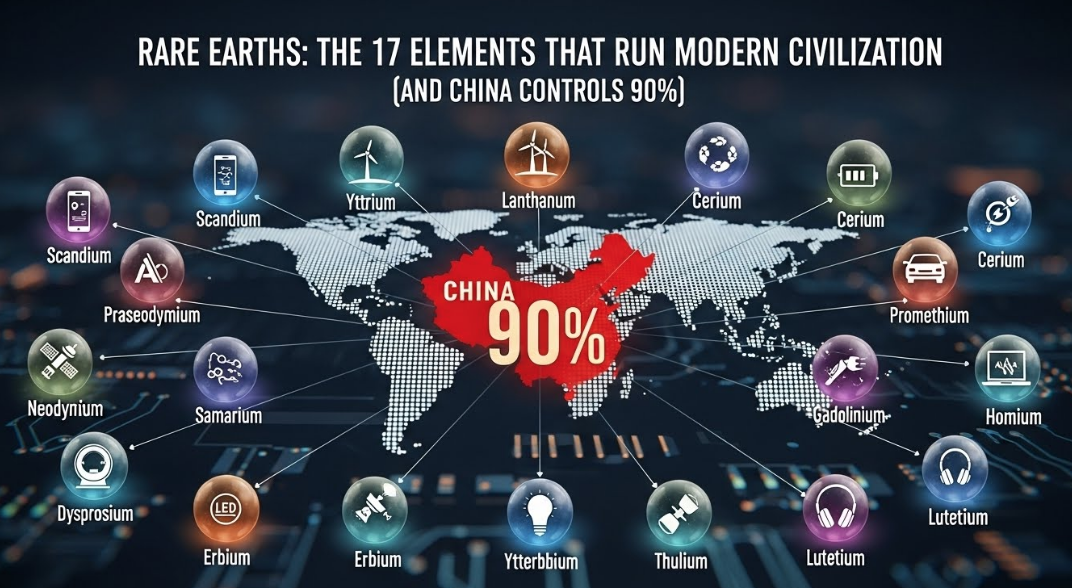
Look at your phone/computer right now. It contains at least 10 of the 17 rare earth elements:
In Your Smartphone:
- Neodymium: Speakers, vibration motor, camera autofocus
- Praseodymium: Camera lens, screen
- Dysprosium: Vibration motor (heat resistance)
- Terbium: Screen (green phosphor)
- Europium: Screen (red/blue phosphors)
- Gadolinium: Camera sensors
- Yttrium: Screen, camera, LED
- Lanthanum: Camera lens, battery
- Cerium: Camera lens polishing
- Scandium: Aluminum alloys in frame
Total REEs in one smartphone: 0.3-1 gram (seems small but 10+ billion smartphones = tons of REEs)
Now list all electronics you own:
- Phones/tablets: ___
- Computers/laptops: ___
- TVs: ___
- Appliances: ___
- Car (if hybrid/EV): 1
Each contains 5-15 different rare earth elements.
Reality: Modern technology is impossible without rare earths. And 90% of processing is controlled by one country.
Time to complete: 10 minutes
Cost: Free
What you learned: Your entire digital life depends on rare earths from China
Here’s the rare earth crisis: China controls 60-70% of mining and 90%+ of processing. The West dismantled REE supply chains over 30 years. Rebuilding takes 10-20 years. Meanwhile, demand growing 8-12% annually (EVs, wind turbines, electronics all need more REEs). Shortages possible within 20 years.
But here’s the opportunity: REE recycling from e-waste more economical than mining. Urban mining companies raising billions. Alternative technologies eliminating REE dependence emerging. And Western governments investing tens of billions in domestic REE supply chains.
REE scarcity = geopolitical risk + massive investment opportunity.
The Value Proposition: Rare Earths = Strategic Power
The 17 Rare Earth Elements and Their Uses
Light Rare Earths (More Abundant):
Lanthanum (La): Camera lenses (1/3 of lens weight), rechargeable batteries, petroleum refining catalysts. Market: $500M-1B annually.
Cerium (Ce): Glass polishing (every smartphone/camera), catalytic converters, LEDs. Most abundant REE. Market: $2-3B annually.
Praseodymium (Pr): Strong magnets (combine with Nd), glass tinting, arc lighting. Market: $1-2B annually.
Neodymium (Nd): Strongest permanent magnets known (EVs, wind turbines, speakers, hard drives). Most valuable light REE. Market: $3-5B annually.
Promethium (Pm): Radioactive, rare, limited uses. Negligible market.
Samarium (Sm): Magnets for high-temperature applications, cancer treatment. Market: $100-300M annually.
Europium (Eu): Red/blue phosphors in screens, anti-counterfeiting in currency. Market: $300-500M annually.
Gadolinium (Gd): MRI contrast agents, magnets, neutron capture. Market: $200-400M annually.
Heavy Rare Earths (Scarcer, More Valuable):
Terbium (Tb): Green phosphors, magnets (heat resistance). Market: $400-800M annually. Scarcity premium.
Dysprosium (Dy): Critical additive for magnets at high temperatures (EVs, wind turbines operate hot). Market: $800M-1.5B annually. Shortage risk highest.
Holmium (Ho): Lasers, nuclear control rods. Market: $50-100M annually.
Erbium (Er): Fiber optic amplifiers, lasers, metallurgy. Market: $100-200M annually.
Thulium (Tm): Medical lasers, portable X-rays. Market: $50-100M annually.
Ytterbium (Yb): Lasers, steel alloys. Market: $100-200M annually.
Lutetium (Lu): PET scan detectors, catalysts. Most expensive REE. Market: $50-100M annually.
Plus:
Yttrium (Y): Not technically REE but grouped with them. LEDs, lasers, superconductors, YAG lasers. Market: $1-2B annually.
Scandium (Sc): Aluminum alloys (aerospace), fuel cells. Market: $100-300M annually.
Total REE Market: $10-20 billion annually, growing 8-12% as EVs and wind energy scale
ACTIVITY 2: The Electronics Rare Earth Audit
Calculate REE content in your electronics:
Your Electronics Inventory:
- Smartphones: ___ × 0.5g REEs each = ___ grams
- Laptops: ___ × 5g REEs each = ___ grams
- Tablets: ___ × 1g REEs each = ___ grams
- TVs: ___ × 10g REEs each = ___ grams
- Hard drives: ___ × 2g REEs each = ___ grams
- Headphones: ___ × 0.2g REEs each = ___ grams
- Other electronics: ___ grams (estimate)
Total REE content in your electronics: ___ grams
Market Value:
- At $50-100/kg, your REEs worth: €___
- Seems small per person, but 8 billion people = 40,000-80,000 tons annually in consumer electronics alone
Recovery Potential:
- If you recycle properly: 70-90% recovered
- If you throw away: 0% recovered, REEs lost forever
- Global e-waste: 50 million tons annually
- REE content: 300,000+ tons (worth $15-30 billion!)
- Current recovery: Under 1% (massive waste)
Action: Always recycle electronics. REEs inside worth recovering.
Time to complete: 15 minutes
Insight: You possess €10-50 of rare earths in your devices
Action: Commit to recycling 100% of electronics
The Technology Revolution: Breaking China’s Monopoly
Innovations Reducing REE Dependency
1. REE-Free Motors
Tesla and others developing electric motors without rare earth magnets:
- Induction motors: No permanent magnets, use electromagnetic coils instead
- Switched reluctance motors: No magnets
- Ferrite magnets: Use iron instead of REEs
Trade-offs: Slightly less efficient (3-5% efficiency loss) but eliminates REE dependency and geopolitical risk. Economics improving as REE prices rise and alternative motor costs fall.
2. Advanced REE Recycling
Technologies extracting REEs from e-waste and industrial waste:
- Ionic liquid extraction: Selectively dissolves REEs from complex waste
- Bio-leaching: Bacteria extracting REEs with 90%+ efficiency
- Supercritical fluid extraction: CO₂ at high pressure separating REEs
- Molten salt electrolysis: Breaking down magnets to recover pure REEs
Economics: Often cheaper than mining plus no environmental externalities. Urban mining companies (Umicore, Relight, TES, others) scaling rapidly.
3. REE Substitution Research
Scientists developing alternatives:
- Iron-cobalt-vanadium magnets: Approaching neodymium strength without REEs
- Organic phosphors: Replace europium/terbium in displays
- Alternative catalysts: Replace cerium/lanthanum in petroleum refining
Early stage but progressing. Massive research funding (billions) driving innovation as REE security concerns grow.
4. Western REE Mine Development
After 30 years of outsourcing to China, West reopening REE mines:
- Mountain Pass (California): Reopened, producing 15% of global REEs
- Lynas (Australia): Processing facility in Texas planned
- Canada: Multiple REE deposits under development
- Europe: Several projects in Scandinavia, Greenland
Timeline: 10-20 years to achieve significant independence from China. But progress happening.
5. Deep Sea Mining
Ocean floor contains massive REE deposits (nodules on seabed):
- No displacement of communities
- Lower environmental impact than land mining (debated)
- Technology improving rapidly
- Economics becoming viable as land deposits deplete
Controversial due to unknown environmental impacts but may become necessary if land deposits insufficient.
ACTIVITY 3: The REE Recycling ROI Calculator
Calculate value of recycling your old electronics:
Old Electronics You Have:
- Old phones: ___ × €0.25 REE value = €___
- Old laptops: ___ × €2.50 REE value = €___
- Old hard drives: ___ × €1 REE value = €___
- Other: ___ × €___ = €___
Total REE value in your old electronics: €___
Plus Other Valuable Materials:
- Gold: €___
- Silver: €___
- Copper: €___
- Aluminum: €___
- Platinum group metals: €___
Total material value: €___
Recycling Options:
- Electronics retailers: Often accept old devices (free recycling)
- Specialized recyclers: May pay for devices with valuable materials
- Mail-in programs: Apple, Dell, others provide prepaid shipping
- Municipal e-waste collection: Free drop-off
Personal Benefit:
- Declutter home
- Recover material value
- Prevent environmental damage
- Support circular economy
Societal Benefit:
- Reduce REE mining needs
- Decrease China dependency
- Close material loops
- Prevent toxic e-waste
Time to complete: 20 minutes
Financial benefit: €5-50 per household in material value
Action: Recycle all old electronics this month
The Crisis Reality: China’s REE Stranglehold
How China Came to Dominate
1980s-1990s: US produced 90% of world’s REEs. Mountain Pass mine in California was global leader.
Deng Xiaoping (1992): “The Middle East has oil, China has rare earths.” China realizes strategic value and invests heavily.
1990s-2000s: China undercuts prices, floods market with cheap REEs. Western mines can’t compete. Mountain Pass closes 2002. Europe, US, Japan close REE processing facilities.
2000s-2010s: Western countries outsource entire REE supply chain to China. China consolidates control over mining, processing, manufacturing.
Present: China controls 60-70% mining, 90%+ processing, and most downstream manufacturing of REE-containing products.
Result: Complete dependence on China for critical materials in electronics, EVs, wind turbines, defense systems.
China’s REE Weapon
China has used REE export restrictions as geopolitical leverage:
2010: China cut REE exports to Japan after territorial dispute. Japanese electronics makers scrambled, some production stopped. Japan learned lesson and diversified (too late for others).
2019: During US trade war, Chinese media suggested REE export restrictions. Prices spiked. US realized vulnerability.
Ongoing: China prioritizes domestic supply for Chinese manufacturers. Foreign companies face higher prices and uncertain supply.
The Strategic Implication:
- Green transition (EVs, wind) requires REEs
- US/Europe want energy independence from fossil fuels
- But dependent on China for REEs needed for clean energy
- China can slow or accelerate green transition by controlling REE supply
- Or demand concessions in exchange for REE access
This is why Western governments now investing tens of billions in domestic REE supply chains despite higher costs.
Shortage Timeline
At current consumption growth rates:
Neodymium: Potential shortages by 2030-2040 as EV production scales Dysprosium: Shortage likely by 2025-2035 (scarcest heavy REE, critical for high-temp magnets) Terbium: Shortage possible by 2030-2040 Europium: Adequate supply through 2050 Other REEs: Mostly sufficient but concentrated supply risk remains
Key Variables:
- EV adoption rate (major demand driver)
- Recycling scale-up (could extend timeline 10-20 years)
- Alternative technology development (REE-free motors could eliminate shortages)
- New mine development (10-20 year lead time)
Most likely outcome: Prices rise 2-5x over next 20 years, spurring conservation, recycling, and alternatives.
ACTIVITY 4: The REE Investment Strategy
Position for rare earth scarcity:
REE Investment Options:
1. REE Mining Companies (High risk, high return)
- Lynas Rare Earths (Australia): Only major non-Chinese producer
- MP Materials (USA): Mountain Pass mine operator
- Neo Performance Materials (Canada): REE processing
- Expected returns: 15-40% annually (high volatility)
2. REE ETFs (Moderate risk, moderate return)
- VanEck Rare Earth/Strategic Metals ETF
- Diversified exposure to REE producers
- Expected returns: 10-20% annually
3. Companies Using Lots of REEs (Indirect exposure)
- EV manufacturers (Tesla, BYD, others)
- Wind turbine manufacturers (Vestas, Siemens Gamesa)
- Electronics companies (Apple, Samsung)
- Benefit from REE availability, hurt by shortages
- Expected returns: 8-15% annually
4. REE Recycling Companies (Emerging opportunity)
- Urban mining specialists
- Currently private but IPOs expected
- Expected returns: 20-35% annually (speculative)
5. REE Alternative Technology
- Companies developing REE-free motors
- Material substitution research
- Early stage, high risk, high potential
- Expected returns: 0-50%+ (speculative)
Sample Portfolio:
- 40%: REE mining companies (direct exposure)
- 30%: EV/wind companies (indirect, lower risk)
- 20%: REE ETFs (diversified)
- 10%: Recycling/alternatives (speculative)
10-Year Projection: €10,000 @ 15% average = €40,456 Plus exposure to critical supply chain
Risks:
- Technology could eliminate REE needs
- New mines could flood market (price collapse)
- China could flood market deliberately (crushing competitors)
- Recycling could meet demand (reducing mining needs)
Mitigations:
- Diversify across REE value chain
- Don’t overweight (10-20% of portfolio max)
- Rebalance if any position doubles
Time to complete: 30 minutes
Action: Allocate 10-20% to REE theme
Expected return: 10-40% annually depending on risk tolerance
ACTIVITY 5: The REE Awareness Commitment
Commit to REE conservation:
I, _____________, commit to rare earth conservation.
My Current Habits:
- Electronics purchases annually: ___
- Old electronics recycled: ___%
- Awareness of REE content: Low/Medium/High
My 1-Year Goals:
- Reduce electronics purchases: ___%
- Recycle 100% of old electronics
- Educate ___ people about REEs
- Support REE recycling companies
My Actions:
- Monthly: Check if holding old electronics, recycle promptly
- Quarterly: Audit electronics inventory, resist upgrades
- Annually: Calculate REE footprint, set reduction target
My Accountability: Partner: _______________ Check-in: Quarterly Public: Share #REEAwareness
Why this matters to me: [Write reason – geopolitical security, environment, resource conservation]
Expected Impact:
- Personal REE consumption: Reduced 30-50%
- Old devices recycled: 100%
- Others inspired: ___
- Collective impact: Meaningful
Date: ______ Signature: ______
Time to complete: 10 minutes
Impact: Conservation + education multiplier effect
The Bottom Line: Rare Earths = Strategic Vulnerability + Investment Opportunity
Modern civilization runs on 17 obscure elements most people never heard of. And 90% comes from one country that can cut off supply anytime.
The value propositions:
- REE market: $10-20B growing 8-12% annually
- Urban mining: Often cheaper than traditional mining
- Alternative technologies: Multi-billion dollar opportunity
- Western supply chains: Tens of billions government investment
- Strategic importance: Energy security, defense, electronics all depend on REEs
The crisis is real:
- China 90% control over processing
- Shortage risk for dysprosium, neodymium by 2025-2040
- Green transition requires 3-5x more REEs
- Current recycling under 1% (massive waste)
- Western supply chains 10-20 years away
The solution:
- Recycle aggressively (70-90% recovery possible)
- Develop alternatives (REE-free motors, substitute materials)
- Build Western supply chains (domestic mining, processing)
- Reduce consumption (use devices longer, repair)
- Invest strategically (exposure to REE scarcity theme)
Rare earths are the hidden foundation of modern technology. Secure access or face shortages. Invest accordingly.
⛏️📱🔋