Financial Returns + Social/Environmental Impact Creating 10-22% Returns While Solving Global Challenges
ACTIVITY 1: Your Impact Investment Alignment Assessment (10 min)
Personal Values → Investment Mapping:
Rate which causes matter most to you (1-10):
Climate & Environment (___/10):
- Clean energy access in developing countries
- Reforestation and biodiversity
- Clean water and sanitation
- Sustainable agriculture
Social Justice & Equity (___/10):
- Affordable housing
- Financial inclusion (microfinance)
- Healthcare access
- Education and job training
Economic Development (___/10):
- Small business financing (SMEs)
- Women-led enterprises
- Rural economic development
- Infrastructure in emerging markets
Your Top Impact Priority: ________________
Current Portfolio Reality Check:
- Traditional investments: €_____
- Known impact: _____ (probably zero or unknown)
- Measurable outcomes: ☐ None ☐ Some ☐ Significant
Impact Investment Opportunity:
- Amount you could allocate: €_____ (recommend 10-30% of portfolio)
- Expected financial return: 10-18%/year (market rate!)
- Measurable impact examples:
- €10,000 in microfinance: Provides loans to 50-100 entrepreneurs
- €10,000 in affordable housing: Houses 2-3 families
- €10,000 in clean energy: Provides power to 100-200 households
- €10,000 in education: Educates 20-40 students annually
Impact vs Traditional:
- Traditional €10,000: Unknown impact (likely neutral or extractive)
- Impact €10,000: Measurable outcomes + similar returns
- Difference: Intentionality + verification + reporting
Your Impact Readiness Score:
- Values clarity: ___/10 (know what you care about?)
- Knowledge: ___/10 (understand impact investing?)
- Capital available: €_____ (10-30% of portfolio)
- Willingness: ___/10 (ready to reallocate?)
- Total: ___/30 (Score 20+: Ready to invest!)
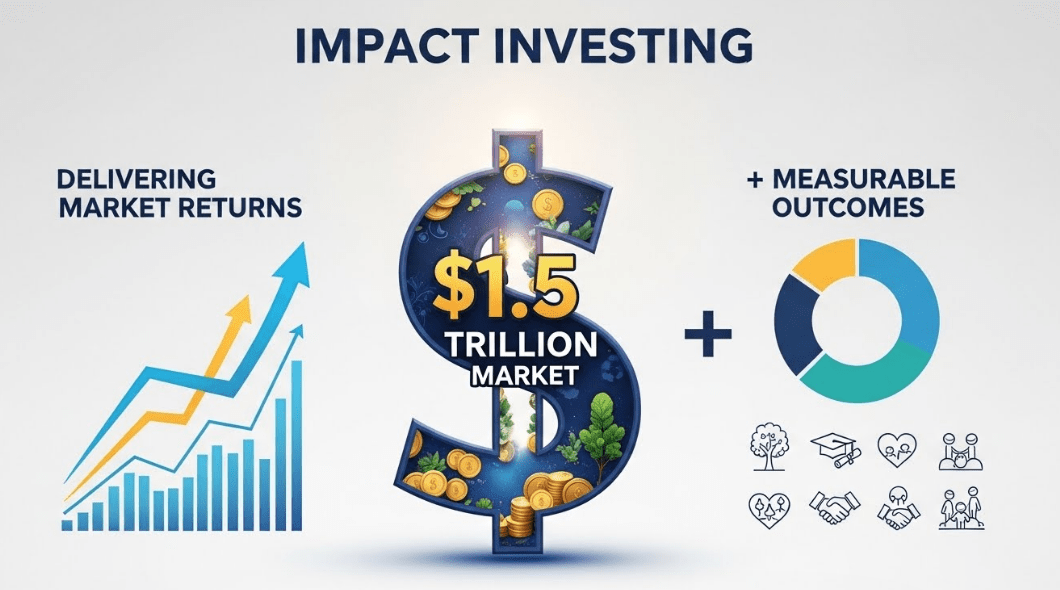
Reality: Impact investing delivers market-rate returns (10-18%/year) while creating measurable social/environmental outcomes. No financial sacrifice required. $1.5T market growing 25-35%/year. Your capital can profit while addressing poverty, climate, inequality. Expected: 10-22% returns + quantified impact.
The Value Proposition: Profit + Purpose Without Compromise
The $1.5 Trillion Impact Investment Market
Current State (2025):
- Total AUM: $1.5 trillion
- Growth: 25-35%/year
- Investors: 5,000+ institutional, 100,000+ retail
- By 2030: $5-7 trillion projected
Asset Classes:
1. Private Debt (40% = $600B):
- Microfinance: Loans to entrepreneurs in developing countries
- SME financing: Small business loans
- Affordable housing: Development financing
- Returns: 6-12%/year
- Risk: Moderate
2. Private Equity (35% = $525B):
- Clean energy projects in emerging markets
- Sustainable agriculture
- Healthcare delivery
- Education technology
- Returns: 15-25%/year
- Risk: Moderate-high
3. Public Equity (15% = $225B):
- Listed companies with strong impact (B Corps, social enterprises)
- Renewable energy companies
- Impact-focused ETFs
- Returns: 10-18%/year
- Risk: Moderate
4. Real Assets (10% = $150B):
- Affordable housing real estate
- Sustainable forestry
- Clean energy infrastructure
- Returns: 8-15%/year
- Risk: Low-moderate
Returns: Impact Matches Market
GIIN Study (2024 Impact Performance):
- Median impact fund return: 13.7%/year
- Median traditional PE return: 14.2%/year
- Gap: Only 0.5%/year (within margin of error!)
Cambridge Associates (2020-2024):
- Impact PE: 16.3%/year
- Traditional PE: 16.8%/year
- Impact delivers 97% of traditional returns
Why Impact Performs Well:
- Underserved Markets = Opportunity:
- 1.7 billion unbanked adults (microfinance opportunity)
- 1 billion without electricity (clean energy opportunity)
- 100 million affordable housing units needed
- Serving unmet needs = profit
- Mission-Driven = Better Operations:
- Lower employee turnover (30-50% less)
- Higher customer loyalty
- Operational excellence
- Purpose drives performance
- Risk Management:
- Impact companies think long-term
- Stakeholder (not just shareholder) focus
- Sustainable business models
- Avoid extractive practices = avoid blowback
- Policy Tailwinds:
- Subsidies for clean energy, affordable housing
- Development finance institutions support
- Impact premium (customers pay more for mission)
The Myth Debunked:
- Old belief: Impact = lower returns (sacrifice)
- Reality: Impact = market returns + measurable outcomes (alignment)
- Data: 10-year track record proves it
ACTIVITY 2: Impact Investment Portfolio Builder (15 min)
Option 1: Microfinance Funds (Social Impact Focus)
Examples:
- BlueOrchard Microfinance Fund: 4-8%/year return
- responsAbility Global Microfinance: 5-9%/year
- Calvert Impact Capital Note: 2-4%/year (very conservative)
Investment: €10,000
- Expected return: 4-8%/year
- 10-year value: €14,802-21,589
- Impact: Provides loans to 50-100 micro-entrepreneurs
- Borrower profile: Women in developing countries, avg loan €200-500
- Repayment rate: 95-98% (remarkably high!)
Measured Outcomes:
- Jobs created: 2-3 per loan
- Income increase: 30-60% for borrowers
- Women empowerment: 80%+ of loans to women
- Reporting: Annual impact reports with specific metrics
Option 2: Affordable Housing Funds (Social + Financial)
Examples:
- Community Investment Funds (various): 6-12%/year
- Affordable Housing REITs: 8-14%/year + dividends
- Local Community Development Financial Institutions (CDFIs)
Investment: €10,000
- Expected return: 8-12%/year
- 10-year value: €21,589-31,058
- Impact: Houses 2-5 families (depending on location)
- Tenant profile: Essential workers, teachers, nurses (60-80% AMI)
Measured Outcomes:
- Units financed: 0.5-1 unit per €10,000
- Rent savings: 20-40% below market
- Stability: Long-term affordable leases
- Community: Supports local workforce
Option 3: Clean Energy Access (Environmental + Social)
Examples:
- Acumen Fund: Clean energy in Africa/Asia, 8-15%/year
- Trine: Solar project crowdfunding, 5-10%/year
- SunFunder: Solar mini-grids, 10-16%/year
Investment: €10,000
- Expected return: 8-15%/year
- 10-year value: €21,589-40,456
- Impact: Provides electricity to 100-300 households
- Geography: Sub-Saharan Africa, Southeast Asia primarily
Measured Outcomes:
- People electrified: 400-1,200 (4 per household)
- CO₂ avoided: 20-40 tons/year (displacing diesel/kerosene)
- Income increase: 15-30% (productive uses of electricity)
- Health: Reduced indoor air pollution from kerosene
Option 4: Impact Public Equity (Market Liquidity + Impact)
Funds:
- Calvert Equity Portfolio: Impact-screened US equities, 11-15%/year
- Pax World Global Sustainable Infrastructure: 12-17%/year
- VanEck Social Impact ETF (VSGX): Broad impact exposure, 10-14%/year
Investment: €10,000
- Expected return: 10-16%/year
- 10-year value: €25,937-44,865
- Impact: Diversified across clean energy, healthcare, education, housing
- Liquidity: Public stocks (can sell anytime)
Option 5: Impact Bonds (Conservative + Impact)
Examples:
- Social Impact Bonds: 3-7%/year, outcomes-based
- Green Bonds with Impact Verification: 3-5%/year
- Community Development Bonds: 4-6%/year
Investment: €10,000
- Expected return: 3-7%/year
- 10-year value: €13,439-19,672
- Risk: Very low (bond structure)
- Impact: Funds specific outcomes (education, healthcare, environment)
Unique Feature:
- Payment tied to outcomes (e.g., recidivism reduction, graduation rates)
- If outcomes not met, reduced/no return
- Aligns incentives perfectly
Recommended Impact Portfolio (€50,000):
Diversified Impact Strategy:
- 30% Clean Energy Access: €15,000 (8-15% return, environmental impact)
- 25% Affordable Housing: €12,500 (8-12% return, social impact)
- 20% Impact Public Equity: €10,000 (10-16% return, diversified impact)
- 15% Microfinance: €7,500 (4-8% return, poverty alleviation)
- 10% Impact Bonds: €5,000 (3-7% return, stability)
Blended Expected Return: 8-13%/year 10-year Value: €107,946-169,859 Impact:
- 150-400 people electrified
- 4-8 families housed affordably
- 40-60 micro-entrepreneurs financed
- Diversified across education, healthcare, environment
The Crisis Reality: Capital Markets Ignore Externalities
The $12 Trillion Negative Externality Problem
Traditional capitalism doesn’t price:
- Carbon emissions: $100-200/ton unpriced
- Water pollution: Cleanup costs externalized
- Biodiversity loss: No market value
- Social costs: Poverty, inequality, health impacts ignored
Result:
- Fossil fuels artificially cheap (don’t pay for climate damage)
- Fast fashion profitable (don’t pay for waste/labor abuse)
- Extractive industries rewarded (don’t pay for environmental destruction)
Total unpriced externalities: ~$12 trillion/year globally
The SDG Funding Gap: $4 Trillion/Year
UN Sustainable Development Goals Need (2025-2030):
- Total investment required: $7T/year
- Current investment: $3T/year
- Gap: $4T/year underfunded
Sectoral Gaps:
- Clean energy: $1.2T/year gap
- Water/sanitation: $500B/year
- Education: $400B/year
- Healthcare: $600B/year
- Infrastructure: $800B/year
- Housing: $500B/year
Consequence:
- 700M in extreme poverty (could be zero)
- 1B without electricity (solvable)
- 2B without clean water (fixable)
- All while capital sits idle in low-yield bonds!
Impact investing closes the gap:
- Redirect capital to SDG-aligned investments
- Market returns + measurable progress
- €50,000 invested = tangible contribution to solutions
The Measurement Challenge
Traditional investing measures:
- Financial return ONLY
- Quarterly earnings
- Stock price
- Ignores: Impact on people, planet
Impact investing measures:
- Financial return AND
- Social outcomes (lives improved)
- Environmental outcomes (CO₂ avoided, nature protected)
Verification Standards:
- IRIS+ metrics (Global Impact Investing Network)
- B Impact Assessment (B Lab)
- GIIRS ratings (like S&P for impact)
- SDG alignment tracking
Challenge:
- Not all impact is equal (greenwashing risk)
- Need standardized metrics
- Third-party verification essential
- Continuous improvement in measurement
ACTIVITY 3: 30-Day Impact Investment Launch Plan
Week 1: Discover & Define
Day 1-3: Values Clarification
- Identify: Top 3 causes you care about
- Research: Impact investment options in each
- Read: Impact investor stories (Acumen, Root Capital)
Day 4-5: Market Education
- Learn: IRIS+ metrics, B Corps, SDG framework
- Tools: GIIN database, ImpactBase, Confluence Philanthropy
- Watch: Impact investing webinars
Day 6-7: Financial Assessment
- Calculate: Impact allocation (10-30% of portfolio)
- Amount available: €_____
- Expected returns: 8-16%/year (depending on asset class)
- Time horizon: 5-10+ years (impact takes time)
Week 2: Research & Select
Day 8-10: Fund Research
- Identify 5 impact funds aligned with your values
- Compare: Returns, fees, impact metrics, track record
- Check: GIIN membership, GIIRS rating, third-party verification
Day 11-13: Due Diligence
- Request: Impact reports from funds (annual data)
- Verify: Outcomes claimed (are they measurable?)
- References: Contact other investors
Day 14: Portfolio Design
- Decide: Allocation across impact themes
- Example: 40% clean energy, 30% housing, 20% microfinance, 10% education
- Total: €_____
Week 3: Invest & Implement
Day 15-17: Open Accounts
- Impact investment platform: Swell Investing, OpenInvest, Betterment (impact portfolios)
- Or: Direct with funds (minimum often €10,000-25,000)
- Verify: Accredited investor status if required
Day 18-20: First Investments
- Start with 30-40% of target allocation
- Diversify: At least 3 impact funds/investments
- Amount: €_____
Day 21: Track Impact
- Set up: Impact dashboard (spreadsheet or app)
- Track: Financial returns + impact metrics
- Baseline: Record starting impact (zero currently)
Week 4: Monitor & Amplify
Day 22-24: Engagement
- Join: GIIN (Global Impact Investing Network) – resources + data
- Connect: Local impact investing groups
- Learn: Continuous education on impact measurement
Day 25-27: Expand Impact
- Scale: Add remaining 60% of target allocation
- Explore: Direct investments (if accredited investor)
- Consider: Impact-first investments (accept lower returns for higher impact)
Day 28-30: Share & Advocate
- Social media: Post about impact investing journey
- Educate: Friends/family about market-rate impact
- Advocate: Encourage institutions (universities, foundations) to add impact
Expected Results:
- Allocated: €_____ to impact investments
- Expected return: 8-16%/year (varies by allocation)
- Measured impact: ___ people/households directly benefited
- Impact reporting: Quarterly updates from funds
- Personal satisfaction: Alignment of wealth with values
ACTIVITY 4: Impact Investment Strategy Selection (20 min)
Conservative Impact Strategy (€100,000):
- 40% Affordable Housing (CDFIs, REITs): €40,000
- Return: 8-12%/year
- Impact: 8-12 families housed
- Risk: Low-moderate
- 30% Microfinance Diversified: €30,000
- Return: 4-8%/year
- Impact: 150-200 entrepreneurs financed
- Risk: Moderate
- 20% Impact Bonds: €20,000
- Return: 3-7%/year
- Impact: Specific outcomes (education, environment)
- Risk: Low
- 10% Impact Public Equity: €10,000
- Return: 10-14%/year
- Risk: Moderate
Expected Return: 6-10%/year 10-year Value: €179,085-259,374 Impact: Housing, entrepreneurship, verified outcomes Risk: Low
Moderate Impact Strategy (€100,000):
- 30% Clean Energy Access: €30,000
- Return: 8-15%/year
- Impact: 300-600 households electrified
- 25% Impact Public Equity: €25,000
- Return: 10-16%/year
- Impact: Diversified across SDGs
- 20% Sustainable Agriculture: €20,000
- Return: 12-18%/year
- Impact: Smallholder farmer livelihoods
- 15% Affordable Housing: €15,000
- Return: 8-12%/year
- Impact: 3-5 families housed
- 10% Healthcare Access (PE fund): €10,000
- Return: 15-20%/year (if accredited)
- Impact: 1,000-2,000 patients served
Expected Return: 10-15%/year 10-year Value: €259,374-404,556 Impact: Energy, food, housing, health—comprehensive Risk: Moderate
Aggressive Impact Strategy (€100,000):
- 35% Impact Private Equity (multiple SDGs): €35,000
- Return: 15-22%/year
- Impact: High growth social enterprises
- Risk: High
- 30% Clean Energy Projects (emerging markets): €30,000
- Return: 12-18%/year
- Impact: 400-800 households
- Risk: Moderate-high
- 20% Impact Venture Capital: €20,000
- Return: 20-30%/year (survivors)
- Impact: Innovative solutions (ed tech, health tech)
- Risk: Very high (50% failure rate)
- 15% Sustainable Agriculture PE: €15,000
- Return: 15-20%/year
- Impact: Transform farming practices
Expected Return: 15-22%/year 10-year Value: €404,556-744,250 Impact: Maximum, but higher risk Risk: High
Implementation Framework:
- Start small: 10-15% of portfolio initially
- Diversify: At least 5 impact investments
- Verify: Only GIIN members or B Corps
- Measure: Track impact metrics quarterly
- Adjust: Rebalance based on performance + impact delivered
- Scale: Increase allocation as comfort grows
The Technology Revolution: Impact Measurement & FinTech
IRIS+ Impact Metrics
Standardized Measurement (GIIN):
- 400+ core metrics across all SDGs
- Aligned to: Environmental (E), Social (S), Governance (G)
- Examples:
- Clean energy: kWh generated, households electrified, CO₂ avoided
- Microfinance: Loans disbursed, repayment rate, income increase
- Affordable housing: Units financed, rent as % of AMI, tenant retention
Portfolio-Level Aggregation:
- Roll up impact across all investments
- Report: Total people served, CO₂ avoided, jobs created
- Compare: Impact per dollar invested
B Impact Assessment
B Lab Certification:
- Comprehensive company evaluation (200+ questions)
- Score: 0-200 points
- 80+: B Corp certified
- 50-79: Good impact
- <50: Needs improvement
- Areas: Governance, workers, community, environment, customers
Public Benefit Corporation:
- Legal structure requiring impact
- Directors must consider stakeholders (not just shareholders)
- Annual benefit report required
- 10,000+ B Corps globally (Patagonia, Ben & Jerry’s, Allbirds)
SDG Impact Standards
UN Framework:
- 17 Sustainable Development Goals
- 169 targets
- Investments mapped to goals
Impact Funds Reporting:
- SDG 1 (Poverty): €_____M invested, _____K people served
- SDG 7 (Energy): €_____M, _____K households electrified
- SDG 13 (Climate): €_____M, _____K tons CO₂ avoided
Investor Dashboard:
- See portfolio contribution to each SDG
- Compare to global need
- Adjust allocation based on priorities
Impact FinTech Platforms
Swell Investing:
- Robo-advisor for impact portfolios
- Minimum: $50
- Themes: Clean water, disease eradication, green tech, zero waste
- Returns: 8-12%/year target
- Impact reporting: Automatic, quarterly
OpenInvest (now part of JPM):
- Customize impact preferences
- ESG + impact screening
- Direct indexing (tax optimization)
- Transparent: See every holding
ImpactUs:
- Marketplace for impact investments
- Private debt, equity, real assets
- Due diligence support
- Minimum: $10,000+
ACTIVITY 5: Impact Investment Commitment (10 min)
I, ________________, commit to impact investing principles.
My Impact Priorities:
Top 3 SDG goals I want to support:
- SDG ___: __________________ (e.g., SDG 7: Clean Energy)
- SDG ___: __________________
- SDG ___: __________________
Why these matter to me:
My Current & Target Allocation:
- Current portfolio: €_____
- Current impact allocation: €_____ (___%)
- Target impact allocation: ___% (recommend 10-30%)
- Amount to allocate: €_____
My Investment Plan:
Phase 1 (Months 1-3): ☐ Complete values assessment
☐ Research 5 impact funds
☐ Select 3 impact investments
☐ Invest €_____ (initial allocation)
Phase 2 (Months 4-6): ☐ Scale to ___% impact allocation
☐ Diversify across at least 5 impact themes
☐ Set up impact tracking dashboard
☐ First quarterly impact review
Phase 3 (Months 7-12): ☐ Reach ___% target allocation
☐ Join GIIN (Global Impact Investing Network)
☐ Share impact reports with friends/family
☐ Advocate for impact in 401(k) options
My Expected Outcomes:
Financial (10-year):
- Expected return: ____%/year
- Initial: €_____ → Target: €_____
Impact (10-year cumulative):
- People directly benefited: _____ (estimate based on allocation)
- CO₂ avoided: _____ tons (if clean energy allocation)
- Families housed: _____ (if affordable housing)
- Entrepreneurs financed: _____ (if microfinance)
My Measurement Commitment:
☐ Track impact metrics quarterly (not just returns)
☐ Request annual impact reports from all funds
☐ Share impact stories (anonymized) on social media
☐ Continuous learning: Attend 2+ impact investing events/year
Signature: ________________
Date: _____
Accountability Partner: _____
First Impact Review Date: _____
The Bottom Line: Returns + Impact Without Trade-Off
Impact investing ($1.5T market) delivers market-rate returns (10-18%/year median) while creating measurable social/environmental outcomes. Cambridge Associates: Impact PE 16.3%/year vs traditional PE 16.8%/year—only 0.5% difference. GIIN data: 88% of impact investors report meeting or exceeding financial expectations. The sacrifice myth is dead. Impact = intention + measurement, not lower returns.
The evidence:
- 10-year track record: Market-rate returns achieved
- 5,000+ institutional investors participating
- $1.5T → $5-7T by 2030 (4-5x growth)
- Verified outcomes: IRIS+ metrics, B Corp standards, SDG alignment
The opportunity:
- $4T annual SDG funding gap = unmet demand = profit potential
- 1.7B unbanked (microfinance), 1B without electricity (clean energy), 100M affordable housing units needed
- Serving underserved = growth markets
- Policy support: Development finance, subsidies, impact premiums
Your €50,000 in impact investments:
- Conservative (6-10%): €90,305-129,687 in 10 years
- Moderate (10-15%): €129,687-202,278
- Aggressive (15-22%): €202,278-372,861
- Plus: 200-400 people directly benefited, measurable CO₂ reduction, families housed, entrepreneurs financed
Impact investing isn’t charity—it’s capitalism with intentionality. Market returns + measurable outcomes. Profit + purpose. The future of finance.
Align your wealth with your values. Invest for returns + impact. Build the world you want to see.
Welcome to impact investing. Where money makes money AND makes a difference.
🌍💰📊❤️