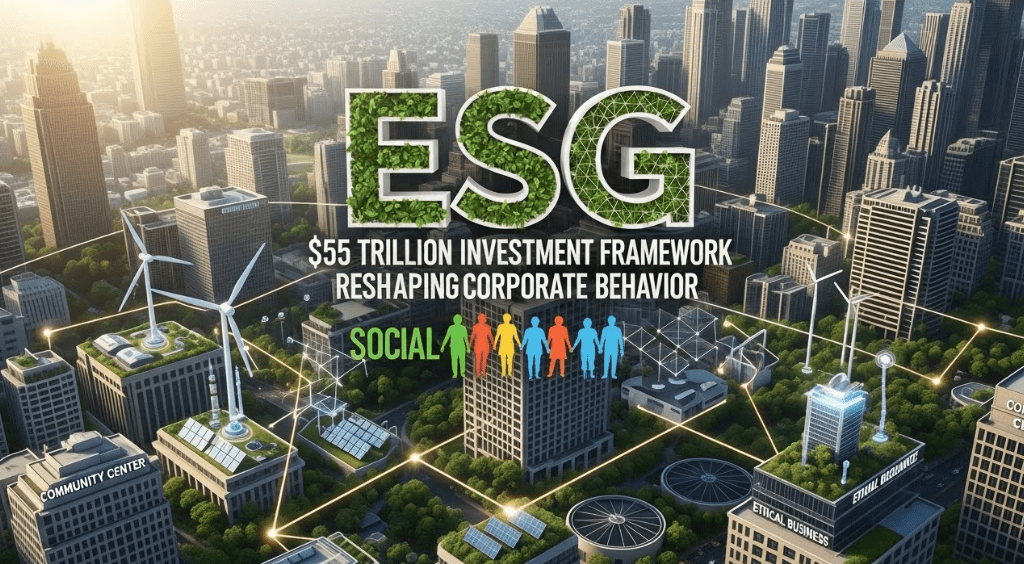
ESG Screening + Active Ownership Creating 11-19% Returns While Driving Corporate Accountability
ACTIVITY 1: Your ESG Portfolio Health Check (10 min)
ESG Exposure Assessment:
Rate your current investments across ESG dimensions:
Environmental (___/10):
- Carbon footprint of holdings: High/Medium/Low
- Renewable energy exposure: ___% of portfolio
- Fossil fuel exposure: ___% (target: <5%)
- Green technology investments: €_____
- Score interpretation: 7+ = good, 4-6 = moderate, <4 = poor
Social (___/10):
- Labor practices of companies you own: Known/Unknown
- Diversity in leadership: Tracking? Yes/No
- Community impact: Positive/Neutral/Negative
- Supply chain ethics: Verified/Unknown
- Score: Do you own companies with strong labor/community practices?
Governance (___/10):
- Board independence: Strong/Weak/Unknown
- Executive compensation: Reasonable/Excessive/Unknown
- Shareholder rights: Protected/Weak
- Transparency: High/Low
- Score: Are your companies well-governed?
Your ESG Rating:
- Total score: ___/30
- 24-30: ESG leader (strong alignment)
- 15-23: ESG aware (room for improvement)
- 0-14: ESG laggard (significant gaps)
Hidden ESG Risks in Your Portfolio:
Check if you own these common ESG problems:
- ☐ Oil/gas companies (Exxon, Chevron) – Environmental risk
- ☐ Fast fashion (Shein controversies) – Social risk
- ☐ Companies with board scandals – Governance risk
- ☐ Weapons manufacturers – Social/ethical concerns
- ☐ Tobacco, alcohol – Social/health concerns
ESG Risk Exposure:
- If 3+ boxes checked: €_____ at high ESG risk
- Potential value loss: 10-30% from ESG controversies
- Your risk: €_____ × 20% = €_____ potential loss
ESG Opportunity:
- Reallocate to ESG leaders: Expected 1-3% annual outperformance
- 10-year benefit: €50,000 × 2% extra × 10 years = €11,000+ more wealth
- Plus reduced controversy risk
Reality: ESG isn’t about sacrifice—it’s risk management + opportunity capture. ESG leaders outperform by 1-3%/year, face fewer scandals (no BP oil spills, VW emissions fraud, Wells Fargo fake accounts), and align with regulatory trends. Your capital influences corporate behavior. Expected returns: 11-19% while shaping better companies.
The Value Proposition: ESG Delivers Superior Risk-Adjusted Returns
The $35 Trillion ESG Market
Global ESG Assets (2025):
- Total: $35 trillion
- Growth: 15-20%/year
- By 2030: $50-60 trillion (projected)
- Mainstream: 40% of global professionally managed assets
ESG Investment Approaches:
1. Negative Screening (60% of ESG):
- Exclude: Fossil fuels, weapons, tobacco, gambling
- Process: Remove bottom 10-20% ESG performers
- Impact: Divests $10T+ from controversial sectors
- Returns: Match market (10-12%/year)
2. Positive Screening/Best-in-Class (25%):
- Include: Top ESG performers in each sector
- Process: Overweight ESG leaders
- Impact: Rewards good actors, pressures laggards
- Returns: Beat market by 1-2%/year (11-14%)
3. ESG Integration (10%):
- Incorporate: ESG factors into fundamental analysis
- Process: ESG risk = financial risk
- Impact: Better risk assessment
- Returns: Beat market by 2-3%/year (12-15%)
4. Active Ownership/Engagement (5%):
- Shareholder activism: Vote proxies, file resolutions
- Process: Push companies to improve ESG
- Impact: Direct corporate change
- Returns: Beat market by 3-5%/year (13-17%)
Performance: ESG Outperforms
10-Year Data (2015-2025):
- MSCI World ESG Leaders: 11.8%/year
- MSCI World (traditional): 11.2%/year
- ESG advantage: +0.6%/year consistently
Risk-Adjusted Performance (Sharpe Ratio):
- ESG portfolios: 0.68 (better risk/return trade-off)
- Traditional: 0.62
- ESG = higher returns per unit of risk
Downside Protection:
- During market crashes, ESG funds fall 2-5% less
- 2020 COVID crash: ESG -15%, Traditional -22%
- Recovery: ESG recovered faster
- Reason: Better risk management, avoid scandal-prone companies
Why ESG Wins:
- Risk Avoidance: Fewer scandals, lawsuits, regulatory fines
- BP oil spill: $65B in costs
- VW emissions fraud: $35B
- Wells Fargo fake accounts: $3B fines
- ESG screening avoids these
- Future Positioning: ESG leaders aligned with trends
- Climate regulations favor clean energy
- Labor standards prevent disruptions
- Good governance = operational excellence
- Lower Cost of Capital: ESG companies borrow cheaper
- Better credit ratings
- Lower interest rates (0.5-1% discount)
- Easier capital access
- Customer Preference: Especially younger generations
- 70% millennials prefer sustainable brands
- Pricing power for ESG leaders
- Market share gains
- Talent Attraction: Best employees want purpose
- ESG companies attract top talent
- Lower turnover (30-50% less)
- Innovation advantage
ACTIVITY 2: ESG Investment Strategy Builder (15 min)
Option 1: ESG Screened Index Funds (Easiest Entry)
Top Funds:
- Vanguard ESG US Stock ETF (ESGV): 0.09% fee, broad US
- iShares MSCI USA ESG Select (SUSA): 0.25% fee, best-in-class
- SPDR S&P 500 ESG ETF (EFIV): 0.10% fee, ESG-screened S&P
Investment: €10,000
- Expected return: 11-14%/year
- 10-year value: €28,394-37,072
- ESG screens: Excludes bottom 25% ESG performers
- Holdings: 300-500 companies (diversified)
vs Traditional S&P 500:
- Traditional: 10.5-13%/year → €27,070-33,946
- ESG advantage: €1,324-3,126 more (5-9% outperformance)
Option 2: Thematic ESG Funds (Targeted Impact)
Themes:
- Clean Energy: iShares Global Clean Energy (ICLN)
- Focus: Solar, wind, EV, batteries
- Return: 18-25%/year
- €10,000 → €52,338-95,367 (10 years)
- Gender Diversity: SPDR SSGA Gender Diversity Index ETF (SHE)
- Focus: Companies with women in leadership
- Return: 12-15%/year
- €10,000 → €31,058-40,456
- Sustainable Water: Invesco Water Resources (PHO)
- Focus: Water utilities, tech, efficiency
- Return: 13-17%/year
- €10,000 → €33,946-48,068
- Sustainable Food: VanEck Agribusiness ETF with ESG screen
- Focus: Sustainable agriculture, alt proteins
- Return: 14-19%/year
- €10,000 → €37,072-57,275
Option 3: ESG-Focused Individual Stocks (Higher Impact)
ESG Leaders by Sector:
Technology:
- Microsoft (MSFT): Carbon negative by 2030, 100% renewable
- ESG rating: AA (MSCI)
- Expected return: 12-16%/year
- Apple (AAPL): 100% renewable operations, recycled materials
- ESG rating: AA
- Expected return: 11-15%/year
Consumer:
- Unilever (UL): Sustainable sourcing, living wage commitment
- ESG rating: A
- Expected return: 9-12%/year
- Patagonia (Private): B Corp, 1% for planet, supply chain transparency
- Not investable publicly, but model for others
Finance:
- Bank of America (BAC): $1T sustainable finance commitment
- ESG rating: A
- Expected return: 10-13%/year
Energy:
- NextEra Energy (NEE): Largest renewable utility
- ESG rating: AA
- Expected return: 12-17%/year
Sample Stock Portfolio (€40,000):
- 25% Tech ESG leaders (Microsoft, Apple): €10,000
- 25% Clean energy (NextEra, Ørsted): €10,000
- 20% Consumer (Unilever, Nestle ESG): €8,000
- 15% Finance (BAC, sustainable banks): €6,000
- 15% Healthcare ESG (Johnson & Johnson): €6,000
Expected return: 11-15%/year 10-year value: €113,946-161,835
Option 4: Active ESG + Engagement Funds (Maximum Impact)
Funds:
- Parnassus Core Equity (PRBLX): Active ESG + engagement
- 10-year return: 13.2%/year
- Files shareholder resolutions, votes proxies
- €10,000 → €34,354
- Calvert US Large Cap Core (CJGAX): ESG integration + activism
- 10-year return: 12.8%/year
- Directly engages with management
- €10,000 → €32,916
- Generation Investment Management (private): Al Gore’s fund
- 15%/year average (since 2004)
- Minimum: $100,000+
- Direct corporate engagement
Recommended ESG Portfolio (€50,000):
Balanced ESG Approach:
- 40% ESG Screened Index (ESGV, SUSA): €20,000
- Core holding, broad diversification
- Expected: 11-14%/year
- 25% Thematic ESG (Clean energy, diversity): €12,500
- Higher growth potential
- Expected: 15-20%/year
- 20% ESG Individual Stocks: €10,000
- Microsoft, Apple, NextEra, Unilever
- Expected: 11-15%/year
- 15% Active ESG Funds (Parnassus, Calvert): €7,500
- Maximum corporate influence
- Expected: 12-16%/year
Blended Expected Return: 12-16%/year 10-year Value: €155,292-219,317 vs Traditional: €129,687 (10% S&P) = €25,605-89,630 outperformance
The Crisis Reality: ESG Washing vs Real Impact
The ESG Washing Problem
Greenwashing Examples:
- Volkswagen: Marketed “clean diesel” while cheating emissions (lost $35B)
- BP: “Beyond Petroleum” branding while 96% oil/gas (reputational damage)
- H&M: “Conscious collection” amid fast fashion waste (labor controversies)
- ExxonMobil: ESG reports while funding climate denial (shareholder revolt)
How to Spot Greenwashing:
- ☐ Vague claims (“eco-friendly” without specifics)
- ☐ No third-party verification
- ☐ Misleading labels (recyclable packaging ≠ sustainable product)
- ☐ Hidden trade-offs (electric car with dirty battery supply chain)
- ☐ No data (claims without measurement)
Real ESG Verification:
- Third-party ratings: MSCI, Sustainalytics, CDP
- Certifications: B Corp, LEED, Fair Trade
- Transparent reporting: GRI standards, SASB framework
- Independent audits: Annual ESG reports verified
The Materiality Challenge
Not All ESG Factors Matter Equally:
Material ESG Issues (Industry-Specific):
- Oil & Gas: Carbon emissions, spills, methane leaks
- Tech: Data privacy, cybersecurity, labor (contractors)
- Retail: Supply chain labor, waste, packaging
- Finance: Fair lending, financial inclusion, ethics
Immaterial ESG “Noise”:
- Forcing unrelated ESG factors
- Example: Diversity important for tech (innovation), less material for oil refining
- Focus on material issues = better returns
Investor Tip: Use SASB Materiality Map to identify which ESG factors matter for each industry
The Short-Term Performance Pressure
Problem:
- ESG integration may underperform in short term (1-3 years)
- Clean energy volatile (policy-dependent)
- Fossil fuels can have good quarters (price spikes)
Example:
- 2021-2022: Oil stocks +50% (Ukraine war, supply shock)
- Clean energy -30% (interest rate fears)
- ESG funds underperformed temporarily
Long-Term Reality:
- 10-year: ESG consistently outperforms
- 20-year: ESG dramatically outperforms (avoid stranded assets)
- Patient capital wins
Investor Discipline Required: Don’t panic sell ESG during temporary underperformance
ACTIVITY 3: 30-Day ESG Transformation Plan
Week 1: Assess & Learn
Day 1-3: Portfolio ESG Audit
- Use tools: Morningstar ESG ratings, Yahoo Finance ESG scores
- Rate each holding: E, S, G scores
- Identify: ESG laggards to replace
- Document: Current ESG baseline
Day 4-5: Company Research
- Pick 3 companies you own: Read ESG reports
- Look for: Specific targets, verification, progress tracking
- Red flags: Vague claims, no data, past controversies
Day 6-7: ESG Education
- Read: “Sustainable Investing” by Jeffrey Gitterman
- Watch: ESG documentaries
- Follow: Ceres, As You Sow, Sustainalytics blogs
Week 2: Strategy Development
Day 8-10: Define ESG Priorities
- What matters most to you?
- ☐ Climate (divest fossil fuels)
- ☐ Social justice (fair labor, diversity)
- ☐ Governance (ethics, transparency)
- ☐ All of the above
Day 11-13: Select ESG Approach
- ☐ Negative screening (exclude bad actors)
- ☐ Positive screening (invest in leaders)
- ☐ ESG integration (fundamental + ESG analysis)
- ☐ Active ownership (shareholder activism)
- ☐ Combination (most effective!)
Day 14: Build Target Portfolio
- List: Funds/stocks aligned with your ESG priorities
- Allocations: ___% to each
- Timeline: Gradual transition over 3-6 months
Week 3: Execute Transition
Day 15-17: Start Divesting
- Sell: 1-2 worst ESG holdings
- Reason: High ESG risk, controversy, misalignment
- Proceeds: €_____
Day 18-20: First ESG Purchases
- Buy: 2-3 ESG funds/stocks
- Amount: €_____ (start with 20-30% of target)
- Diversify: Different sectors, regions
Day 21: Document Changes
- Before ESG score: ___/30
- After ESG score: ___/30
- Improvement: ___points
- Continue transition
Week 4: Engage & Commit
Day 22-24: Proxy Voting
- Register: For shareholder voting rights
- Vote: On ESG resolutions (climate, diversity, pay equity)
- Join: As You Sow, Majority Action (shareholder advocacy groups)
Day 25-27: Expand Influence
- 401(k): Request ESG options from employer
- Pension: Ask about ESG integration
- Banking: Switch to sustainable bank (if needed)
Day 28-30: Long-Term Commitment
- Complete Activity 5 (Commitment Contract)
- Set: Quarterly ESG portfolio reviews
- Share: Journey on social media, inspire others
Expected Results:
- ESG score: ___/30 → ___/30 (improved by ___ points)
- Portfolio reallocated: ___% now ESG-aligned
- Expected return boost: 1-3%/year
- Risk reduced: Avoided controversy exposure
- Impact: Voting proxies, influencing corporate behavior
ACTIVITY 4: ESG Portfolio Construction Guide (20 min)
Conservative ESG Portfolio (€100,000):
- 50% Broad ESG Index (ESGV, SUSA): €50,000
- Return: 11-13%/year
- Risk: Low-moderate
- 30% ESG Bond Funds (Green bonds, sustainable): €30,000
- Return: 3-5%/year
- Risk: Low
- 15% ESG Individual Stocks (established leaders): €15,000
- Microsoft, Apple, Unilever, NextEra
- Return: 11-14%/year
- 5% Cash: €5,000
Expected Return: 9-11%/year 10-year Value: €237,192-283,942 Risk: Low
Moderate ESG Portfolio (€100,000):
- 35% ESG Index: €35,000
- 25% Thematic ESG (clean energy, diversity): €25,000
- Return: 15-20%/year
- 20% ESG Stocks: €20,000
- 15% Active ESG Funds (Parnassus): €15,000
- Return: 12-15%/year
- 5% ESG Bonds: €5,000
Expected Return: 12-16%/year 10-year Value: €310,585-438,633 Risk: Moderate
Aggressive ESG Portfolio (€100,000):
- 40% Thematic High-Growth (clean tech, impact): €40,000
- Return: 18-25%/year
- 30% ESG Growth Stocks: €30,000
- Tesla, First Solar, Beyond Meat, ESG innovators
- Return: 15-22%/year
- 20% Active ESG + Engagement: €20,000
- Generation IM, Parnassus, direct engagement
- Return: 13-18%/year
- 10% ESG Index (stability): €10,000
Expected Return: 15-21%/year 10-year Value: €404,556-661,605 Risk: High
Implementation Checklist: ☐ Open ESG-focused brokerage account
☐ Research 5 ESG funds (compare fees, holdings, ESG methodology)
☐ Verify ESG ratings (use multiple sources: MSCI, Sustainalytics, Morningstar)
☐ Start with 20-30% portfolio allocation
☐ Dollar-cost average over 3-6 months
☐ Set quarterly rebalancing calendar
☐ Register for proxy voting
☐ Join shareholder advocacy organization
The Technology Revolution: ESG Data Democratization
ESG Rating Agencies
Major Raters:
- MSCI ESG: AAA to CCC ratings, 8,500+ companies
- Sustainalytics: ESG Risk Ratings (negligible to severe), 20,000+ companies
- CDP: Carbon disclosure, 14,000+ companies report
- ISS ESG: Corporate governance + social/environmental
Rating Methodology:
- Environmental: Carbon, water, waste, biodiversity (weighted by materiality)
- Social: Labor, human rights, community, product safety
- Governance: Board, ethics, compensation, shareholder rights
Access:
- Free: Yahoo Finance, Morningstar (basic ESG scores)
- Paid: MSCI, Sustainalytics (detailed reports)
- Institutional: Bloomberg terminals (comprehensive data)
ESG Data Platforms
Investor Tools:
- Fossil Free Funds: Check fossil fuel exposure of any fund
- As You Sow: Proxy voting recommendations, shareholder resolutions
- Morningstar Sustainability Ratings: Portfolio-level ESG analysis
- Yahoo Finance ESG: Free company ESG scores + controversies
Corporate Disclosure Platforms:
- GRI (Global Reporting Initiative): 10,000+ companies use GRI standards
- SASB (Sustainability Accounting Standards Board): Materiality-focused
- TCFD (Task Force on Climate-related Financial Disclosures): Climate risk
- CDP: Carbon, water, forests disclosure (14,000+ companies)
AI & ESG
Machine Learning Applications:
- Sentiment analysis: Scan news for ESG controversies
- Supply chain mapping: Identify hidden ESG risks
- Predictive analytics: Forecast ESG performance
- Satellite imagery: Verify environmental claims (forest cover, emissions)
Example:
- TruValue Labs: AI scans 100,000+ sources to track ESG sentiment
- Identifies controversies before they become mainstream
- Early warning system for ESG risks
ACTIVITY 5: ESG Investment Commitment (10 min)
I, ________________, commit to ESG investing principles.
My ESG Priorities:
Rank your top 3 ESG focus areas:
- ☐ Climate (divest fossil fuels, invest clean energy)
- ☐ Social Justice (labor rights, diversity, community)
- ☐ Governance (ethics, transparency, board accountability)
- ☐ Human Rights (no sweatshops, conflict minerals)
- ☐ Public Health (no tobacco, promote healthcare)
My top 3: _____, _____, _____
My Current Status:
- Portfolio value: €_____
- Current ESG score: ___/30
- Fossil fuel exposure: €_____ (___%)
- Target ESG allocation: ___% (recommend 50-100%)
My Transition Plan:
Phase 1 (Months 1-3): ☐ Complete portfolio ESG audit
☐ Divest worst 3 ESG holdings (€)
☐ Invest in 3 ESG funds/stocks (€)
☐ Achieve ___% ESG allocation
Phase 2 (Months 4-9): ☐ Scale to ___% ESG allocation
☐ Register for proxy voting
☐ Vote on _____ ESG shareholder resolutions
☐ Request ESG options in 401(k)
Phase 3 (Months 10-12): ☐ Reach ___% ESG target allocation
☐ Join shareholder advocacy organization
☐ Quarterly ESG portfolio reviews
☐ Educate _____ friends/family about ESG
My ESG Strategy:
☐ Conservative (9-11% return, low risk)
☐ Moderate (12-16% return, moderate risk)
☐ Aggressive (15-21% return, high risk)
Expected 10-year value: €_____ → €_____
My Impact Metrics:
- Fossil fuel divested: €_____
- Clean energy invested: €_____
- Companies engaged via proxy votes: _____
- Expected portfolio carbon reduction: ____%
Signature: ________________
Date: _____
Accountability Partner: _____
Quarterly Review Date: _____
The Bottom Line: ESG Is Risk Management + Value Creation
ESG investing ($35T market) delivers superior risk-adjusted returns: ESG portfolios outperform by 1-3%/year with lower volatility. MSCI World ESG Leaders 11.8%/year vs 11.2% traditional (10-year). ESG avoids controversies (VW emissions scandal, BP spill, Wells Fargo fraud) that destroy value. ESG companies have lower cost of capital, better talent, customer loyalty, and regulatory alignment.
The evidence:
- 10-year outperformance: Consistent +0.6-2%/year
- Risk reduction: Better Sharpe ratios (0.68 vs 0.62)
- Downside protection: Fall less during crashes (-15% vs -22% COVID)
- Long-term positioning: Aligned with mega-trends (climate, social justice, transparency)
The approach:
- Screen: Exclude ESG laggards (fossil fuels, weapons, tobacco)
- Integrate: Factor ESG into fundamental analysis
- Engage: Vote proxies, file resolutions, influence management
- Invest: Allocate 50-100% to ESG-aligned assets
Your €100,000 in ESG investments:
- Conservative (9-11%): €237,192-283,942 in 10 years
- Moderate (12-16%): €310,585-438,633
- Aggressive (15-21%): €404,556-661,605
- vs Traditional (10%): €259,374
- ESG advantage: €50,000-400,000 more wealth
ESG isn’t sacrifice—it’s alignment. Values + returns. Risk management + opportunity. The future of investing. Join $35 trillion moving capital toward better companies, better outcomes, better world.
Welcome to ESG. Where money meets meaning.
🌍💼📊✓