Fuel Cell Trucks + H₂ Shipping + E-Fuels Aviation Creating 20-40% Returns While Eliminating 3 Gt CO₂
ACTIVITY 1: Your Heavy Transport Hydrogen Exposure (10 min)
Hidden Heavy Transport in Your Life:
Calculate your dependence on sectors that need hydrogen:
Trucking (Goods Delivery):
- Every product you buy: Transported by truck at some point
- Average person: 10-15 tons of goods moved by truck/year
- Heavy trucks (>26 tons): Cannot use batteries (too heavy, range issues)
- Your trucking footprint: 0.3-0.5 tons CO₂/year (diesel trucks)
- H₂ truck alternative: 0.03-0.05 tons CO₂/year (95% reduction)
Shipping (International Trade):
- 90% of global trade: Ships (11 billion tons cargo/year)
- Your consumption: ~1.5 tons imported goods/year (clothing, electronics, food)
- Ships burn heavy fuel oil (dirtiest fossil fuel)
- Your shipping footprint: 0.4-0.6 tons CO₂/year
- H₂/ammonia ships: 0.04-0.06 tons CO₂/year (90-95% reduction)
Aviation (If You Fly):
- 1 transatlantic flight: ~1.5 tons CO₂
- Average: 1-3 flights/year = 1.5-4.5 tons CO₂
- Jet fuel: 100% fossil, no alternative today
- Synthetic e-fuels (H₂-based): 0.15-0.45 tons CO₂ (90% reduction with direct air capture)
Your Total Heavy Transport Footprint:
- Trucking: 0.3-0.5 tons CO₂/year
- Shipping: 0.4-0.6 tons
- Aviation: 1.5-4.5 tons (if you fly)
- Total: 2.2-5.6 tons CO₂/year
- With hydrogen: 0.22-0.56 tons (90% savings!)
Investment Opportunity Assessment:
Your H₂ transport investment readiness:
- Understanding fuel cells: ___/10
- Knowledge of shipping/aviation: ___/10
- Risk tolerance (early tech): ___/10
- Capital available: €_____ (recommend €15,000-50,000)
- Time horizon (10-15 years): ___/10
- Total: ___/50 (35+ = ready!)
Market Size:
- Heavy trucks: $150B market (2050)
- Shipping: $150B H₂/ammonia fuel market (2050)
- Aviation e-fuels: $100B market (2050)
- Total: $400B/year hydrogen transportation
Expected Returns:
- Fuel cell truck companies: 25-45%/year
- H₂ shipping infrastructure: 18-30%/year
- E-fuels producers: 20-35%/year
- Diversified portfolio: 20-35%/year
Reality: Transportation = 24% of global emissions (8 Gt CO₂/year). Heavy-duty (trucks >26 tons, ships, planes) = 40% of transport = 3.2 Gt CO₂/year. Cannot electrify with batteries (too heavy, insufficient range, charging time). Hydrogen fuel cells (trucks), H₂/ammonia (ships), e-fuels (planes) are only viable alternatives. Market transition: 2025-2045. Early investors capture 20-40% returns.
The Value Proposition: Hydrogen Solves Heavy-Duty Range & Weight Problems
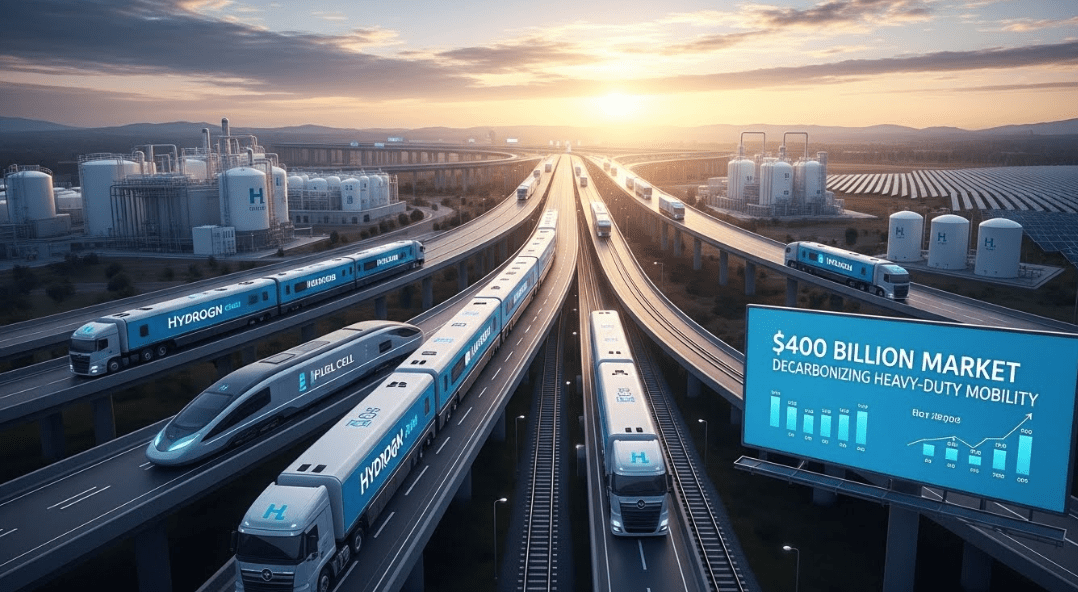
The $400 Billion H₂ Transportation Market (2050)
Why Batteries Don’t Work for Heavy-Duty:
Heavy Trucks (Example: 40-ton 18-wheeler):
- Range needed: 500-800 km/day
- Battery required: 6-8 tons (!)
- Problem: Reduces cargo capacity by 25%
- Charging time: 4-8 hours (trucker loses entire day)
- Solution: H₂ fuel cell + 5-min refueling
Ships (Example: Container ship):
- Route: Asia → Europe (10,000+ nautical miles)
- Battery required: 100,000+ tons (entire ship weight!)
- Impossible with today’s battery density
- Solution: H₂ or ammonia fuel (energy dense)
Planes (Example: 787 Dreamliner):
- Battery needed for 7,000 km flight: 300 tons
- Max takeoff weight: 250 tons total (entire plane!)
- Physics: Batteries 50x worse energy density than jet fuel
- Solution: Synthetic e-fuels (H₂ + captured CO₂ → hydrocarbons)
Hydrogen Trucks: $150B Market
Market Size:
- Global heavy trucks: 30 million vehicles
- Fuel consumption: 300 billion liters diesel/year
- H₂ equivalent: 35-40 Mt H₂/year (2050)
- At $3/kg: $105-120B fuel market
- Plus infrastructure: +$30-50B
- Total: $150B/year
Technology: Fuel Cell Electric Trucks
How It Works:
- H₂ tank (700 bar compressed): 40-80 kg capacity
- Fuel cell: H₂ + O₂ → electricity + water
- Electric motor: Powers wheels
- Range: 500-800 km (same as diesel)
- Refueling: 10-15 minutes (vs 4-8 hours battery)
Leading Companies:
Hyundai XCIENT Fuel Cell:
- 1,600+ trucks deployed (Switzerland, Germany, Korea)
- 190 kW fuel cell, 350 km range
- Leasing model: €1,500-2,000/month (competitive with diesel + carbon cost)
Nikola (NKLA) – USA:
- Class 8 fuel cell trucks
- 500-900 km range
- Expected: 25-50%/year returns (high risk, early stage)
Daimler Truck (DTG) – Germany:
- Mercedes GenH2 truck: 1,000 km range (!), liquid H₂
- Production: 2027-2028
- Expected: 15-25%/year
Toyota (TM) – Japan:
- Heavy-duty fuel cell platform
- Partnership with Hino
- Expected: 10-15%/year (diversified company)
Total Cost of Ownership (TCO) Parity:
- 2025: H₂ trucks 30-50% more expensive (fuel + vehicle)
- 2030: Parity achieved (H₂ $3/kg, carbon pricing $100+/ton)
- 2035: H₂ cheaper (H₂ $2/kg, diesel carbon cost +$0.50/L)
Hydrogen Shipping: $150B Market
Market Size:
- Global shipping fuel: 300 Mt/year (heavy fuel oil)
- H₂ equivalent: 50-60 Mt H₂/year
- Or 90-100 Mt ammonia (easier to store/transport)
- At $3/kg H₂ or $500/ton ammonia: $150B fuel market
Technology Options:
1. Ammonia Fuel (Leading Candidate):
- Ammonia (NH₃): 17.6% hydrogen by weight
- Burns in modified engines: NH₃ + O₂ → N₂ + H₂O (no CO₂!)
- Advantage: Liquid at -33°C or 8 bar (much easier than H₂)
- Storage: Uses existing ammonia infrastructure
Companies:
- Yara International: Green ammonia for shipping
- MAN Energy Solutions: Ammonia engines
- Wärtsilä: Ammonia-ready ship engines
2. Direct H₂ Fuel Cells:
- Large fuel cell: Megawatt-scale
- Advantage: Zero emissions (only water)
- Disadvantage: H₂ storage difficult (need liquid H₂ at -253°C)
Companies:
- Ballard Power (BLDP): Marine fuel cells
- PowerCell Sweden: Shipping focus
3. Methanol (Transition Fuel):
- Methanol from H₂ + captured CO₂
- Advantage: Liquid at room temp, existing infrastructure
- Disadvantage: Still emits CO₂ (but from captured carbon = net-zero)
Companies:
- Maersk: 25+ methanol ships ordered
- Methanex: World’s largest methanol producer, going green
Deployment Timeline:
- 2025: First ammonia-powered ships (pilots)
- 2030: 5-10% of new ships H₂/ammonia capable
- 2040: 40-60% of fleet (as old ships retire)
- 2050: 80%+ (IMO 2050 net-zero target)
Investment Thesis:
- Shipping MUST decarbonize (IMO regulations)
- No alternative to H₂/ammonia for long distances
- Fleet replacement cycle: 20-30 years (locked-in demand)
Aviation E-Fuels: $100B Market
Market Size:
- Aviation fuel: 350 billion liters/year (2025)
- E-fuel equivalent: 30-35 Mt H₂/year (to make synthetic kerosene)
- At $3-5/L e-fuel: $100B+ market (2050)
Technology: Power-to-Liquid (PtL)
Process:
- Green H₂: Electrolysis using renewable energy
- Capture CO₂: Direct air capture (DAC) or industrial sources
- Fischer-Tropsch: H₂ + CO₂ → synthetic hydrocarbons (jet fuel)
- Result: Drop-in fuel (works in existing planes!)
Why E-Fuels (Not H₂ Direct):
- Jet engines optimized for liquid hydrocarbons
- Energy density: 12 kWh/kg (best for aviation weight)
- Infrastructure: Existing (airports, pipelines, tankers)
- H₂ direct: Would require complete aircraft redesign (risky, expensive, slow)
Leading Companies:
Synhelion (Switzerland):
- Solar thermal + thermochemical process
- €500M raised
- Commercial: 2028-2030
- Expected return: 30-60%/year (private, watch IPO)
Infinium (USA):
- E-fuel production, $1.5B projects
- Customers: Amazon, American Airlines
- Expected return: 25-45%/year
Porsche/HIF Global:
- E-fuel plant in Chile (Haru Oni)
- Scaling to 500M liters/year by 2027
- Invest via: Porsche AG stock (limited exposure)
Airlines Committed:
- United Airlines: 1 billion liters e-fuel (2030)
- Lufthansa: 10% e-fuel by 2030
- Delta: SAF (Sustainable Aviation Fuel) commitments
- Demand is locked in (EU mandates 5% SAF by 2030, 70% by 2050)
Cost Trajectory:
- 2025: $5-8/L e-fuel (5-8x diesel)
- 2030: $3-4/L (carbon pricing makes it competitive)
- 2040: $2-3/L (scale + cheaper H₂)
- Parity: 2035-2040 (with carbon costs)
ACTIVITY 2: H₂ Transportation Investment Builder (15 min)
Option 1: Fuel Cell Truck Companies
Nikola (NKLA) – USA:
- Investment: €10,000
- Expected return: 25-50%/year (high risk!)
- 10-year projection: €93,132-433,068
- Risk: Early stage, execution challenges
Hyundai (005380.KS) – Korea:
- Investment: €10,000
- H₂ truck division + NEXO car
- Expected return: 12-20%/year
- 10-year: €31,058-61,917
- Risk: Moderate (established company)
Daimler Truck (DTG) – Germany:
- Investment: €10,000
- Expected return: 15-25%/year
- 10-year: €40,456-95,367
- Risk: Moderate
Option 2: Marine Fuel Cell & Ammonia
Ballard Power (BLDP) – Canada:
- Marine fuel cell leader
- Investment: €10,000
- Expected return: 20-35%/year
- 10-year: €61,917-207,359
Yara International (YAR.OL) – Norway:
- Green ammonia for shipping
- Investment: €10,000
- Expected return: 12-18%/year
- 10-year: €31,058-52,338
Wärtsilä (WRT1V.HE) – Finland:
- Ammonia engines for ships
- Investment: €10,000
- Expected return: 13-19%/year
- 10-year: €33,946-57,275
Option 3: E-Fuels (Aviation)
Direct Investment (If Available):
- Synhelion (private): Watch for IPO 2026-2027
- Infinium (private): Secondary market (if accredited)
- Expected: 30-60%/year
Public Alternatives:
- Neste (NESTE.HE): Renewable diesel/SAF leader
- €10,000 → €31,058-52,338 (12-18%/year)
- Airlines with SAF exposure:
- United Airlines (UAL): €10,000 → €25,937-44,865 (10-16%/year)
Option 4: H₂ Infrastructure (Fueling Stations)
Air Liquide (AI.PA) – France:
- 200+ H₂ fueling stations globally
- Investment: €10,000
- Expected: 11-15%/year
- 10-year: €28,394-40,456
Nel ASA (NEL.OL) – Norway:
- H₂ fueling station manufacturer
- Investment: €10,000
- Expected: 20-30%/year
- 10-year: €61,917-137,858
Option 5: Diversified H₂ Transport ETF
Future ETF (expected 2026):
- Holdings: Trucks (30%), shipping (25%), aviation (20%), infrastructure (25%)
- Expected: 20-30%/year
- €10,000 → €61,917-137,858 (10 years)
Build Your Own Basket:
- 30% Fuel cell trucks (NKLA, Hyundai, Daimler): €15,000
- 25% Marine (Ballard, Yara, Wärtsilä): €12,500
- 20% E-fuels/Airlines (Neste, UAL): €10,000
- 25% Infrastructure (Air Liquide, Nel): €12,500
Recommended Portfolio (€50,000):
Balanced H₂ Transport:
- 30% Fuel cell trucks: €15,000 (NKLA 10%, Hyundai 10%, Daimler 10%)
- Return: 17-32%/year weighted
- 25% Marine/Shipping: €12,500 (Ballard 10%, Yara 10%, Wärtsilä 5%)
- Return: 15-24%/year
- 20% Aviation e-fuels: €10,000 (Neste 10%, UAL 5%, wait for Synhelion IPO 5%)
- Return: 15-28%/year
- 15% Infrastructure: €7,500 (Air Liquide 7.5%, Nel 7.5%)
- Return: 15-23%/year
- 10% Cash (for IPOs): €5,000
Expected Blended Return: 16-27%/year 10-year Value: €219,317-496,684
The Crisis Reality: 3 Gt CO₂ from Heavy Transport with No Battery Solution
The Heavy-Duty Emissions Problem
Transportation = 8 Gt CO₂/year (24% of Global):
Breakdown:
- Light-duty vehicles (cars, SUVs): 4.5 Gt → CAN electrify (batteries work!)
- Heavy trucks (>16 tons): 1.5 Gt → CANNOT electrify (batteries too heavy)
- Shipping: 1.0 Gt → CANNOT electrify (range impossible)
- Aviation: 0.9 Gt → CANNOT electrify (energy density insufficient)
- Rail/other: 0.1 Gt → Mixed (some electric, some H₂)
Total Heavy-Duty: 3.4 Gt CO₂/year (cannot battery-electrify)
Why Batteries Fail for Heavy-Duty
Physics of Energy Density:
- Jet fuel: 12 kWh/kg
- Diesel: 11 kWh/kg
- Gasoline: 10 kWh/kg
- Hydrogen (compressed): 3.3 kWh/kg (system-level)
- Lithium-ion battery: 0.25 kWh/kg (50x worse than fuel!)
Real-World Consequences:
Heavy Truck Example (800 km range):
- Diesel: 300 L × 0.85 kg/L = 255 kg fuel
- H₂: 80 kg (700 bar tank total = 400 kg with tank)
- Battery: 2,000 kg (8,000 kWh pack) = Cargo capacity destroyed!
Container Ship Example:
- Heavy fuel oil: 5,000 tons for Asia-Europe route
- Battery equivalent: 200,000 tons (ship can’t carry cargo!)
- H₂/Ammonia: 8,000 tons (feasible!)
This Isn’t a “Better Battery” Problem:
- Even 2x better batteries (0.5 kWh/kg): Still 25x worse than fuel
- Physics fundamental limit: Chemical bonds > electrochemical storage
- Hydrogen is only solution
The Timing Crisis
IMO (Shipping) Targets:
- 2030: 40% emission reduction (vs 2008)
- 2050: Net-zero
- Problem: Fleet turnover 25-30 years (new ships today = operating until 2050)
- Must order H₂/ammonia ships NOW
Aviation:
- IATA: Net-zero 2050
- EU: 5% SAF mandatory 2030, 70% by 2050
- Problem: E-fuels expensive ($5-8/L) today
- Need rapid cost decline + scale-up
Trucking:
- EU: 100% zero-emission new trucks by 2040
- California: 2035 for heavy-duty
- Problem: H₂ infrastructure lacking (only 1,000 stations globally)
- Need 50,000+ stations by 2035
Consequence if Delays:
- Miss climate targets (3 Gt CO₂/year continuing)
- Stranded assets (diesel trucks/ships worthless)
- Trade disruptions (carbon border tariffs)
ACTIVITY 3: 30-Day H₂ Transport Investment Plan
Week 1: Research & Education
Day 1-3: Technology Deep-Dive
- Watch: How fuel cells work
- Read: Ammonia shipping explainers
- Understand: E-fuels vs biofuels vs H₂ direct
Day 4-5: Company Research
- Nikola: Review technology, production timeline
- Ballard: Marine applications
- Neste: SAF production capacity
Day 6-7: Market Sizing
- Heavy truck market: 30M vehicles, €150B fuel
- Shipping: 60,000 ships, €150B fuel
- Aviation: €100B e-fuel market
Week 2: Build Strategy
Day 8-10: Allocate Capital
- H₂ transport target: ___% of portfolio (recommend 10-20%)
- Amount: €_____
- Split: ___% trucks, ___% marine, ___% aviation, ___% infrastructure
Day 11-13: Risk Assessment
- Technology risk: Fuel cells proven, e-fuels emerging
- Policy risk: Strong regulatory support (IMO, IATA, EU)
- Market risk: Transition timing uncertain (2030 vs 2040?)
- Company risk: Early-stage players (Nikola bankruptcy risk)
Day 14: Watchlist
- Stocks: NKLA, BLDP, Hyundai, Yara, Neste, Air Liquide, Nel
- IPOs: Synhelion (2026-2027), Infinium (2027-2028)
- News: Set alerts for “hydrogen trucks,” “ammonia shipping,” “SAF”
Week 3: Execute
Day 15-17: Open Accounts
- International access needed (Korean, Norwegian, Finnish stocks)
- Platforms: Interactive Brokers, Saxo, local brokers
Day 18-20: First Purchases
- Start: 30-40% of target allocation
- Diversify: Minimum 5 holdings across trucking/marine/aviation
- Example: NKLA (10%), Hyundai (10%), Ballard (10%), Yara (10%), Neste (10%)
Day 21: Track & Monitor
- Portfolio tracker setup
- Quarterly earnings calendar
- Policy tracking (IMO/IATA/EU regulations)
Week 4: Scale & Commit
Day 22-24: Add Positions
- Remaining 60% of target allocation
- Dollar-cost average over 3-6 months
- Rebalance quarterly
Day 25-27: Infrastructure Research
- Nel fueling stations vs Air Liquide vs Linde
- Decide: Pure-play (Nel) vs diversified (Air Liquide)
Day 28-30: Long-Term Commitment
- This is 10-15 year hold (infrastructure buildout takes time)
- Expect volatility (especially Nikola, early-stage names)
- Review Activity 5 (commitment contract)
Expected Results:
- Allocated: €_____ to H₂ transport
- Expected: 16-27%/year (diversified)
- 10-year value: €_____ → €_____
- Impact: Supporting 5,000-20,000 H₂ trucks, 100-500 ships, 1-5 billion liters e-fuel
ACTIVITY 4: H₂ Transport Portfolio Strategy (20 min)
Conservative (€100,000):
- 40% Established infrastructure (Air Liquide, Linde): €40,000
- Return: 10-14%/year
- 30% Diversified majors (Hyundai, Yara, Neste): €30,000
- Return: 11-17%/year
- 20% Fuel cell leaders (Ballard): €20,000
- Return: 15-25%/year
- 10% Cash: €10,000
Expected: 11-17%/year 10-year: €283,942-482,253 Risk: Low-moderate
Moderate (€100,000):
- 30% Fuel cell trucks (NKLA, Daimler, Hyundai): €30,000
- Return: 17-32%/year weighted
- 25% Marine (Ballard, Yara, Wärtsilä): €25,000
- Return: 15-24%/year
- 20% Aviation/e-fuels (Neste, airlines): €20,000
- Return: 12-20%/year
- 15% Infrastructure (Nel, Air Liquide): €15,000
- Return: 13-19%/year
- 10% Cash (IPO opportunities): €10,000
Expected: 15-24%/year 10-year: €404,556-827,847 Risk: Moderate
Aggressive (€100,000):
- 40% Early-stage fuel cell (NKLA, private e-fuel cos): €40,000
- Return: 30-60%/year (high risk!)
- 30% High-growth (Ballard, Nel, emerging plays): €30,000
- Return: 20-35%/year
- 20% Aviation e-fuels (wait for Synhelion IPO): €20,000
- Return: 25-45%/year
- 10% Infrastructure (stability): €10,000
- Return: 11-15%/year
Expected: 24-42%/year (high variance) 10-year: €827,847-3,643,735 Risk: Very high
The Technology Revolution: Fuel Cells + Ammonia + E-Fuels Converging
Fuel Cell Trucks – Hitting the Road
Hyundai XCIENT Reality Check:
- 1,600+ trucks deployed (real operations!)
- 350 km range (expanding to 500 km next-gen)
- Uptime: 95%+ (proven reliability)
- TCO: Within 20% of diesel (with carbon pricing)
Infrastructure Scaling:
- Germany: 200 H₂ stations by 2025 (heavy-duty corridors)
- California: 100 heavy-duty stations by 2030
- Korea: 310 stations by 2025
- Global: 1,000 → 50,000 stations needed (2025-2040)
Ammonia Shipping – First Vessels Launching
MAN Energy Solutions:
- First ammonia engine: 2024 (operational!)
- Can burn 95% ammonia + 5% pilot fuel
- Retrofit: Existing ships convertible (~$20M per ship)
Maersk Fleet Transition:
- 25 methanol ships ordered (transitional)
- Ammonia-ready designs: 2026-2028
- Target: 25% green fuel by 2030
Green Ammonia Supply:
- Yara: 500,000 tons/year (Norway, Australia)
- OCI: 1 Mt/year (Texas, Netherlands)
- Saudi Aramco: Mega-projects (1+ Mt/year each)
- Supply scaling to meet 100 Mt/year demand (2050)
E-Fuels Aviation – Pilots to Production
Synhelion (Swiss):
- Solar thermal tower concentrates sunlight → 1,500°C
- Thermochemical process: H₂O + CO₂ → syngas → jet fuel
- Efficiency: 15-20% (solar → fuel)
- Cost target: $3/L by 2030 (vs $5-8 today)
Haru Oni (Chile):
- Porsche + Siemens + HIF Global
- Wind power → green H₂ → e-fuel
- Capacity: 550M liters/year by 2027
- Customers: Porsche (cars), aviation exploring
Airline Commitments:
- United: 1.5B liters SAF (2030)
- Lufthansa: 2B liters (2030)
- Delta: 10% SAF (2030)
- Demand locked in (EU mandates 5% → 70% by 2050)
ACTIVITY 5: H₂ Transport Investment Commitment (10 min)
I, ________________, commit to hydrogen transportation investing.
My Understanding:
- Heavy transport: 3.4 Gt CO₂/year (cannot battery-electrify)
- Solutions: Fuel cells (trucks), H₂/ammonia (ships), e-fuels (aviation)
- Market size: $400B/year (2050)
- My conviction: ___/10
My Investment Plan:
Phase 1 (Months 1-6): ☐ Allocate €_____ to H₂ transport (___% of portfolio)
☐ Split: ___% trucks, ___% marine, ___% aviation, ___% infrastructure
☐ Initial holdings: _________________ (list 5+)
Phase 2 (Months 7-18): ☐ Scale to €_____ total
☐ Add IPO exposure (Synhelion, Infinium): €_____
☐ Monitor: H₂ infrastructure buildout, TCO milestones
Phase 3 (Years 2-10): ☐ Target allocation: % maintained
☐ Expected value: €__ → €_____
☐ Rebalance quarterly, hold long-term
My Expected Returns:
- Conservative: ___%/year
- Base case: 16-27%/year
- Optimistic: ___%/year
- 10-year value: €_____
My Impact Goal:
- H₂ trucks financed: _____ vehicles
- Ships converted: _____ vessels
- E-fuel aviation: _____ billion liters
- CO₂ avoided: _____ Mt (lifetime)
Signature: ________________
Date: _____
Review: _____ (quarterly)
The Bottom Line: Hydrogen Powers Mobility Where Batteries Can’t
Heavy transport (trucks >16 tons, ships, aviation) = 3.4 Gt CO₂/year (40% of transport, 10% of global emissions). Cannot battery-electrify due to physics: batteries 50x worse energy density than fuels. Only solution: Hydrogen fuel cells (trucks), H₂/ammonia (shipping), e-fuels (aviation). Market size: $400B/year (2050). TCO parity: 2030-2035 as H₂ drops to $2-3/kg. Regulatory mandates locked in: IMO 2050 net-zero, EU 70% SAF by 2050.
Returns:
- Fuel cell trucks (Nikola, Hyundai, Daimler): 15-35%/year
- Marine (Ballard, Yara, Wärtsilä): 12-24%/year
- Aviation e-fuels (Neste, Synhelion): 15-35%/year
- Infrastructure (Nel, Air Liquide): 11-19%/year
- Diversified: 16-27%/year expected
Your €100,000:
- Conservative (11-17%): €283,942-482,253 (10 years)
- Moderate (15-24%): €404,556-827,847
- Aggressive (24-42%): €827,847-3,643,735 (high variance)
Invest in H₂ transport. Decarbonize 3 Gt CO₂. Profit from the $400B heavy-duty transition. Where batteries fail, hydrogen delivers.
🚛🚢✈️💧🌍