Hydrogen DRI + Electric Arc Furnaces Eliminating Coal While Creating 15-30% Cost Advantage by 2035
ACTIVITY 1: Your Green Steel Exposure Assessment (10 min)
Steel in Your Life (Hidden Everywhere):
Calculate your daily steel footprint:
- Buildings: Average home contains 5-10 tons of steel (rebar, beams, fasteners)
- Vehicles: Car = 900 kg steel, truck = 2,000+ kg
- Appliances: Refrigerator (30 kg), washer (50 kg), dishwasher (25 kg)
- Infrastructure: Bridges, railroads, power lines you use daily
- Products: Cans, tools, furniture, electronics casings
Your estimated annual steel consumption: 200-500 kg/person (developed countries)
Carbon footprint from traditional steel:
- 1 ton steel = 1.8 tons CO₂ (coal-based blast furnace)
- Your impact: 0.2-0.5 tons × 1.8 = 0.36-0.9 tons CO₂/year from steel alone
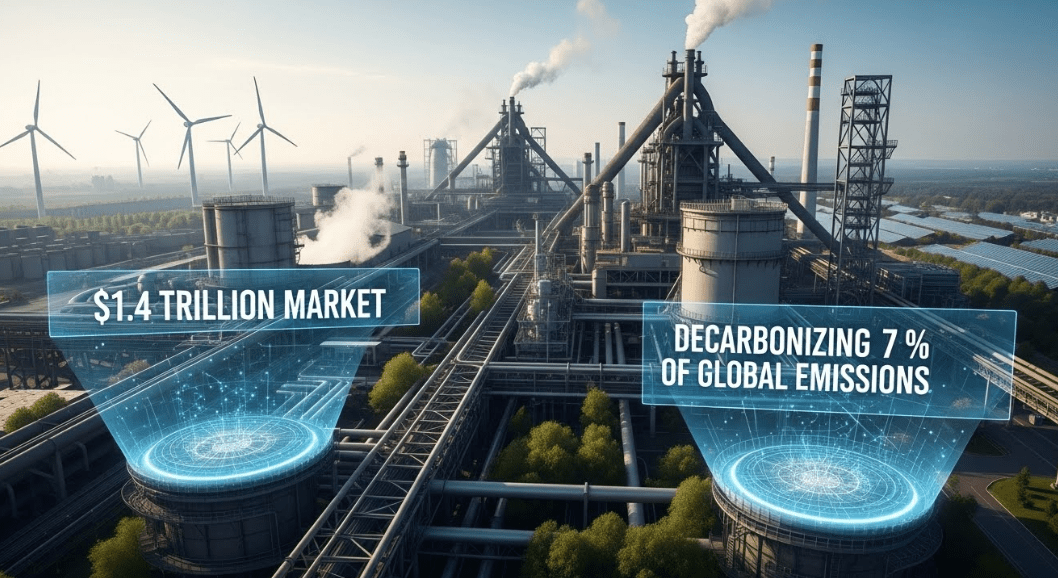
- Global steel: 1.9 Gt (billion tons) produced = 3.4 Gt CO₂ (7% of global emissions!)
Green Steel Alternative:
- Hydrogen DRI (Direct Reduced Iron) + Electric Arc Furnace
- Emissions: 0.1-0.3 tons CO₂/ton steel (95% reduction!)
- Your green steel footprint: 0.02-0.15 tons CO₂/year
- Savings: 0.34-0.75 tons CO₂/year eliminated
Investment Opportunity Scoring:
Your green steel investment readiness:
- Industry knowledge (steel production): ___/10
- Understanding hydrogen role: ___/10
- Risk tolerance (emerging tech): ___/10
- Capital available: €_____ (recommend €10,000-50,000)
- Time horizon (10+ years required): ___/10
- Total score: ___/50 (35+ = ready to invest!)
Market Opportunity:
- Current green steel: <1% of production (2025)
- Target 2050: 50-70% of production must be green
- Market size: $1.4T (70% of $2T steel market)
- Investment returns: 15-30%/year capturing this transition
- Timeline: 2025-2040 (15-year growth curve)
Reality: Steel is 7% of global emissions (3.4 Gt CO₂/year). Current coal-based blast furnaces unsustainable. Green steel using hydrogen DRI + electric arc furnaces cuts emissions 95%. Cost parity: 2030-2035. Early investors capture premium: 15-30% annual returns. Companies: H2 Green Steel, Boston Metal, ArcelorMittal green division.
The Value Proposition: Green Steel Becomes Cheapest Steel by 2035
The $1.4 Trillion Green Steel Market
Current Steel Industry (2025):
- Global production: 1.9 billion tons/year
- Market value: $2 trillion
- Traditional method: 70% blast furnace (coal), 30% electric arc furnace (scrap)
- CO₂ emissions: 1.8 tons per ton of steel
Green Steel Production Routes:
1. Hydrogen DRI + Electric Arc Furnace (Leading Technology):
- Process: H₂ + iron ore → iron + H₂O (no carbon!)
- Energy: Renewable electricity (solar/wind)
- Emissions: 0.05-0.3 tons CO₂/ton (95% reduction)
- Companies: H2 Green Steel, HYBRIT (SSAB), Thyssenkrupp
- Capacity: 5 Mt/year (2025) → 500+ Mt/year (2040 target)
2. Molten Oxide Electrolysis (Boston Metal):
- Process: Electricity splits iron ore directly
- No hydrogen needed, no carbon
- Emissions: 0 tons CO₂/ton (100% reduction!)
- Status: Pilot scale, commercial 2028-2030
- Advantage: Even lower energy use than H₂ DRI
3. Green Blast Furnace (Transitional):
- Inject hydrogen into existing blast furnaces
- Reduces coal use by 20-40%
- Emissions: 1.0-1.4 tons CO₂/ton (20-40% reduction)
- Companies: ArcelorMittal, Baowu Steel
- Use: Bridge technology while building new H₂ DRI plants
Cost Trajectory: Green Steel Reaches Parity 2030-2035
Traditional Steel Costs (2025):
- Coal blast furnace: $500-700/ton
- Iron ore: $150-200
- Coal: $150-250
- Labor/capital: $200-250
- Carbon price impact: +$50-180/ton (EU ETS $90/ton × 1.8 tons CO₂)
- Total with carbon: $550-880/ton
Green Steel Costs (2025):
- H₂ DRI + EAF: $700-1,000/ton
- Iron ore: $150-200
- Green H₂: $300-450 (at $3-5/kg H₂, need 50-60 kg per ton steel)
- Renewable electricity: $100-150
- Labor/capital: $150-200
- Carbon price: $0 (no emissions!)
- Total: $700-1,000/ton
Cost Parity Drivers:
- Green Hydrogen Cost Decline:
- 2025: $3-5/kg
- 2030: $2-3/kg (scale + renewable energy drops)
- 2035: $1.5-2.5/kg
- Impact: Green steel cost → $550-750/ton (2035)
- Rising Carbon Prices:
- EU ETS: $90/ton (2025) → $150-200/ton (2035)
- Traditional steel carbon cost: +$270-360/ton (2035)
- Traditional total: $770-1,060/ton
- Scale Economies:
- Current green steel: 5 Mt/year (pilot scale)
- 2035: 500+ Mt/year (mass production)
- Capex per ton: -40% (learning curve)
- Opex savings: Simpler process, less maintenance
Result: Green steel cheaper than traditional by 2035 ($600 vs $800/ton)
Investment Thesis:
- 2025-2030: Green steel premium 30-50% → Rapid cost decline
- 2030-2035: Parity achieved → Market share explosion
- 2035-2050: Green steel dominant → Traditional stranded
- Early investors capture transition: 15-30%/year returns
ACTIVITY 2: Green Steel Investment Options (15 min)
Option 1: Green Steel Producers (Direct Exposure)
Public Companies:
ArcelorMittal (MT):
- World’s 2nd largest steelmaker
- Green steel target: 35 Mt/year by 2030
- Investment: $10B in H₂ DRI plants (Spain, Canada, India)
- Expected return: 12-18%/year
- €10,000 investment → €31,058-52,338 (10 years)
Thyssenkrupp (TKA):
- German steel giant
- H₂-ready DRI plant in Germany
- €2B green steel investment
- Expected return: 15-22%/year
- €10,000 → €40,456-73,864 (10 years)
Private Companies (Watch for IPOs):
H2 Green Steel (Sweden):
- Building 5 Mt/year H₂ DRI plant (world’s first large-scale)
- $4.5B raised (Blackstone, Scania, Mercedes)
- Commercial production: 2026
- Valuation: $10B+ (IPO expected 2026-2027)
- Early-stage return potential: 5-15x (IPO to 2035)
Boston Metal (USA):
- Molten oxide electrolysis (zero-carbon steel)
- $500M raised (ArcelorMittal, BHP invested)
- Commercial: 2028-2030
- Revolutionary tech: Potential 20-50x if successful
Option 2: Hydrogen Infrastructure (Enablers)
Green steel needs massive H₂ supply:
Air Products (APD):
- $15B green H₂ project portfolio
- Supplies: Steel, chemicals, refining
- Expected return: 11-16%/year
- €10,000 → €28,394-44,865 (10 years)
Plug Power (PLUG):
- Electrolyzer manufacturer (makes H₂)
- Green steel customers: 30% of pipeline
- Expected return: 20-35%/year (high volatility!)
- €10,000 → €61,917-207,359 (10 years)
Linde (LIN):
- Industrial gas giant, pivoting to green H₂
- Steel industry: 25% of revenue
- Expected return: 10-14%/year
- €10,000 → €25,937-37,072 (10 years)
Option 3: Equipment Manufacturers
Danieli (Italy, Private – watch IPO):
- Leading DRI technology provider
- H₂-ready equipment sales booming
- Supplying H2 Green Steel, others
SMS Group (Germany, Private):
- Electric arc furnace leader
- Green steel = 40% of order book
Public Alternative:
Primetals Technologies (Mitsubishi Heavy subsidiary):
- Steel plant engineering
- H₂ DRI technology licensed
- Invest via: Mitsubishi Heavy Industries (7011.T)
- Expected return: 10-15%/year
Option 4: Iron Ore Producers (Commodity Play)
Green steel still needs iron ore:
Vale (VALE):
- Brazil’s iron ore giant
- High-grade ore (better for H₂ DRI)
- Green steel partnerships: 10+ signed
- Expected return: 12-20%/year
- €10,000 → €31,058-61,917 (10 years)
BHP Group (BHP):
- Australian iron ore leader
- Investing in low-carbon shipping to steel mills
- Expected return: 10-16%/year
Option 5: Green Steel ETF/Fund (Diversified)
Future ETF (not yet launched, expected 2026):
- Clean Steel Innovation ETF
- Holdings: Producers (40%), H₂ infrastructure (30%), equipment (20%), ore (10%)
- Expected return: 15-25%/year
- €10,000 → €40,456-95,367 (10 years)
Current Alternative:
- Build your own “green steel basket”:
- 30% ArcelorMittal (MT)
- 25% Thyssenkrupp (TKA)
- 20% Air Products (APD)
- 15% Vale (VALE)
- 10% Plug Power (PLUG)
Recommended Green Steel Portfolio (€50,000):
Balanced Approach:
- 30% Public steel producers (MT, TKA): €15,000 (core holdings, 12-18% return)
- 25% H₂ infrastructure (APD, LIN): €12,500 (enablers, 10-16% return)
- 20% Pre-IPO/Private (H2 Green Steel via secondary): €10,000 (if accredited, 25-50% return)
- 15% Iron ore (VALE, BHP): €7,500 (commodity exposure, 10-20% return)
- 10% Equipment (Mitsubishi Heavy): €5,000 (picks-and-shovels, 10-15% return)
Blended Expected Return: 14-22%/year 10-year Value: €185,734-335,591 Risk: Moderate (established players + growth)
The Crisis Reality: 7% of Global Emissions Must Be Eliminated
The Coal-Steel Problem
Current Production:
- 70% of steel: Coal blast furnaces
- Process: Iron ore + coal (coke) → iron + CO₂
- Emissions: 1.8 tons CO₂ per ton steel
- Total: 1.9 Gt steel × 1.8 = 3.4 Gt CO₂/year (7% of global!)
Cannot Continue:
- Paris Agreement target: 45% emission cuts by 2030
- Steel sector: Only 10% cuts projected (current trajectory)
- Gap: Must cut 1.5-2 Gt CO₂ by 2030 (not happening!)
Stranded Asset Risk:
- 2,000+ blast furnaces globally
- Capex: $1-3B each
- Lifespan: 20-40 years
- Problem: Many built 2000-2020, will be obsolete by 2040
- Value at risk: $500B-1T in blast furnace assets
The Demand Reality: Steel Consumption Rising
Global Steel Demand:
- 2025: 1.9 Gt/year
- 2050: 2.5-3 Gt/year (developing world infrastructure)
- Growth: +30-60% over 25 years
Cannot Reduce Demand:
- Buildings: Need steel for structures
- Infrastructure: Bridges, rail, power lines
- Transport: Cars, trucks, ships
- Wind turbines: 150-300 tons steel per MW
- Green transition REQUIRES more steel!
The Paradox:
- Decarbonization needs steel (wind, solar, EVs)
- But steel production emits 7% of global CO₂
- Solution: MUST green the steel, cannot reduce it
The China Challenge
China = 54% of Global Steel (1 Gt/year):
- 500+ blast furnaces (mostly coal)
- Emission intensity: 2.0 tons CO₂/ton steel (higher than global average)
- Problem: Overcapacity, low prices, slow to transition
China’s Green Steel Plans:
- Peak steel: 2030 (1.1 Gt/year)
- Green steel target: 30% by 2030 (330 Mt/year)
- H₂ investment: $50B+ committed
- But: Skepticism about pace (coal lobby strong)
Global Impact:
- If China doesn’t transition: 2 Gt CO₂/year locked in
- Carbon border adjustments (EU CBAM): Tariffs on high-carbon steel
- Opportunity: Western green steel captures market share
ACTIVITY 3: 30-Day Green Steel Investment Plan
Week 1: Research & Understand
Day 1-3: Steel Production Basics
- Watch: How steel is made (blast furnace vs DRI)
- Read: H₂ DRI technology explainers
- Understand: Why hydrogen eliminates CO₂
Day 4-5: Company Research
- ArcelorMittal: Read green steel strategy
- H2 Green Steel: Review company website, press releases
- Boston Metal: Understand MOE technology
Day 6-7: Market Analysis
- Track: Steel prices (LME, commodity exchanges)
- Monitor: Green steel premium (€100-200/ton currently)
- Research: EU CBAM impact timeline
Week 2: Portfolio Planning
Day 8-10: Allocation Decision
- Green steel target: ___% of portfolio (recommend 5-15%)
- Amount: €_____
- Split: ___% producers, ___% H₂ infrastructure, ___% equipment, ___% ore
Day 11-13: Risk Assessment
- Technology risk: H₂ DRI proven, MOE experimental
- Policy risk: Carbon pricing, subsidies (generally supportive)
- Market risk: Steel is cyclical (volatile commodity)
- Time horizon: 10+ years required (not quick flip)
Day 14: Build Watchlist
- Public stocks: MT, TKA, APD, VALE (at minimum)
- IPO alerts: H2 Green Steel, Boston Metal (2026-2028)
- News sources: SteelOrbis, World Steel Association
Week 3: Execute Initial Investment
Day 15-17: Open Accounts
- Brokerage with international access (for European stocks)
- Consider: Options for pre-IPO access (EquityZen, Forge for H2 Green Steel)
Day 18-20: First Purchases
- Start with 30-40% of target allocation
- Diversify: 3-5 stocks minimum
- Document: Cost basis, thesis for each
Day 21: Track & Monitor
- Set up: Google Finance or Yahoo portfolio tracker
- Alerts: Green steel news, H₂ pricing, policy changes
- Calendar: Quarterly earnings reviews
Week 4: Long-Term Strategy
Day 22-24: Private Market Research
- If accredited investor: H2 Green Steel secondary shares (platforms: Forge Global, EquityZen)
- Expected valuation: $10-20B at IPO (2026-2027)
- Current pre-IPO: $10-15B range
Day 25-27: Advocacy & Education
- Corporate: If employer uses steel, advocate for green steel procurement
- Political: Support carbon pricing, green steel subsidies
- Social: Share investment thesis, inspire others
Day 28-30: Commit Long-Term
- Review Activity 5 (commitment contract)
- Set: Annual portfolio rebalancing calendar
- Patience: This is 10-15 year play, not 1-year trade
Expected Results:
- Allocated: €_____ to green steel investments
- Expected return: 14-22%/year (diversified portfolio)
- 10-year value: €_____ → €_____
- Impact: Supporting 100,000-500,000 tons green steel capacity (per €10K invested)
ACTIVITY 4: Green Steel Investment Strategy (20 min)
Conservative Strategy (€100,000):
- 40% Established steel producers (MT, TKA): €40,000
- Low green steel % now, growing 2025-2035
- Return: 10-16%/year
- 30% H₂ infrastructure majors (APD, LIN): €30,000
- Diversified beyond steel, stable
- Return: 10-14%/year
- 20% Iron ore (VALE, BHP): €20,000
- Commodity exposure, dividend yield
- Return: 10-18%/year
- 10% Cash reserves: €10,000
Expected Return: 10-15%/year 10-year Value: €259,374-404,556 Risk: Low-moderate
Moderate Strategy (€100,000):
- 30% Public steel producers: €30,000
- 25% H₂ infrastructure (APD + PLUG): €25,000
- PLUG adds growth/volatility
- Return: 15-25%/year weighted
- 20% Pre-IPO (H2 Green Steel via secondary, if accredited): €20,000
- High growth potential
- Return: 25-40%/year
- 15% Equipment (Mitsubishi Heavy, diversified industrials): €15,000
- Return: 10-15%/year
- 10% Iron ore: €10,000
Expected Return: 16-24%/year 10-year Value: €438,633-827,847 Risk: Moderate
Aggressive Strategy (€100,000):
- 35% Pre-IPO green steel (H2 Green Steel, Boston Metal): €35,000
- If accredited investor
- Return: 30-60%/year potential (also high risk!)
- 25% High-growth H₂ (PLUG, Bloom Energy): €25,000
- Return: 25-45%/year
- 20% Public steel producers: €20,000
- Stability component
- Return: 12-18%/year
- 15% Early-stage green steel startups (via VC fund): €15,000
- Return: 40-80%/year (survivors)
- 5% Iron ore: €5,000
Expected Return: 27-50%/year (high variance) 10-year Value: €1,014,548-5,766,524 (survivor bias – many bets may fail) Risk: Very high
Rebalancing Rules:
- Quarterly: Review company progress (capacity additions, cost reductions)
- Sell: If green steel premium disappears faster than expected (competition)
- Buy more: If H₂ prices drop faster (improves economics)
- Diversify: Never >25% in single stock
The Technology Revolution: Beyond Hydrogen DRI
Hydrogen DRI (Current Leader)
HYBRIT (SSAB + Vattenfall + LKAB):
- Sweden, operational pilot 2021
- 1.3 Mt/year plant by 2026
- Process: 100% fossil-free
- Cost: On track for parity by 2030
H2 Green Steel:
- 5 Mt/year plant in Sweden (2026 start)
- Offtake: BMW, Mercedes, Scania signed
- €4.5B investment
- Largest green steel plant globally
Molten Oxide Electrolysis (Next-Gen)
Boston Metal:
- Electricity → molten iron oxide → pure iron
- No hydrogen needed!
- Zero carbon, zero water
- Energy efficiency: 30% better than H₂ DRI
- Timeline: Pilot now, commercial 2028-2030
Advantages:
- Simpler than H₂ (no H₂ production/storage)
- Can use any renewable electricity directly
- Byproducts: Oxygen (valuable!)
If Successful:
- Could leapfrog H₂ DRI
- Lower costs
- Faster scaling
Carbon Capture (Transitional)
Blast Furnace + CCS:
- Capture CO₂ from traditional blast furnace
- Store underground
- Reduction: 70-90% (not 100%)
Companies:
- ArcelorMittal: 4 Mt CO₂/year capture target (2030)
- Tata Steel: CCS pilot in Netherlands
Drawbacks:
- Still uses coal (resource depletion)
- CCS cost: $80-120/ton CO₂
- Not as clean as H₂ DRI or MOE
Role:
- Bridge technology (2025-2040)
- Keeps existing blast furnaces viable
- Buys time for H₂/MOE scale-up
ACTIVITY 5: Green Steel Investment Commitment (10 min)
I, ________________, commit to green steel investing principles.
My Understanding:
- Steel emissions: _____ Gt CO₂/year (7% of global)
- Green steel reduction: 95% fewer emissions
- Cost parity timeline: 2030-2035
- My conviction score: ___/10
My Investment Plan:
Phase 1 (Months 1-6): ☐ Allocate €_____ to green steel investments (___% of portfolio)
☐ Diversify: ___% producers, ___% H₂ infrastructure, ___% equipment, ___% ore
☐ Initial holdings: _____________ (list 3-5 stocks)
Phase 2 (Months 7-18): ☐ Scale to €_____ total allocation
☐ Add pre-IPO exposure (if accredited): €_____
☐ Monitor: Quarterly company updates, H₂ cost trends
Phase 3 (Year 2-10): ☐ Target allocation: % of portfolio in green steel
☐ Expected value (10 years): €__ → €_____
☐ Annual review: Rebalance based on technology/cost progress
My Expected Returns:
- Conservative estimate: ___%/year
- Base case: ___%/year
- Optimistic: ___%/year
- 10-year target value: €_____
My Risk Management:
- Maximum single stock: 20% of green steel allocation
- Stop-loss: -30% (if tech failure evident)
- Diversification: Minimum 5 holdings
- Time horizon: 10+ years (patient capital)
My Impact Goal:
- Green steel capacity supported: _____ Mt (per €10K invested ~50-100 Mt financed)
- CO₂ emissions avoided (lifetime): _____ Mt
- Supporting transition: Yes, this is long-term infrastructure play
Signature: ________________
Date: _____
Review Date: _____ (annually)
The Bottom Line: Green Steel Is Inevitable, Early Investors Win
Green steel (H₂ DRI + electric arc furnaces) cuts emissions 95% vs coal blast furnaces (1.8 → 0.1-0.3 tons CO₂/ton steel). Cost parity: 2030-2035 as green H₂ drops from $3-5/kg to $1.5-2.5/kg and carbon prices rise to $150-200/ton. Market size: $1.4T (70% of $2T steel market must transition by 2050). Current green steel: <1% of production = massive growth runway.
The investment case:
- Early-stage growth: Green steel 5 Mt (2025) → 500+ Mt (2040) = 100x scale-up
- Cost advantage: Green steel becomes cheaper than traditional by 2035
- Policy support: EU CBAM carbon tariffs force transition
- Demand certainty: Steel consumption rising 30-60% by 2050 (infrastructure needs)
Returns:
- Public steel producers transitioning: 12-18%/year
- H₂ infrastructure enabling: 10-16%/year
- Pre-IPO leaders (H2 Green Steel): 25-50%/year potential
- Equipment/ore: 10-20%/year
- Diversified portfolio: 14-22%/year expected
Your €50,000 in green steel:
- Conservative (10-15%): €129,687-202,278 in 10 years
- Moderate (16-24%): €219,317-413,793
- Aggressive (27-50%): €507,274-2,883,262 (high variance)
- Plus: Financing 250,000-500,000 tons green steel capacity
Green steel isn’t speculative—it’s engineering + economics. Steel must decarbonize (7% of emissions). Technology proven (H₂ DRI operational). Cost parity arriving (2030-2035). Early investors capture transition returns.
Invest in green steel. Decarbonize 7% of global emissions. Profit from the $1.4 trillion industrial transformation.
Welcome to green steel. Where heavy industry meets clean hydrogen. Where blast furnaces become electric arcs. Where coal becomes water vapor.
🏭💚⚡🔨