Why STEM Education and Reducing Disparity Create the Greatest Returns in Human History
ACTIVITY 1: The Human Development Opportunity Audit
Assess opportunity access in your life:
Education Access (1-10 scale):
- Quality primary/secondary education: ___
- STEM education opportunities: ___
- Higher education access: ___
- Lifelong learning opportunities: ___
- Digital literacy resources: ___ Education Score: ___/50
Economic Opportunity (1-10 scale):
- Living wage job access: ___
- Career advancement pathways: ___
- Entrepreneurship resources: ___
- Financial services access: ___
- Economic mobility potential: ___ Economic Score: ___/50
Social Equity (1-10 scale):
- Healthcare access: ___
- Housing affordability: ___
- Safe environment: ___
- Social services available: ___
- Equal treatment/opportunity: ___ Social Score: ___/50
Your Total Opportunity Score: ___/150
Benchmarks:
- 120-150: High opportunity (top 20% globally)
- 90-119: Moderate opportunity (middle 40%)
- 60-89: Low opportunity (bottom 40%)
- Under 60: Crisis level (bottom 20%)
Reality: Billions score under 90. Your score determines life outcomes more than talent or effort.
Time to complete: 15 minutes
Cost: Free
What you learned: Opportunity is distributed extremely unequally
Here’s the human development reality: Education, opportunity, and equity determine everything. Yet 250 million children lack basic education. 700 million live in extreme poverty. 3.5 billion lack meaningful internet access. The disparity is obscene and economically wasteful.
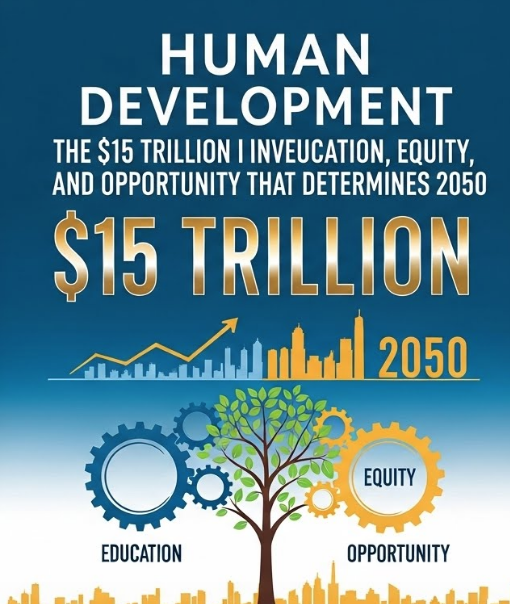
But here’s the opportunity: Investing in human development returns $10-20 per dollar invested. STEM education alone generates $7-14 trillion economic value. Reducing disparity unleashes billions of untapped human potential worth $15+ trillion.
Human development isn’t charity—it’s the highest-ROI investment civilization can make.
The Value Proposition: Human Development = Economic Growth
Education ROI: $10-20 Per Dollar Invested
Every year of schooling: Increases lifetime earnings 10% on average.
Example:
- No high school: $25,000 annual earnings (lifetime: $1M)
- High school diploma: $35,000 annual (lifetime: $1.4M) – +40%
- Bachelor’s degree: $55,000 annual (lifetime: $2.3M) – +120%
- Graduate degree: $75,000 annual (lifetime: $3M) – +200%
ROI calculation:
- Cost of education: $50,000-200,000 total
- Lifetime earnings gain: $500,000-2,000,000
- ROI: 250-1,000% (2.5-10x return)
But education benefits extend beyond individual:
Social returns on education investment:
- Economic growth: 1 year average schooling = 0.37% GDP growth
- Innovation: Educated workforce generates patents, startups, productivity
- Health: More educated = healthier (understand health info, afford care)
- Civic participation: Democracy functions better with educated citizens
- Crime reduction: Education reduces crime 10-20%
- Intergenerational: Educated parents → better outcomes for children
Total societal ROI: $10-20 per $1 invested in education (World Bank estimate)
Pattern: Education is perhaps highest-ROI investment any society can make.
STEM Education: $7-14 Trillion Value Creation
STEM shortage crisis:
- 3 million STEM jobs unfilled globally (shortage)
- Demand growing 8-12% annually
- Starting salaries: $60,000-90,000 (vs $35,000-45,000 non-STEM)
- Lifetime premium: $500,000-1,000,000 for STEM degree
Economic value:
- STEM workers drive innovation (patents, products, companies)
- Every STEM job creates 2-3 additional jobs
- STEM sectors grow 2-3x faster than overall economy
- Global STEM talent shortage costs $7-14 trillion in unrealized GDP
Solution: Massive investment in STEM education globally.
ROI for individuals: 300-700% (STEM degree costs vs lifetime premium)
ROI for society: $15-30 per $1 invested (economic growth from STEM workforce)
Reducing Disparity: $15 Trillion Opportunity
Income inequality at historic highs:
- Top 1%: Own 50% of wealth
- Bottom 50%: Own under 2% of wealth
- Gini coefficient worsening in most countries
Economic cost of inequality:
- Reduced consumption: Poor spend everything, rich save. Inequality = lower demand.
- Social instability: Crime, protests, political extremism cost billions.
- Lost human potential: Billions of talented people never reach potential due to lack of opportunity.
- Health costs: Inequality correlates with worse health outcomes (stress, lack of care).
Estimated cost: $15+ trillion in lost GDP annually from extreme inequality.
Solutions that work:
- Progressive taxation: Fund services without killing growth
- Universal basic services: Healthcare, education free to all
- Minimum/living wages: Ensure work pays enough to live
- Access to capital: Microfinance, small business loans for poor
- Infrastructure: Connect excluded communities
ROI: Every $1 invested in reducing inequality returns $3-7 in economic growth (more consumption, healthier population, social stability, unleashed potential).
ACTIVITY 2: The STEM Skills Assessment
Assess your STEM readiness:
Science (1-10):
- Understanding of scientific method: ___
- Ability to evaluate scientific claims: ___
- Basic physics/chemistry/biology knowledge: ___
- Science Score: ___/30
Technology (1-10):
- Digital literacy (use computers, internet): ___
- Basic coding knowledge: ___
- Understanding of major technologies (AI, blockchain, etc.): ___
- Technology Score: ___/30
Engineering (1-10):
- Problem-solving ability: ___
- Design thinking skills: ___
- Systems thinking: ___
- Engineering Score: ___/30
Mathematics (1-10):
- Arithmetic/algebra: ___
- Statistics/probability: ___
- Data analysis: ___
- Mathematics Score: ___/30
Your STEM Score: ___/120
Benchmarks:
- 90-120: Strong STEM foundation (competitive for STEM careers)
- 60-89: Moderate STEM (can build skills)
- 30-59: Weak STEM (needs significant development)
- Under 30: STEM illiterate (barriers to most modern careers)
Actions Based on Score:
- 90+: Pursue STEM career, mentor others
- 60-89: Take online courses (Coursera, edX, Khan Academy – many free)
- 30-59: Start with basics (math, coding fundamentals)
- Under 30: Community college, adult education programs
Resources (Free/Low-Cost):
- Khan Academy: Free K-12 + college math, science
- Coursera: Free courses from top universities (pay only for certificate)
- edX: Similar to Coursera
- freeCodeCamp: Free coding bootcamp
- YouTube: Countless STEM tutorials
Time to complete: 20 minutes
Cost: Free
Action: Identify gaps, start learning this week
The Technology Revolution: Democratizing Education
Online Learning Platforms
Traditional education barriers:
- Geographic (live far from good schools)
- Financial (tuition costs)
- Time (can’t attend during work hours)
- Prerequisites (lacking prior education)
Online learning solves all:
- Access: Anyone, anywhere with internet
- Cost: Free to $50/month (vs $10,000-50,000 tuition)
- Flexibility: Learn anytime, any pace
- Quality: Top professors, best content
Major platforms:
- Coursera: 5,000+ courses, 100M+ learners
- edX: Courses from MIT, Harvard, others
- Khan Academy: K-12 math, science free
- Udacity: Tech-focused, nano-degrees
- YouTube: Billions of hours educational content
Economics:
- Traditional 4-year degree: $40,000-200,000
- Online equivalent: $5,000-25,000 (80-90% savings)
- Time: 4 years full-time vs 1-3 years part-time online
Quality: Many studies show online learning outcomes equal or better than traditional.
Barrier remaining: Credentials. Employers slowly accepting online certificates but traditional degrees still preferred for many jobs.
AI-Powered Personalized Learning
Traditional education: One-size-fits-all (teacher lectures 30 students at same pace).
AI-personalized: Adapts to each student’s level, pace, learning style.
How it works:
- AI assesses student knowledge
- Identifies gaps
- Presents content at right difficulty
- Adjusts based on performance
- Provides instant feedback
Results:
- 30-50% faster learning
- 15-30% better retention
- 60-80% higher engagement
Platforms: Khan Academy (free), Duolingo (language), Carnegie Learning (math), others.
Future: AI tutors available 24/7 to every student globally at near-zero marginal cost. Revolutionary for global education access.
Digital Credentials and Skills Verification
Problem: Hard to verify skills, credentials easily faked.
Blockchain solution: Immutable, verifiable credentials.
How it works:
- Institution issues credential to blockchain
- Can’t be altered or faked
- Employers verify instantly
- Portable across borders
Benefits:
- Reduces degree fraud
- Enables micro-credentials (skill verification)
- Lowers employer verification costs
- Increases trust in online learning
Adoption: Growing. MIT, others issuing blockchain credentials.
VR/AR for Experiential Learning
Some things need hands-on practice: Surgery, engineering, manufacturing, etc.
VR/AR solution: Realistic simulations at fraction of cost.
Examples:
- Medical students practice surgery in VR (no risk to patients, unlimited practice)
- Engineering students test designs virtually
- Chemistry experiments in VR (no dangerous chemicals)
- Historical site visits virtually
Cost: VR headset $300-500 vs $10,000-100,000 for physical labs/equipment/travel.
Effectiveness: Studies show 70-80% as effective as real experience, 90%+ for some skills.
ACTIVITY 3: The 30-Day Learning Challenge
Commit to continuous learning:
Week 1: Assess and Plan
- Day 1-3: Complete Activity 2 (STEM assessment)
- Day 4-5: Identify skill gaps most relevant to goals
- Day 6-7: Select learning resources (courses, books, tutorials)
Week 2: Start Learning
- Day 8-14: Study 30-60 min daily on chosen topic
- Track progress, adjust difficulty if needed
- Join online communities (Reddit, Discord) for support
Week 3: Apply Knowledge
- Day 15-21: Work on project applying new skills
- Code something, solve problems, create something
- Get feedback from online community
Week 4: Reflect and Continue
- Day 22-24: Assess progress, identify next steps
- Day 25-27: Share learning journey (blog, social, friends)
- Day 28-30: Commit to ongoing learning (1 hour daily minimum)
Expected Results:
- New skill: Basic competence in 30 days
- Confidence: Realize learning is achievable
- Habit: Daily learning becomes routine
- Network: Connected to learning community
- Career: Skills applicable to better jobs/raises
Share: #30DayLearningChallenge
Time commitment: 30-60 min daily
Cost: €0-50 (mostly free resources)
ROI: Potentially €10,000-50,000+ in career value
The Crisis Reality: Billions Left Behind
250 Million Children Out of School
Primary causes:
- Poverty: Must work instead of school
- Conflict: Schools destroyed, unsafe to attend
- Discrimination: Girls, minorities excluded
- Geography: No schools in remote areas
- Disability: Schools lack accommodations
Consequences:
- Lifetime poverty (no education = no jobs)
- Health problems (don’t understand health info)
- Higher crime rates
- Cycle repeats (uneducated parents → uneducated children)
Economic cost: $10+ trillion in lost lifetime earnings for children currently out of school.
Solution: $200 billion annually would provide universal primary education. ROI: 50x over lifetime of these children.
STEM Gender Gap
Women in STEM careers: 25-30% globally (should be 50%).
Causes:
- Stereotypes: “Math is for boys” discourages girls
- Role models: Few visible female scientists/engineers
- Bias: Women in STEM face discrimination, harassment
- Pipeline leak: Women leave STEM careers at higher rates
Cost: 50% of human talent wasted in STEM fields. Economic loss: $2-5 trillion annually in innovation not created.
Solutions: Mentorship programs, bias training, flexible work (caregiving), harassment elimination, visible role models.
ROI: Doubling women in STEM = $2-5 trillion additional GDP.
Global Digital Divide
Internet access:
- Developed: 90%+
- Developing: 50-70%
- Least developed: Under 30%
- Total: 3.5 billion without internet
Consequences:
- Can’t access online education
- Can’t participate in digital economy
- Isolated from global information
- Excluded from modern opportunities
Economic cost: $2-5 trillion in unrealized economic activity from digital exclusion.
Solution: $100 billion investment in rural broadband, satellite internet (Starlink, etc.), mobile coverage. ROI: 20-50x through economic activity enabled.
ACTIVITY 4: The Human Development Investment Portfolio
Invest in education and opportunity:
Investment Options:
1. Education Technology (15-30% returns)
- Coursera, Udemy, Duolingo (some public)
- EdTech startups (mostly private)
- Expected growth: 15-25% annually
2. Skills Training Platforms (20-35% returns)
- Coding bootcamps, vocational training
- Corporate training companies
- Expected growth: 20-30% annually
3. Educational Content (10-20% returns)
- Publishers adapting to digital
- Content creation platforms
- Expected growth: 10-15% annually
4. Education Infrastructure (8-15% returns)
- School construction in developing countries
- Technology infrastructure for schools
- Expected growth: 6-12% annually
5. Impact Investing (10-25% returns + social benefit)
- Microfinance institutions
- Social enterprises in education/training
- Measurable social impact + financial return
Sample Portfolio:
- 35%: EdTech platforms (high growth)
- 25%: Skills training (addressing workforce gaps)
- 20%: Impact investments (returns + social good)
- 15%: Education infrastructure (stable, needed)
- 5%: Speculative (early-stage EdTech startups)
10-Year Projection: €10,000 @ 18% average = €52,338
Thesis: Education is underinvested globally. Technology enabling access at scale. Growing workforce needs = huge demand. High returns + social impact.**
Time to complete: 30 minutes
Action: Allocate 10-15% to human development
Expected return: 10-35% annually + social impact
ACTIVITY 5: The Human Development Commitment
Commit to expanding opportunity:
I, _____________, commit to human development.
My Personal Actions:
- Continuous learning: ___ hours weekly
- Skill development: Master ___ new skill(s) this year
- Share knowledge: Mentor/teach ___ people
My Community Actions:
- Volunteer: ___ hours monthly (tutoring, mentoring)
- Advocate: Support education funding, equity policies
- Donate: €___ annually to education/opportunity causes
My Investment Actions:
- Allocate ___% portfolio to human development
- Expected return: ___% + social impact
My Career Actions:
- Pursue work contributing to opportunity (EdTech, nonprofit, policy)
- OR use career earnings to fund opportunity expansion
- Target: Help ___ people access opportunity
My Accountability: Partner: _______________ Quarterly: Review learning, volunteer hours Annually: Assess impact (people helped, skills gained)
Why this matters: [Write reason – fairness, economic growth, human potential, personal growth]
Expected Impact:
- Personal: Continuous growth, meaning, skills
- Direct: ___ people helped annually
- Systemic: Pressure for policy changes
- Economic: Returns from investments
Date: ______ Signature: ______
Time to complete: 15 minutes
Impact: Personal + community transformation
The Bottom Line: Human Development = Prosperity for All
The greatest untapped resource on Earth isn’t oil, minerals, or land—it’s human potential. Billions of brilliant minds wasted due to lack of opportunity.
The value propositions:
- Education: $10-20 return per $1 invested
- STEM education: $7-14 trillion value if gap closed
- Reduced disparity: $15+ trillion opportunity
- Online learning: 80-90% cost savings vs traditional
- Investment returns: 10-35% in human development sectors
The crisis is real:
- 250 million children out of school
- 700 million in extreme poverty
- 3.5 billion without internet
- Massive STEM shortage (3 million jobs unfilled)
- Gender gaps, racial gaps, geographic gaps
- Obscene inequality ($15T cost)
The solution:
- Universal education: Every child in school
- STEM for all: Close gender, racial, geographic gaps
- Digital access: Universal internet
- Lifelong learning: Continuous skill development
- Reduce disparity: Progressive policies + opportunity expansion
Investing in people is the highest-ROI investment civilization can make. Do it and unlock $15+ trillion in human potential.
📚🎓🌟