Why Ocean Health Is Your Personal Survival Issue and Massive Investment Opportunity
ACTIVITY 1: The Ocean Dependency Test
Take 10 deep breaths right now. Count them: 1… 2… 3… 4… 5… 6… 7… 8… 9… 10.
Done? Good. 5 of those 10 breaths (50% of oxygen) came from the ocean. Not forests. The ocean. Specifically, phytoplankton—microscopic plants you’ve never seen.
Now here’s the terrifying part: Ocean phytoplankton populations declined 40% since 1950. And declining 1% more annually. Do the math: In 50 years, you’ll be breathing 50% less oxygen if this continues.
Still think ocean health doesn’t affect you personally?
Time to complete: 2 minutes
Cost: Free
What you learned: Half your oxygen comes from the ocean, and we’re killing it
Here’s what most people miss: Oceans cover 71% of Earth, produce 50% of oxygen, absorb 30% of CO₂, regulate climate, and feed 3 billion people directly. They’re not optional scenery—they’re life support.
And we’re destroying them systematically: 90% of fisheries maxed out or overfished. Ocean acidification up 30% (highest in 300+ million years). Plastic pollution creating 5 trillion pieces floating in oceans. Coral reefs dying (50% gone since 1950s). Dead zones expanding (oxygen-depleted areas killing everything).
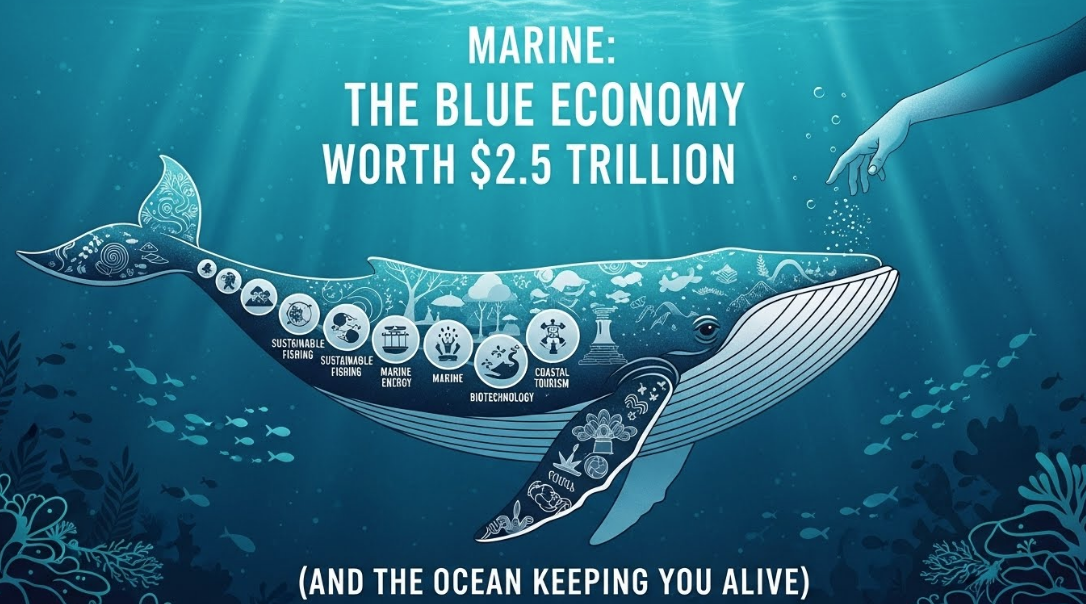
But here’s the opportunity: The blue economy is worth $2.5 trillion annually and growing. Sustainable fisheries could add $53 billion in value. Ocean restoration returns $7-10 per dollar invested. And marine tech is $650 billion market by 2050.
The Value Proposition: Blue Economy = Green Returns
Ocean Economics Are Massive and Growing
Sustainable Fisheries: $53 Billion Opportunity
Currently, overfishing costs global economy $53 billion annually in lost potential catch value. Sustainable fishery management could reverse this creating $53 billion gain—a $106 billion swing from current practice.
Fish stocks in marine protected areas recover by 400-600% over 10 years. This isn’t theory—it’s proven in MPAs worldwide from Philippines to Mediterranean to Caribbean. Protected areas pay for themselves within 5-10 years through increased catch in surrounding waters and tourism revenue.
Investment in sustainable fisheries infrastructure (monitoring, enforcement, sustainable gear) returns $5-12 per dollar invested according to World Bank analysis.
Blue Economy: $2.5 Trillion Annually
Ocean-based industries generate $2.5 trillion annually: Fisheries ($400 billion), shipping ($380 billion), tourism ($390 billion), offshore oil/gas ($500 billion transitioning to offshore wind), marine biotechnology ($6 billion growing rapidly), and more.
This economy supports 350+ million jobs globally. And it’s growing: Ocean-based renewable energy projected to reach $650 billion by 2050. Sustainable aquaculture growing 5% annually reaching $250 billion. Marine biotechnology discovering compounds worth billions for medicine and materials.
Coastal Property Protection: $65 Billion from Reefs Alone
Coral reefs protect $65 billion worth of coastal property from storm damage annually. Mangroves protect another $65+ billion. Salt marshes add billions more. Total coastal ecosystem protection value exceeds $200 billion annually.
Restoring these ecosystems costs $2,000-20,000 per hectare. The protection value: $100,000-400,000 per hectare annually in storm surge reduction. That’s 5-200x annual return on restoration investment.
Marine Tourism: $390 Billion Annually
Healthy oceans drive tourism worth $390 billion annually globally. Coral reef tourism alone worth $36 billion. Whale watching $2+ billion. Diving, surfing, beach tourism all dependent on ocean health.
Destinations with degraded reefs lose 30-50% of tourism revenue. Those investing in marine conservation see tourism revenues increase 15-40%. Conservation pays.
The Pattern: Ocean health = economic wealth. Ocean destruction = economic loss. Simple as that.
ACTIVITY 2: The Seafood Sustainability Scorecard
Rate your seafood consumption and calculate ocean impact:
Step 1: Track One Week of Seafood Monday: _______ (species, amount) Tuesday: _______ Wednesday: _______ Thursday: _______ Friday: _______ Weekend: _______
Step 2: Rate Each Choice (use Seafood Watch app or seafoodwatch.org) Green (sustainable): 3 points Yellow (some concerns): 1 point
Red (avoid): -2 points
Your Weekly Score: _____ points
Step 3: Calculate Impact Negative score: You’re contributing to overfishing 0-5: Neutral impact 6-15: Positive impact (supporting sustainable fisheries) 16+: Ocean champion!
Step 4: Calculate Financial Impact Sustainable seafood often costs 10-30% more initially BUT:
- Wild-caught sustainable fish has 2-3x more omega-3s (better health = lower healthcare costs)
- Supports local fishing communities (economic multiplier effect)
- Protects fish stocks ensuring future availability and stable prices
Unsustainable cheap fish seems cheaper but:
- Lower nutritional value (farmed fish often fed grain, not natural diet)
- Contributes to overfishing (creates scarcity, driving future price increases)
- Destroys ecosystems (reducing tourism, coastal protection, future food security)
Time to complete: 15 minutes
Cost: Free
Action: Switch to sustainable seafood, use Seafood Watch app
The Technology Revolution: Ocean Tech Boom
Innovation Protecting Oceans and Creating Wealth
1. Sustainable Aquaculture (Fish Farming Done Right)
Old aquaculture had problems: pollution, disease, wild fish used as feed. New sustainable aquaculture solves these: Closed-loop systems recycle water (zero pollution). Multi-trophic systems combine species (seaweed cleans water from fish waste). Plant-based and insect-based fish feeds (no wild fish needed).
Companies like Atlantic Sapphire, Innovasea, and others raising billions for sustainable aquaculture facilities. Market growing 5% annually reaching $250 billion globally. Early investors seeing 15-30% annual returns as demand explodes and technology improves.
2. Ocean Cleanup Technologies
Ocean Cleanup organization developed systems collecting plastic from ocean garbage patches. Deployed in Pacific Garbage Patch already removing tons. Interceptor systems in rivers prevent plastic reaching ocean (80% of ocean plastic comes from rivers).
This creates circular economy: Collected plastic recycled into products (sunglasses, shoes, clothing) commanding premium prices. Consumers pay extra for ocean plastic products. Companies profit while solving environmental problem.
Investment in ocean cleanup tech growing explosively. Market projected $15+ billion by 2030 as governments mandate cleanup and consumers demand action.
3. Offshore Renewable Energy
Offshore wind energy costs dropped 70% in decade. Now competitive with fossil fuels in many locations. Global offshore wind capacity growing from 60GW (2024) to projected 380GW by 2030.
Floating wind turbines enable deployment in deep water (accessing enormous energy potential). Wave energy and tidal energy technologies improving. Ocean thermal energy conversion (OTEC) showing promise in tropics.
Total ocean-based renewable energy market projected $650 billion by 2050. Early investors in offshore wind leaders (Ørsted, Equinor, others) saw 200-400% returns over past decade.
4. Marine Protected Area Monitoring
Satellite monitoring, AI-powered image recognition, underwater drones, and acoustic sensors now track illegal fishing in real-time. This enables enforcement of marine protected areas previously impossible to patrol.
Technology companies developing these systems raising hundreds of millions. Governments and NGOs buying these systems spending billions. And effectiveness proven: MPAs with tech monitoring see 90%+ compliance versus 30-50% without.
5. Coral Restoration and Reef Engineering
Scientists growing coral 25-50x faster than natural growth rates using coral nurseries. Coral restoration projects deploying millions of coral fragments onto degraded reefs. Success rates improving from 20% to 70-80% with new techniques.
3D-printed reef structures provide habitat while coral grows. Biorock technology uses mild electrical current to accelerate coral growth and strengthen structures. Coral probiotics protect corals from disease.
Investment in coral restoration growing rapidly. Reef restoration ROI: $4-7 per dollar invested in tourism, fisheries, and coastal protection benefits.
ACTIVITY 3: The Ocean Footprint Calculator
Calculate your total ocean impact:
Plastic Consumption: Single-use plastic items per week: ___ × 52 = ___ annually (Bottles, bags, straws, containers, packaging) Each item takes 200-400 years to decompose in ocean Your plastic legacy: ___ items in ocean over your lifetime
Seafood: Seafood meals per week: ___ Sustainable choices (from Activity 2): ___% Unsustainable choices: ___% Ocean impact: High/Medium/Low
Coastal Visits: Beach/ocean visits annually: ___ Sunscreen usage: Reef-safe? Yes/No (Traditional sunscreen kills coral) Trash left behind: Any? Yes/No Ocean respect score: ___/10
Carbon Footprint: Annual CO₂ emissions: ___ tons (Use calculator at carbonfootprint.com) Ocean absorbs 30% of this = ___ tons absorbed Ocean acidification contribution: ___ tons
TOTAL OCEAN IMPACT SCORE: Calculate: (Plastic × 0.3) + (Unsustainable seafood % × 0.3) + (Ocean respect × 0.2) + (Carbon × 0.2) = ___
Under 30: Heavy negative impact 30-50: Moderate negative impact
50-70: Neutral impact 70-85: Positive impact 85+: Ocean champion!
Time to complete: 20 minutes
Cost: Free
Action: Reduce plastic, choose sustainable seafood, use reef-safe sunscreen
The Crisis Reality: Oceans Are Collapsing Fast
The Numbers That Should Terrify Every Human
Overfishing: 90% of Fisheries Maxed or Overfished
We’ve removed 90% of large predatory fish from oceans since industrial fishing began. Bluefin tuna down 97%. Many shark species down 90%. Cod, grouper, swordfish all showing dramatic declines.
This isn’t sustainable. Fish populations can’t recover at current fishing rates. And when fish stocks collapse, they often don’t recover even with fishing bans (Grand Banks cod still hasn’t recovered 30+ years after collapse).
Economic impact: $53 billion annual loss from overfishing. 3 billion people depend on fish for protein facing food security crisis if fisheries collapse completely.
Ocean Acidification: Up 30% Since Industrial Revolution
Oceans absorbed 30% of human CO₂ emissions (good for atmosphere, bad for ocean). This creates carbonic acid making ocean 30% more acidic than pre-industrial levels.
Acidification dissolves calcium carbonate that corals, shellfish, and many plankton use for shells/skeletons. Lab studies show many species struggling to survive in projected 2050 ocean chemistry. Coral reefs particularly vulnerable—acidification plus warming creating catastrophic bleaching and death.
Timeline critical: If we don’t dramatically cut emissions by 2030, ocean acidification may trigger ecosystem collapse impossible to reverse on human timescales.
Plastic Pollution: 5 Trillion Pieces
5 trillion plastic pieces weighing 250,000 tons float in ocean currently. Production growing: 400 million tons plastic produced annually, 8-12 million tons entering ocean.
Microplastics found in fish, salt, drinking water, and human tissues globally. Health impacts unknown but concerning. Ocean wildlife dying from ingesting plastic (seabirds, turtles, whales, fish all affected).
Economic cost: $13 billion annually in damage to marine ecosystems, fishing, tourism, and cleanup.
Dead Zones: Expanding Oxygen-Depleted Areas
Agricultural runoff creates dead zones—areas without oxygen killing all sea life. Over 400 dead zones globally covering area larger than UK. Largest in Gulf of Mexico (size of New Jersey) and Baltic Sea.
These zones expanding as agricultural intensification increases nutrient runoff. Climate change worsening problem as warmer water holds less oxygen. Timeline: Dead zones doubled since 1950s, projected to double again by 2050 without intervention.
ACTIVITY 4: The 30-Day Sustainable Seafood Challenge
Transform your seafood consumption in 30 days:
Week 1: Awareness
- Day 1-3: Download Seafood Watch app, learn ratings
- Day 4-5: Survey local seafood options (restaurants, stores)
- Day 6-7: Calculate current sustainable %
Week 2: Transition
- Day 8-10: Switch 50% of seafood to sustainable options
- Day 11-13: Try 3 new sustainable species
- Day 14: Share sustainable seafood recipes on social media
Week 3: Full Commitment
- Day 15-21: 100% sustainable seafood only
- Track: Money spent, health changes, satisfaction
- Find favorite sustainable options
Week 4: Expand Impact
- Day 22-24: Convince 3 friends/family to try sustainable
- Day 25-27: Talk to favorite restaurant about sustainable options
- Day 28-30: Calculate impact, commit to permanent change
Track These Metrics: Week 1 sustainable %: ___% Week 4 sustainable %: % Cost difference: € (usually -10 to +20%) Health improvements: Better energy? Sleep? (omega-3 benefits) Social impact: ___ people influenced
Bonus: Join sustainable seafood community online (#SustainableSeafoodChallenge)
Time commitment: 30 days, 15-30 min daily
Financial impact: €0-50 extra monthly (better health = long-term savings)
Ocean impact: Reduce overfishing pressure, support sustainable practices
The Investment Opportunity: Blue Economy Boom
Where Ocean Money Is Flowing
Sustainable Aquaculture: $250 Billion Market
Growing 5% annually. Companies developing closed-loop systems, plant-based fish feeds, and multi-trophic farming raising billions. Early investors in Atlantic Sapphire, Innovasea, Mowi, and others seeing 15-30% annual returns.
Publicly traded aquaculture companies outperforming market indices. Private aquaculture investments averaging 20-35% IRR. Market accessible to individual investors through seafood-focused funds or individual company stocks.
Offshore Wind: $650 Billion by 2050
Fastest growing renewable energy sector. Ørsted (Danish offshore wind leader) stock up 450% over 8 years. Equinor, SSE, and others investing tens of billions annually.
Individual investors can access through: Renewable energy ETFs, offshore wind-focused funds, or individual company stocks. Expected returns: 12-20% annually as market grows exponentially.
Ocean Cleanup: $15+ Billion Market
Companies developing cleanup technologies, river interceptors, and circular economy solutions raising hundreds of millions. Governments mandating cleanup creating guaranteed demand.
Investment opportunities: Impact investing funds focused on ocean cleanup, individual companies going public, green bonds financing cleanup projects. Market nascent but growth trajectory extremely strong.
Marine Biotechnology: Growing 10% Annually
Oceans contain compounds with medical, industrial, and agricultural applications. Marine-derived pharmaceuticals worth billions. Algae-based materials, cosmetics, and food additives growing rapidly.
Companies in this space raising capital aggressively. Market highly specialized requiring research but potential returns enormous (biotech typically high risk, high reward).
Coastal Restoration: $5-10 Return Per Dollar
Mangrove restoration, reef restoration, salt marsh protection all provide economic returns through coastal protection, fisheries, and tourism. Investment vehicles emerging: Blue bonds, coastal resilience funds, nature-based solution funds.
Returns combination of financial (tourism, fisheries) and avoided costs (storm damage prevention). Total ROI: $5-10 per dollar invested making this attractive impact investment.
ACTIVITY 5: The Blue Investment Portfolio Builder
Position portfolio for ocean economy boom:
Assessment: Current ocean/blue economy exposure: €___ (__%) Target ocean allocation: ___%
Blue Investment Options:
Conservative (Lower Risk):
- 40%: Offshore wind companies (Ørsted, Equinor, SSE)
- 30%: Sustainable seafood leaders (Mowi, Bakkafrost, Grieg Seafood)
- 20%: Blue bonds (ocean conservation financing)
- 10%: Ocean-focused ETFs (if available)
Moderate (Medium Risk):
- 30%: Offshore renewable energy
- 25%: Aquaculture companies
- 20%: Marine technology companies
- 15%: Ocean cleanup/circular economy
- 10%: Coastal real estate (benefits from restoration)
Aggressive (Higher Risk, Higher Potential):
- 30%: Ocean tech startups (cleanup, monitoring, restoration)
- 25%: Marine biotechnology
- 20%: Early-stage aquaculture
- 15%: Tidal/wave energy (emerging)
- 10%: Blue carbon credits
Expected Returns (10-Year Projection): Conservative: €10,000 @ 12% = €31,058 Moderate: €10,000 @ 15% = €40,456 Aggressive: €10,000 @ 20% = €61,917
Plus: Ocean impact (sustainable fisheries, habitat restoration, pollution reduction)
Time to complete: 30 minutes
Action required: Open investment account, allocate funds
Expected return: 12-20% annually + ocean protection impact
The Bottom Line: Ocean Health = Human Survival = Economic Opportunity
50% of your oxygen comes from the ocean. 30% of CO₂ absorbed by ocean. 3 billion people fed by ocean. $2.5 trillion economy depends on ocean. When ocean dies, humanity follows.
The value propositions are massive:
Sustainable fisheries: $53 billion opportunity. Blue economy: $2.5 trillion growing 5% annually. Offshore wind: $650 billion by 2050. Aquaculture: $250 billion growing rapidly. Coastal protection: $200+ billion value from healthy ecosystems. Ocean restoration: $7-10 return per dollar invested.
The crisis is urgent:
90% fisheries maxed out. Ocean acidification up 30%. 5 trillion plastic pieces. Dead zones expanding. Coral reefs dying. Timeline: 10-20 years to reverse trends or face irreversible collapse.
The opportunity is now:
Blue economy investments returning 12-20% annually. Ocean tech raising billions. Sustainable seafood commanding premiums. Career opportunities in marine conservation, sustainable fisheries, ocean tech all growing rapidly with strong salaries.
Healthy oceans mean human survival. Protecting oceans means economic prosperity. The choice is obvious.
🌊🐟💙