Why Clean Air Is Worth $8 Trillion and How Carbon Markets Create Wealth
ACTIVITY 1: The Breath Count Reality Check
Take 10 deep breaths right now. Count them slowly: 1… 2… 3… 4… 5… 6… 7… 8… 9… 10.
Done? You just breathed in approximately 5 liters of air containing:
- 78% nitrogen (harmless)
- 21% oxygen (keeping you alive)
- 0.04% CO₂ (natural, but rising dangerously)
- Plus: Particulate matter, volatile organic compounds, nitrogen oxides, sulfur dioxide, ozone
If you live in a polluted city (Delhi, Beijing, Lagos, Cairo, Los Angeles during bad days), those 10 breaths just:
- Deposited micro-particles deep in your lungs (causes heart disease, cancer, stroke)
- Reduced your lifespan by 0.5 seconds (adds up to 1-2 years over lifetime)
- Cost your body energy fighting inflammation (chronic health decline)
And that’s every 10 breaths. You take 20,000+ daily.
Time to complete: 2 minutes
Cost: Free
What you learned: Every breath either extends or shortens your life depending on air quality
Here’s the atmospheric crisis in numbers: CO₂ reached 420ppm (highest in 3+ million years). Air pollution kills 7 million annually ($8 trillion economic cost). We’re approaching climate tipping points. And 92% of humanity breathes air exceeding WHO safety limits.
But here’s the opportunity: The clean energy transition represents $100 trillion in investment through 2050. Carbon markets growing from $850 billion to $6+ trillion. Renewable energy jobs expanding from 12 million to 40+ million. Clean air zones showing 10-15% property premiums. And green tech sector growing 15-30% annually.
Atmospheric protection isn’t sacrifice—it’s the largest wealth creation opportunity in human history.
The Value Proposition: Clean Air = Massive Returns
Health Savings: $8 Trillion Annually
Air Pollution Economic Cost:
Air pollution costs global economy $8 trillion annually through healthcare costs, lost productivity, and premature deaths. Breaking down: $3 trillion in direct healthcare treating pollution-related diseases (respiratory, cardiovascular, cancer). $2.5 trillion in lost productivity (sick days, reduced cognitive function, early retirement). $2.5 trillion in premature death economic value.
Individual impact: Average person in polluted city pays €2,000-5,000 annually in extra healthcare costs from air pollution. Loses 5-10 productive days yearly to pollution-related illness. And loses 1-2 years of lifespan.
Clean Air ROI:
Moving from polluted to clean air area adds 1-2 years to life expectancy (value: priceless, economic value €200,000-500,000 based on statistical life value). Reduces healthcare costs €2,000-5,000 annually. Increases productivity 6-9% (cognitive function improves dramatically in clean air). And properties in clean air zones command 10-15% premiums.
Installing HEPA air purifiers costs €200-500 per room one-time, then €50-100 annually for filters. Health benefit worth €1,000-3,000 annually in avoided healthcare and productivity gains. ROI: 200-600% annually. No other health intervention offers this return.
The Pattern: Clean air is literally life extension + wealth creation combined.
ACTIVITY 2: The Personal Carbon Footprint Deep Dive
Calculate your complete carbon footprint across all categories:
Transportation:
- Car miles annually: ___ × 0.4 kg CO₂/mile = ___ kg
- Flights annually: ___ hours × 250 kg/hour = ___ kg
- Public transport: Usually neutral (already efficient) Transportation Total: ___ kg CO₂
Energy:
- Electricity: ___ kWh annually × 0.5 kg/kWh = ___ kg
- Natural gas: ___ therms × 5.3 kg/therm = ___ kg
- Heating oil: ___ gallons × 10 kg/gallon = ___ kg Energy Total: ___ kg CO₂
Food:
- Meat consumption (high): 2,500 kg/year
- Meat consumption (medium): 1,500 kg/year
- Meat consumption (low): 800 kg/year
- Vegetarian: 500 kg/year
- Vegan: 300 kg/year Food Total: ___ kg CO₂
Consumption:
- Shopping/goods: Average 1,000-2,000 kg/year
- Fast fashion: Add 500 kg/year
- Minimalist: Subtract 500 kg/year Consumption Total: ___ kg CO₂
TOTAL FOOTPRINT: ___ kg (convert to tons: ÷1,000)
Benchmarks:
- US average: 16 tons/year
- EU average: 7 tons/year
- Global average: 4 tons/year
- Sustainable target: 2 tons/year
Your Score:
- Under 3 tons: Climate champion!
- 3-6 tons: Above average, room to improve
- 7-12 tons: Average, major changes needed
- 13+ tons: High impact, urgent action required
Time to complete: 15 minutes
Cost: Free
Action: Identify biggest sources, plan reductions
The Technology Revolution: Clean Energy Transformation
Renewables Now Cheaper Than Fossil Fuels
Solar Power: 90% Cost Drop in Decade
Solar panel costs dropped 90% from 2010 to 2020 and continuing to decline. Now cheapest electricity source in history in most locations globally. Utility-scale solar: $0.02-0.04/kWh versus coal $0.05-0.15/kWh. Rooftop solar pays for itself in 5-10 years then provides free electricity for 15-20 more years.
Global solar capacity: 1,200 GW in 2025, projected 8,000+ GW by 2050. Investment opportunity massive: Solar companies growing 20-40% annually. Early investors in solar leaders (First Solar, SunPower, Enphase, Canadian Solar) saw 200-800% returns over decade.
Wind Power: Offshore Boom
Offshore wind costs dropped 70% in decade. Now competitive with fossil fuels in many markets. Global offshore wind: 60 GW in 2024, projected 380 GW by 2030. Floating offshore wind enables deep-water deployment accessing enormous wind resources.
Companies like Ørsted, Equinor, SSE investing tens of billions annually. Stock performance: Ørsted up 450% over 8 years. Market accessible to individual investors through renewable energy ETFs or direct stock purchase.
Battery Storage: Enabling 24/7 Renewables
Battery costs dropped 85% in decade making renewable energy storage economically viable. Home battery systems (Tesla Powerwall, LG Chem, Sonnen) provide backup power during outages while optimizing electricity costs.
Utility-scale battery storage exploding: 20 GW globally in 2024, projected 400+ GW by 2030. This enables 100% renewable grids (California, Denmark, others already hitting 100% renewable hours regularly).
Electric Vehicles: Transportation Transformation
EVs reached price parity with gas cars in many markets. Operating costs 50-70% lower (electricity cheaper than gas, maintenance much cheaper). Global EV sales: 14 million in 2024, projected 50+ million annually by 2030.
EV leaders (Tesla, BYD, others) outperforming traditional automakers dramatically. Battery supply chain (lithium, cobalt, nickel mining plus processing) creating enormous investment opportunities.
Carbon Removal: New Industry Emerging
Carbon removal technologies (direct air capture, enhanced weathering, biochar, ocean alkalinization) removing CO₂ from atmosphere. Costs declining rapidly: $600/ton in 2020, $300/ton in 2024, projected under $100/ton by 2030.
Carbon removal companies raising billions: Climeworks, Carbon Engineering, Charm Industrial, Running Tide, and dozens others. Market projected to grow from nearly zero to $50+ billion by 2035 as regulations mandate removal.
ACTIVITY 3: The Clean Air Benefits Calculator
Calculate personal benefits from clean air:
Scenario: Move from Polluted to Clean Air Area
Health Benefits:
- Life expectancy gain: 1-2 years
- Economic value: €200,000-500,000 (statistical life value)
- Annual healthcare savings: €2,000-5,000
- Reduced sick days: 5-10 days annually
- Productivity value: €3,000-8,000/year
Property Value:
- Clean air premium: 10-15%
- On €300,000 property: €30,000-45,000
- Plus easier resale (sells 20-30% faster)
Quality of Life:
- Better sleep (air quality affects sleep)
- Improved cognitive function (6-9% productivity boost)
- Better exercise outcomes (easier breathing)
- Reduced allergy/asthma symptoms
Total Annual Value: €5,000-13,000 plus property appreciation
Alternative: Install Home Air Purification
Investment:
- HEPA purifiers for home: €800-2,000
- Annual filter replacement: €200-400
Benefits:
- Healthcare savings: €1,000-3,000/year
- Productivity improvement: €2,000-5,000/year
- Better sleep = improved earnings potential
ROI: 150-400% annually
Time to complete: 10 minutes
Insight: Clean air is highest-ROI health investment available
Action: Install purifiers OR plan move to clean air zone
The Business Opportunity: $100 Trillion Energy Transition
Where the Massive Money Is Flowing
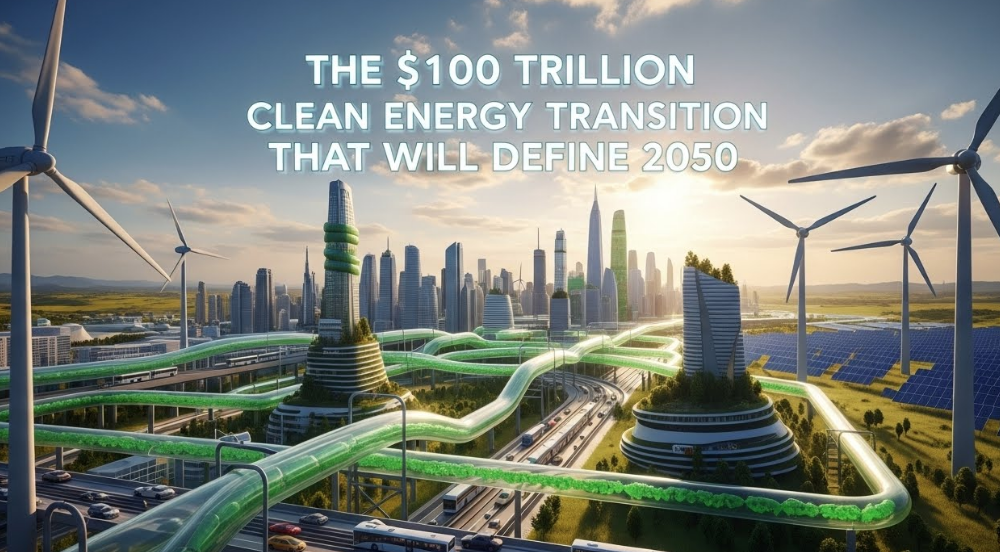
Clean Energy: $100 Trillion Through 2050
Transitioning global energy system from fossil fuels to renewables requires $100+ trillion investment through 2050. This creates opportunities across entire value chain: Solar panel manufacturing, wind turbine production, battery manufacturing, grid infrastructure, energy storage, smart grid technology, EV charging networks, and more.
Early movers capturing market share: Tesla (EVs, batteries, solar), NextEra Energy (renewable utilities), Ørsted (offshore wind), First Solar (solar panels), Enphase (solar inverters). Stock performance: Many up 200-800% over decade.
Individual investors access through: Renewable energy ETFs (ICLN, TAN, FAN, etc.), individual stock purchase, green bonds, or renewable energy infrastructure funds. Expected returns: 12-25% annually as sector grows.
Carbon Markets: $850 Billion → $6 Trillion
Carbon pricing expanding globally: EU ETS ($300B annually), China national market ($100B+), California/Quebec, others. Carbon prices rising: EU permits went from €20/ton (2020) to €80-100/ton (2024), projected €150+/ton by 2030.
This creates opportunities: Companies reducing emissions sell credits (profitable). Carbon offset projects (reforestation, carbon removal) generate credits. Trading platforms facilitating carbon markets growing rapidly. Investment funds focused on carbon credits seeing 20-40% annual returns.
Renewable Energy Jobs: 12M → 40M+ by 2030
Clean energy sector already employs 12 million globally (solar, wind, EV, battery, efficiency sectors). Growing faster than economy overall: 7-10% annual job growth versus 2% for overall employment.
Job types and salaries:
- Solar installers: €35,000-55,000 (short training required)
- Wind technicians: €40,000-65,000 (technical degree)
- Energy engineers: €60,000-110,000 (engineering degree)
- Climate data scientists: €70,000-140,000 (data science background)
- Carbon market analysts: €60,000-120,000 (finance + environmental knowledge)
- EV engineers: €70,000-130,000 (electrical engineering)
Green Buildings: $350 Billion Market
Building efficiency, green construction, LEED certification creating massive market. Green buildings show 10% rent premiums, 8% higher property values, 20% lower operating costs, higher occupancy rates.
Investment opportunities: Green building materials companies, efficiency technology firms, LEED consultants, green real estate funds. Market growing 10% annually.
ACTIVITY 4: The 30-Day Carbon Reduction Challenge
Systematically reduce carbon footprint over 30 days:
Week 1: Transportation (Target: 30% reduction)
- Day 1-2: Calculate current transportation emissions
- Day 3-4: Plan alternatives (bike, walk, public transit for short trips)
- Day 5-6: Combine car trips, carpool when possible
- Day 7: Track weekly reduction, celebrate wins
Week 2: Energy (Target: 25% reduction)
- Day 8-10: Switch to LED bulbs, lower thermostat 2°C
- Day 11-13: Unplug devices, use power strips, reduce phantom load
- Day 14: Research solar quotes or renewable energy supplier
Week 3: Food (Target: 40% reduction)
- Day 15-17: Reduce meat consumption 50%
- Day 18-20: Buy local and seasonal produce
- Day 21: Plan meals, reduce food waste to near zero
Week 4: Consumption (Target: 35% reduction)
- Day 22-24: Buy nothing new (except essentials)
- Day 25-27: Repair instead of replace, buy secondhand
- Day 28-30: Calculate total footprint reduction, share results
Expected Results:
- Starting footprint: ___ tons CO₂/year
- 30-day reduction: 30% average = ___ tons reduced
- Annual savings: €500-2,000 (energy, transport, consumption)
- Environmental impact: ___ tons × €80/ton carbon price = €___ value created
Share on social media: #CarbonReductionChallenge
Time commitment: 30-60 min daily for 30 days
Financial benefit: €500-2,000 annual savings
Carbon reduction: 30-50% of footprint (3-8 tons annually)
The Crisis Reality: Time Is Running Out
CO₂ at 420ppm: Highest in 3+ Million Years
Atmospheric CO₂ reached 420 parts per million in 2024—highest level since Pliocene epoch 3+ million years ago (when sea levels were 20 meters higher and Arctic was ice-free). We’ve increased CO₂ 50% since pre-industrial 280ppm. And rising 2-3 ppm annually.
This drives climate change: 1.2°C warming already (drought, floods, wildfires, heat waves all intensifying). On track for 2.5-3°C by 2100 without dramatic emissions cuts (catastrophic impacts). Need to limit warming to 1.5°C requiring net-zero emissions by 2050.
Timeline: Next 10 years (2026-2035) determine whether we stabilize climate or trigger runaway warming.
Air Pollution: 7 Million Deaths Annually
Air pollution kills 7 million people yearly making it larger killer than smoking, car accidents, or HIV/AIDS. 92% of humanity breathes air exceeding WHO safety guidelines. Developing countries hit hardest but developed countries not immune (LA, Paris, London all have bad air days).
Economic cost: $8 trillion annually (10% of global GDP) in healthcare, lost productivity, premature death. This is pure economic waste—eliminated through clean energy transition.
Tipping Points Approaching
Several climate tipping points approaching: Amazon rainforest shifting from carbon sink to carbon source. Atlantic meridional overturning circulation weakening (disrupts weather globally). Arctic sea ice disappearing. Permafrost thawing releasing massive methane. Each tipping point triggers cascade effects making others more likely.
Crossing these points creates irreversible change on human timescales. And we’re approaching them faster than predicted. Timeline: Some tipping points possible within 10-20 years if emissions don’t drop dramatically.
ACTIVITY 5: The Climate Investment Strategy Builder
Position portfolio for $100T energy transition:
Current Portfolio Climate Assessment:
- Fossil fuel exposure: €___ (__%)
- Clean energy exposure: €___ (__%)
- Climate-neutral investments: €___ (__%)
Stranded Asset Risk:
- Fossil fuel investments likely lose 30-70% by 2040
- Your potential loss: €___ × 50% = €___
Climate-Positive Portfolio Options:
Conservative (Lower Risk, 10-15% Returns):
- 40%: Clean energy utilities (NextEra, Ørsted, Iberdrola)
- 30%: Renewable energy ETFs (ICLN, TAN)
- 20%: Green bonds
- 10%: Cash/stable ESG funds
Moderate (Medium Risk, 15-22% Returns):
- 30%: Solar companies (First Solar, SunPower, Enphase)
- 25%: Wind energy (Vestas, Siemens Gamesa, Nordex)
- 20%: EV sector (Tesla, BYD, ChargePoint)
- 15%: Battery technology (QuantumScape, Solid Power)
- 10%: Carbon removal companies
Aggressive (Higher Risk, 20-35% Returns):
- 35%: Clean energy growth stocks
- 25%: Climate tech startups (via VC funds if accessible)
- 20%: Carbon credit funds
- 15%: Green hydrogen companies
- 5%: Experimental (fusion, advanced storage)
10-Year Projections: €10,000 conservative @ 12% = €31,058 €10,000 moderate @ 18% = €52,338 €10,000 aggressive @ 25% = €93,132
Plus: Climate impact (contributing to emissions reduction)
Time to complete: 30 minutes
Action: Reallocate investments away from fossil fuels toward clean energy
Expected return: 12-35% annually + climate impact
The Bottom Line: Clean Air = Wealth + Life Extension
Every breath in polluted air costs you money and lifespan. Every ton of CO₂ creates future damage costs. And the atmosphere is approaching tipping points that could make Earth uninhabitable.
The value propositions are staggering:
Clean energy: $100 trillion opportunity through 2050. Carbon markets: $850B → $6T by 2030. Clean air health savings: $8 trillion annually. Renewable energy jobs: 12M → 40M+ by 2030. Green tech: 15-35% annual returns. Property premiums: 10-15% in clean air zones. Individual health gains: 1-2 years life expectancy worth €200K-500K.
The timeline is critical:
Next 10 years determine climate future. Tipping points approaching. Air pollution killing 7M annually. But technology exists to solve this: Renewables cheaper than fossils. EVs reaching price parity. Carbon removal becoming viable. Everything needed for transition available now.
The opportunity is massive:
Position portfolio for energy transition (12-35% returns). Pursue clean energy careers (€35K-140K salaries). Install home efficiency and solar (15-30x ROI over 25 years). Move to clean air zones (10-15% property premium). Support carbon pricing policies.
Clean atmosphere equals healthy humans, stable climate, and enormous wealth creation. Protect it or lose everything.
🌍💨⚡