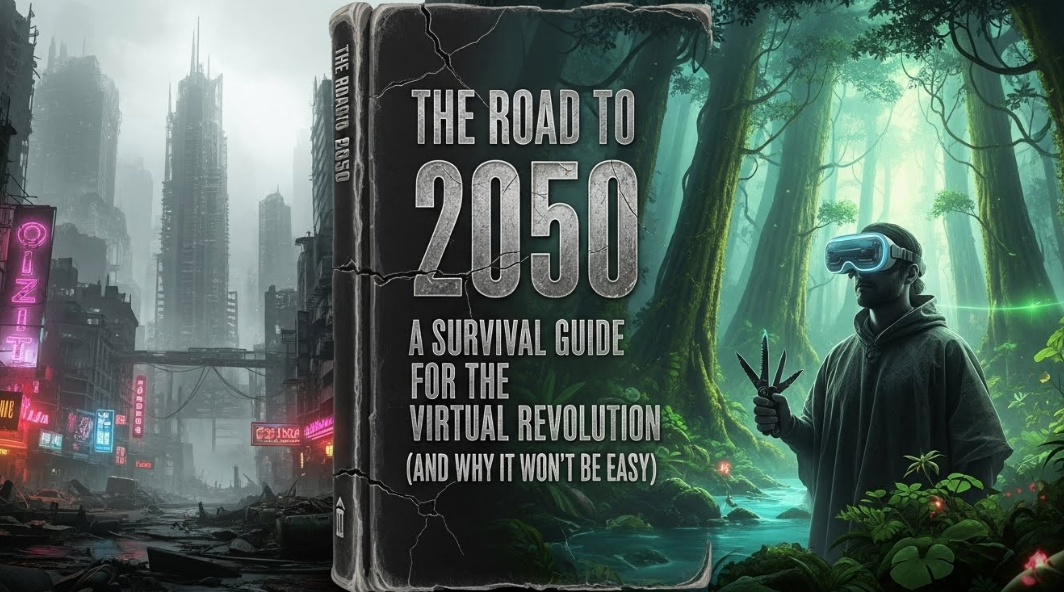
So you’ve read about the glorious virtual future of 2050. Sounds amazing, right? Remote surgery through robots, carbon emissions dropping like a rock, shopping in virtual malls while wearing your pajamas. Sign me up!
But here’s the thing nobody likes to talk about: getting from here to there is going to be messy, expensive, and occasionally ridiculous. Think of it like the difference between watching videos of someone completing a marathon and actually running one yourself. Sure, the finish line looks great. But mile 18? That’s where things get ugly.
Let’s talk about what’s really going to happen between now and 2050, the roadblocks we’ll hit, the mistakes we’ll make, and why some of us will want to throw our VR headsets out the window at least once a decade.
Phase 1: The Awkward Years (2026-2030)
The Hardware Headache
Right now, in early 2026, VR and AR headsets are… well, they’re not great. Sure, Meta’s Quest 3 is pretty decent at $499, and Apple’s Vision Pro exists if you’ve got a spare $3,500 lying around. But here’s the brutal truth: most people aren’t buying them.
Why? Let’s count the reasons:
They’re still too expensive. Even at $499, that’s a significant chunk of change for most families. And that’s just the entry-level device. Want something with real power and comfort? You’re looking at $1,000 or more. For comparison, that’s about the same as a decent smartphone, except your smartphone is actually essential to daily life and this… makes virtual meetings slightly more awkward.
They’re uncomfortable. Wear one for more than 30 minutes and you’ll understand. The weight on your face, the pressure on your nose, the heat building up around your eyes. It’s like wearing ski goggles while sitting in a sauna. Current adoption shows people use VR for about 30-45 minutes at a time, two to four times a week. Know why? Because that’s about all they can stand.
Motion sickness is real. Studies show nearly 58% of users experience motion sickness at least sometimes. Imagine trying to convince your boss that virtual meetings are the future while you’re fighting the urge to vomit.
Lack of content. This is the classic chicken-and-egg problem. People won’t buy headsets because there’s not enough to do with them. Companies won’t create content because not enough people have headsets. It’s a frustrating stalemate, and surveys show 27% of businesses cite this as the biggest barrier to adoption.
The “why bother” factor. For most people, their smartphone and laptop work just fine. A VR headset feels like a luxury toy, not a necessity. And you know what? Right now, they’re not wrong.
Between 2026 and 2030, expect slow, grinding progress. Headsets will get slightly cheaper, slightly lighter, and slightly more comfortable. We’ll see incremental improvements, not revolutionary breakthroughs. By 2030, maybe we hit 100-150 million regular users globally. Sounds like a lot until you remember there are 8 billion people on Earth.
This is the phase where early adopters will love it, tech enthusiasts will defend it passionately online, and everyone else will wait to see if it becomes actually useful.
The Connectivity Crisis
Here’s something they don’t mention in the glossy metaverse marketing: all these virtual worlds need insane amounts of bandwidth and processing power. The data centers alone will require enough electricity to power small countries.
5G is rolling out, but it’s patchy. Rural areas? Forget it. Developing countries? They’re barely getting reliable 4G. The “metaverse for everyone” promise hits a brick wall called “infrastructure inequality.”
And then there’s the energy question. Remember how we said virtual worlds could reduce carbon emissions? That only works if we power the data centers with renewable energy. Right now, many are still running on fossil fuels. Some studies suggest the energy demands could actually increase carbon emissions in the short term before the benefits kick in.
So between 2026 and 2030, expect articles about “the metaverse’s dirty secret” and heated debates about whether we’re solving climate change or making it worse.
The Content Desert
Let’s be honest: most early metaverse experiences will be… not great. Gaming will be the exception—gamers are used to immersive experiences and they’ve got the hardware. But educational metaverses? Healthcare applications? Professional collaboration spaces?
They’ll exist. They’ll be clunky. Universities will experiment with virtual campuses that feel more like ghostly tech demos than bustling academic centers. Companies will try virtual offices where avatars awkwardly float around conference rooms while everyone secretly wishes they were just on a regular video call.
The problem isn’t technology; it’s that we’re still figuring out what works. Remember early smartphones? The first apps were basically just mobile versions of websites. It took years before developers understood what mobile could really do. Same deal here.
Phase 2: The Growing Pains (2030-2040)
The Interoperability Nightmare
By 2030, we’ll have dozens of metaverse platforms, and here’s the kicker: they won’t talk to each other. At all.
Imagine buying a cool avatar outfit in one metaverse, then discovering you can’t wear it anywhere else. Or earning virtual currency in a gaming metaverse that’s completely worthless in an education metaverse. Or having different avatars for each platform because they use incompatible standards.
This is where things get truly frustrating for users. You’ll need multiple accounts, multiple avatars, multiple digital wallets. It’ll be like having a different email address for every website you visit. Technically possible, but infuriatingly inconvenient.
The Metaverse Standards Forum, founded back in 2022, is trying to solve this. Over 1,800 companies have signed on. They’re working on standards for avatars, 3D objects, virtual worlds, identity management, and economic systems. It’s noble work, but also agonizingly slow.
Why? Because every company has different incentives. Meta wants you locked into their ecosystem. Microsoft wants you in theirs. Apple definitely wants you in theirs. They’ll talk about “open standards” in press releases while their lawyers work overtime to protect their competitive advantages.
By 2035, we’ll start seeing some interoperability—probably for basic avatars and simple virtual goods. But full, seamless movement between metaverses? That’s still years away. The technical challenges are immense:
Identity standards: How do you prove you’re you across different platforms without giving up privacy?
Asset compatibility: That photorealistic avatar rendering in one metaverse might crash another platform with different graphics capabilities.
Economic systems: How do you create exchange rates between virtual currencies? What prevents fraud and money laundering?
Behavioral standards: Different platforms have different rules. What’s acceptable in a gaming metaverse might be banned in an educational one.
This decade will be marked by frustration, fragmentation, and fierce competition. Users will complain. Developers will complain. Everyone will complain. But slowly, painfully, standards will emerge.
The Privacy Nightmare
Here’s something that’ll keep you up at night: VR and AR systems collect insane amounts of data about you. Not just what you click on, but how you move, where you look, how long you hesitate, your emotional responses, your physical reactions.
Eye-tracking data reveals what captures your attention. Haptic feedback shows how you interact with objects. Biometric sensors monitor your heart rate and stress levels. Motion tracking records every gesture, every stumble, every unconscious movement.
This isn’t hypothetical. This is happening now. And by the 2030s, when millions more people are using these systems daily, the privacy implications become terrifying.
Who owns this data? Who can access it? Can your employer monitor your productivity in virtual offices? Can advertisers track your unconscious reactions to products? Can insurance companies adjust rates based on your stress responses? Can governments surveil your virtual activities?
The 2030s will see major privacy battles. Expect data breaches that make current ones look quaint. Expect scandals about companies selling biometric data. Expect calls for regulation and fierce debates about balancing innovation with protection.
Europe will probably lead with GDPR-style regulations for the metaverse. The US will… well, the US will argue about it for a decade before doing something halfway. China will impose strict controls with different priorities. And the result will be a fractured regulatory landscape that makes compliance a nightmare for global platforms.
The Digital Divide Deepens
Remember that promise about democratizing access? Here’s the uncomfortable truth: in the 2030s, the metaverse might actually increase inequality rather than reduce it.
The people who benefit most will be those who can afford high-end equipment, fast internet, and time to learn new systems. Those already disadvantaged—people in developing countries, rural communities, low-income families—will be left further behind.
Sure, smartphone-based AR will be accessible. But the truly transformative experiences—the ones that reshape education, healthcare, and work—will require expensive hardware and robust connectivity.
This creates a two-tier system. The haves get virtual access to world-class education, cutting-edge healthcare, and global job opportunities. The have-nots get… limited experiences that don’t fundamentally change their circumstances.
By 2040, this will be a major political issue. Expect calls for public investment in metaverse infrastructure, debates about treating internet access (including metaverse-quality bandwidth) as a human right, and proposals for government-subsidized hardware.
Some countries will make progress. Others won’t. And the gap between them will be visible, measurable, and embarrassing.
Phase 3: The Maturation (2040-2050)
Things Actually Start Working
By 2040, we’re finally getting somewhere. Headsets are light, comfortable, and affordable. Most households in developed countries own at least one. Battery life is measured in days, not hours. Motion sickness is largely solved through better frame rates and predictive rendering.
Interoperability standards are… functional, if not perfect. You can use the same avatar across many major platforms. Virtual goods have established value and exchange mechanisms. Identity management works smoothly most of the time.
The content ecosystem is mature. You have compelling reasons to use VR/AR beyond gaming:
Education: Virtual campuses feel alive. You can attend lectures from anywhere, collaborate with students globally, and access learning experiences impossible in physical classrooms. Medical students perform virtual surgeries that feel real. History students walk through ancient Rome that’s been reconstructed with archaeological accuracy.
Healthcare: Telemedicine has evolved into genuinely useful virtual consultations. Therapists conduct sessions in calming virtual environments. Physical therapy uses gamified VR to improve patient engagement and outcomes. The healthcare applications that seemed gimmicky in 2030 are now standard practice.
Work: Remote work through metaverse platforms is normalized. You “go to” a virtual office that feels more natural than video calls. Collaboration tools actually enhance productivity rather than hindering it. Companies have figured out what works and what doesn’t.
Retail: Virtual shopping has evolved beyond gimmick status. You can examine products in detail, get personalized recommendations, and make purchases with confidence. Returns have decreased because virtual try-ons are accurate.
This is the decade where the metaverse moves from “interesting technology” to “infrastructure.” It becomes like electricity or the internet—something we use without thinking about it much.
The Robot Integration Revolution
By the mid-2040s, the combination of virtual presence and physical robots reaches critical mass. This is the game-changer that earlier decades promised but couldn’t deliver.
Telepresence robots are affordable, reliable, and everywhere. Eldercare becomes genuinely practical—family members anywhere in the world provide physical assistance through home robots. Remote surgery is routine. Manufacturing operates with human expertise controlling robots globally.
The sustainability benefits start showing up in measurable ways. Business travel plummets. Physical retail continues shrinking as virtual shopping (enhanced by robotic hands for those who want to touch fabrics and products) becomes the norm. Office buildings are repurposed. Commuting becomes optional for most knowledge workers.
But this creates new challenges:
Job displacement: Many physical jobs can now be done remotely through robots, which means labor markets become truly global. A construction robot in Dubai might be operated by an expert in Brazil. This is great for the expert in Brazil but potentially devastating for local workers. The political tensions around this will be intense.
Maintenance infrastructure: Billions of robots need maintenance, repair, and eventual recycling. This creates jobs, but also enormous waste management challenges if not handled properly.
The authenticity question: When you’re interacting with someone through a robot, is it really them? When you’re shopping through a robot’s hands, is it really you? These philosophical questions have real practical implications for law, ethics, and human experience.
The Finance Hybrid Actually Works
Remember all that speculation about DeFi versus CeFi? By 2045, the dust has settled into something pragmatic.
Gaming and entertainment metaverses run primarily on blockchain-based economies. True ownership of digital assets is the norm. Play-to-earn models have evolved into legitimate economic opportunities for some people (though not the get-rich-quick scheme promoters promised in the 2020s).
Healthcare, education, and government remain primarily centralized for accountability and regulatory compliance. Some blockchain elements exist for record-keeping and verification, but the core transactions flow through traditional financial systems.
Retail is genuinely hybrid. You pay with whatever method is convenient. The backend sorts it out. You don’t need to think about whether you’re using CeFi or DeFi—it just works.
The energy concerns about blockchain have largely been addressed through more efficient consensus mechanisms. Proof-of-stake and similar approaches use a fraction of the energy of early proof-of-work systems.
But here’s what nobody predicted: a lot of virtual economic activity happens outside both DeFi and traditional finance. Gift economies, reputation systems, and alternative value mechanisms have emerged organically in virtual communities. Not everything that matters can be bought or sold, even in virtual worlds.
The Sustainability Reckoning
By 2050, we have real data about whether the metaverse helped or hurt the planet. The verdict is… complicated.
The wins:
- Business travel dropped by about 60%
- Commuting reduced by 40% for knowledge workers
- Physical retail square footage decreased by 35%
- Educational infrastructure needs significantly reduced
- Manufacturing and design processes became more efficient through digital twins
The losses:
- Data center energy consumption increased dramatically
- E-waste from obsolete VR/AR devices piles up
- Manufacturing virtual hardware required significant rare earth minerals
- Some people spent more, not less, because consumption became too easy
The net effect depends entirely on how we powered those data centers. Countries that went all-in on renewable energy see genuine benefits. Countries that didn’t find their metaverse infrastructure is a carbon nightmare.
This leads to massive political pressure for clean energy. Some countries mandate renewable energy for data centers. Others impose carbon taxes on high-compute virtual activities. The metaverse becomes a key battleground in climate policy.
The Big Picture: What We Learned the Hard Way
As we hit 2050, here are the lessons that took 25 years of trial, error, and occasional disaster to learn:
Technology adoption is always slower than optimists predict and faster than pessimists expect. The metaverse didn’t revolutionize everything by 2030, but it also didn’t fade away like some critics predicted.
Hardware matters more than we thought. All the software innovation in the world doesn’t matter if wearing the headset gives you a headache. The 2030s were largely spent making devices people could actually stand to use.
Interoperability can’t be optional. The fragmentation of the early years nearly killed the metaverse. Once we got serious about standards, adoption accelerated.
Privacy isn’t a feature; it’s a requirement. The scandals and backlashes of the 2030s forced companies to take data protection seriously, whether they wanted to or not.
Sustainability requires planning, not hope. The early assumption that virtualization automatically means sustainability was naive. It required deliberate choices about energy sources, hardware lifecycles, and consumption patterns.
Inequality doesn’t solve itself. Left to market forces alone, the metaverse increased rather than decreased disparities. Addressing this required active intervention through policy, public investment, and deliberate inclusion efforts.
Humans need physicality. One of the biggest surprises: even with perfect virtual experiences, people still craved physical presence for certain activities. The future isn’t entirely virtual; it’s hybrid in ways we didn’t expect.
Job displacement is real but not apocalyptic. Yes, many jobs changed or disappeared. But new ones emerged. The transition was painful for many people, requiring significant retraining and social support.
The killer apps weren’t what we expected. In 2025, everyone focused on gaming and entertainment. By 2050, the most transformative applications were in healthcare, education, and accessibility—areas that seemed boring in the early hype cycles.
The Road Ahead After 2050
By 2050, the metaverse isn’t finished; it’s just mature. The technology that seemed revolutionary in 2025 will seem quaint. New challenges will emerge. New opportunities will present themselves.
The integration of brain-computer interfaces is starting to blur the line between thought and action. AI assistants in virtual worlds are becoming more sophisticated and raising new questions about consciousness and identity. The distinction between human and artificial intelligence is getting fuzzy in ways that make ethicists nervous.
But here’s the thing: we got through the hard part. The infrastructure exists. The standards work. The regulatory frameworks are in place. The sustainability challenges are being addressed.
Was it worth it? That depends on who you ask and where they are. For people with disabilities who gained access to experiences previously impossible, absolutely. For workers displaced by remote automation, maybe not. For the planet, the jury’s still out.
The metaverse of 2050 isn’t the utopia promised in 2025. It’s messier, more complicated, more political. It’s shaped by corporate interests, government regulations, and cultural conflicts. It’s not evenly distributed. It’s not perfect.
But it’s also genuinely useful in ways that matter. It expanded human capability. It connected people across distances. It created new possibilities for learning, healing, and working. It became part of life, not a replacement for it.
And if we’re lucky, we learned something important along the way: technology doesn’t solve problems by itself. It amplifies human choices. The metaverse of 2050 reflects the decisions we made—and continue to make—about what kind of future we want.
So here we are. The road was longer and harder than anyone admitted in 2025. The destination isn’t quite where we thought we were heading. But we made it.
Now comes the part where we figure out what to do with it.
The Reality Check
If you’re reading this in 2026, understand: the next 25 years won’t be smooth. You’ll see false starts and dead ends. You’ll see companies pour billions into projects that flop. You’ll see regulatory fights that seem to go nowhere. You’ll see technology that promises everything and delivers headaches.
But you’ll also see incremental progress compound into genuine transformation. You’ll see problems get solved. You’ll see new possibilities emerge. You’ll see people adapt and innovate in ways nobody predicted.
The road to 2050 is messy. But that’s okay. The best technologies always are.
Just… maybe hold off on throwing away your regular laptop quite yet. You’re going to need it.