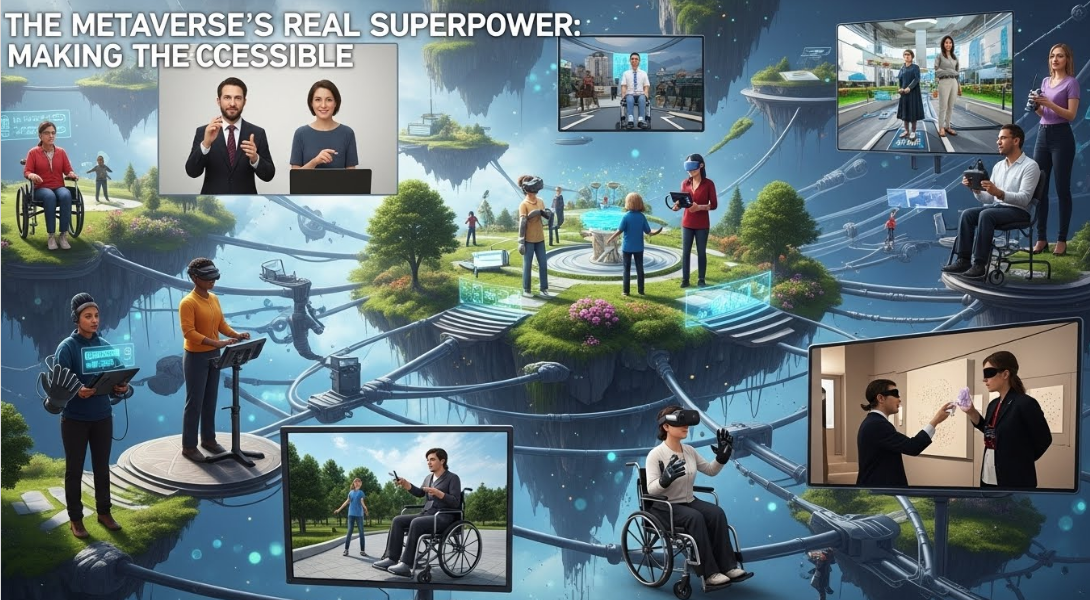
Forget the virtual sneakers. Forget the NFTs. Forget the corporate virtual offices.
The metaverse’s most powerful value proposition isn’t about making money or selling products or hosting virtual meetings. It’s about something far more fundamental: making the world accessible to everyone, regardless of physical ability or mental health condition.
And here’s the kicker: this isn’t some distant future promise. It’s already happening. We just haven’t been paying attention.
Part 1: The Disability Inclusion Revolution
The Problem We’re Not Talking About
Right now, in 2026, the physical world systematically excludes over 1 billion people with disabilities. That’s 15% of the global population. Let that sink in.
Can’t leave your house because of mobility issues? You miss concerts, museums, social events, job opportunities. Vision impaired? Most digital content is still inaccessible despite decades of web standards. Deaf or hard of hearing? Good luck at most live events or in most virtual meetings. Social anxiety or autism? Face-to-face interactions in unfamiliar places are often overwhelming. Chronic pain or fatigue? Standing in line, traveling to venues, physical presence itself becomes a barrier.
The physical world was built without considering everyone. And it shows.
What the Metaverse Actually Offers
Now imagine this instead:
Sarah has cerebral palsy. She uses a wheelchair and has limited hand mobility. In the physical world, she can’t access most buildings, can’t travel easily, can’t participate in many social activities.
In the metaverse? She’s limited only by her imagination. She designs an avatar that can run, dance, and climb mountains. She attends virtual concerts where she experiences music with her friends. She works remotely in immersive spaces designed from the ground up to be accessible. She explores virtual museums in Paris, Tokyo, and Cairo—all from her home.
The barriers of the physical world simply don’t exist.
Marcus has severe social anxiety and is on the autism spectrum. Crowded spaces overwhelm him. Unpredictable social interactions trigger panic attacks. He’s been isolated for years.
In the metaverse, he controls everything. He can adjust sensory inputs like turning down sounds or reducing visual complexity. He creates a safe zone that protects him from unexpected interactions. He practices social skills in controlled environments, connects with others who understand his experiences, and participates in communities without the physical presence that triggers his anxiety.
For the first time in his life, he has a social life on his own terms.
Jennifer is deaf. In the physical world, most events lack proper sign language interpretation. Captions are an afterthought. She constantly feels like she’s missing information.
In the metaverse? Everything can have real-time sign language avatars, customizable caption size and contrast and position, visual alerts for sounds, spatial audio that she can feel through haptic feedback, and community spaces designed by and for deaf users.
She’s not accommodated. She’s included from the start.
The Data Actually Backs This Up
Research from 2024 shows what’s possible when accessibility is built in from the beginning:
Current State of Metaverse Accessibility (based on expert analysis):
Customizable sensory controls allow users to adjust visual contrast, sound direction and volume, and caption formatting. Remote accessibility services enable sign language interpretation, virtual guides, and personalized assistance. Physical barriers are eliminated since there are no stairs, no inaccessible buildings, and no transportation limits. Assistive technologies can be integrated directly into the platform, and social pacing allows users to control interaction intensity.
But Here’s the Problem: Most metaverse platforms are repeating the same mistakes.
A 2024 comprehensive study found that despite significant potential, the metaverse shows “notable gaps, especially in integrating assistive technologies and ensuring interoperability across different virtual environments.”
Translation: We’re screwing this up AGAIN.
What Needs to Happen
The research is clear on what makes an accessible metaverse:
1. Active Involvement of People with Disabilities Not consultation. Not feedback. Active co-design. People with disabilities must be involved from day one in platform development This isn’t charity. It’s essential for actually solving real problems.
2. Universal Design Principles Build for everyone from the start, not as an afterthought Flexibility in sensory presentation (visual, auditory, haptic) Multiple ways to navigate and interact Customization as a core feature, not an add-on
3. Interoperability Standards Assistive technologies must work across platforms If an accessibility solution only works on one metaverse, it’s useless Cross-platform accessibility standards are non-negotiable
4. Regulatory Frameworks Anti-discrimination laws must extend to virtual spaces Platforms must meet accessibility requirements to operate Enforcement mechanisms need teeth
5. Cultural Shift in Development Designer biases create inaccessible products Unconscious stereotypes about disability get baked into code Teams must be diverse, or the product will exclude
The Real-World Impact
When done right, the benefits are transformative:
Employment Access: People with disabilities face 50%+ unemployment rates globally Remote work in accessible virtual environments eliminates physical barriers Skills matter, not whether you can climb stairs to an office
Education Without Borders: Students with mobility issues can access any virtual campus Sensory accommodations are instant and personalized Learning materials adapt to individual needs automatically
Social Connection: Isolation is one of the biggest challenges for people with disabilities Virtual communities provide connection without physical barriers Shared experiences that were impossible before become routine
Creative Expression: Artists with physical disabilities can create in ways the physical world doesn’t allow Musicians who can’t play traditional instruments can compose in virtual spaces The limits are imagination, not physical capability
The Companies Getting It Right (and Wrong)
Meta’s Efforts (Yes, Even After Their Struggles): Partnered with disability advocates for co-design Built in accessibility features like voice commands, customizable environments, “Safe Zone” protections Sponsored the Inclusive Metaverse Index to measure accessibility globally Created 45 Accessibility Centers worldwide
But they still struggle with bulky headsets, limited assistive tech integration, and accessibility being separate from core design.
Accenture’s Approach: Created “Immersive Metaverse Experience Tours” specifically designed with and for people with disabilities Employs people with disabilities in software engineering and design roles Treats accessibility as innovation driver, not compliance burden
The Failures: Most blockchain metaverses have ZERO accessibility consideration NFT-based platforms are often completely inaccessible to screen readers “Move fast and break things” culture breaks accessibility every time
The Opportunity Cost of Getting This Wrong
Here’s what we lose if the metaverse isn’t accessible:
Economic Loss: 1+ billion potential users excluded from the digital economy Trillions in lost productivity and innovation Massive untapped market for accessible experiences
Social Loss: Continued isolation for people with disabilities Missed connections, collaborations, friendships Cultural contributions that will never happen
Technological Loss: Innovations that people with disabilities would create Solutions to problems we haven’t solved yet Perspectives that make technology better for everyone
Moral Failure: We’re building a new world and choosing to exclude 15% of humanity Again.
Part 2: Mental Health’s Virtual Revolution
Now let’s talk about the other massive human value proposition: mental health treatment.
The Mental Health Crisis Nobody’s Solving
The stats are brutal: Mental health disorders affect 1 in 4 people globally Depression and anxiety increased 25% during COVID-19 Most people with mental health conditions never receive treatment In many countries, the ratio of patients to mental health professionals is 1,000,000:1
Traditional mental health care is: Expensive (who can afford $150/session weekly?) Inaccessible (try finding a therapist with availability) Stigmatized (people avoid seeking help) Limited by geography (rural areas have almost no providers) Not scalable (training therapists takes years)
And here comes the metaverse with some genuinely revolutionary solutions.
What’s Actually Working Right Now
Let’s look at real clinical applications that are showing results:
VR Exposure Therapy for Anxiety and PTSD:
A 2022 randomized controlled trial published in Lancet Psychiatry found that automated VR therapy significantly reduced agoraphobic avoidance and distress in patients with psychosis.
How it works: Patients gradually expose themselves to anxiety-triggering situations in safe, controlled virtual environments The therapist (or AI) adjusts scenarios in real-time based on patient responses Patients can practice coping strategies without real-world consequences Progress is measurable and trackable
Results: Patients showed significant improvement in anxiety management and willingness to engage in previously avoided situations.
Social Skills Training for Autism Spectrum Disorders:
Metaverse-based social skills programs for children with autism have shown significant improvements in social interaction abilities.
Why it works: Predictable, controlled environment reduces anxiety Visual cues can be exaggerated to aid understanding Social scenarios can be repeated until mastered Safe practice without real-world social consequences Immediate feedback and adjustment
Current Clinical Applications (from 2024-2025 research):
NightWare (FDA-cleared): Treats PTSD-related nightmares using smart devices that detect nightmares and intervene with gentle vibrations.
Freespira: Digital therapeutic for panic disorder and PTSD that uses biofeedback to teach breathing techniques.
EndeavorRx: FDA-authorized prescription video game treatment for ADHD in children.
Sleepio: Evidence-based digital therapeutic for chronic insomnia using cognitive-behavioral therapy.
Dance Movement Therapy in VR: Shows promise for treating depression and anxiety through embodied movement in immersive spaces.
Why Virtual Mental Health Actually Works
The research identifies several key advantages:
1. Accessible and Scalable: Available anywhere with internet Can serve thousands simultaneously Much lower cost than traditional therapy No geographic limitations
2. Reduces Stigma and Barriers: Anonymity through avatars reduces shame No one sees you walking into a therapist’s office Can be done from the safety of home Particularly valuable for populations where mental health is stigmatized
3. Enhanced Therapeutic Presence: Immersive environments create genuine emotional engagement Presence in virtual scenarios activates similar brain regions as real experiences Exposure therapy is more effective when it FEELS real
4. Personalization and Control: Environments adapt to individual needs Pacing controlled by patient Sensory inputs can be customized Progress tracking is automatic and detailed
5. Transfer to Real Life: Skills practiced in virtual environments transfer to real-world situations The brain doesn’t fully distinguish between virtual and real experiences for learning purposes Repeated practice in VR builds real neural pathways
The Specific Mental Health Applications
Let’s break down where this actually works:
Anxiety Disorders (Proven Effective): Phobias (heights, flying, social situations, spiders, etc.) Panic disorder Agoraphobia Social anxiety
PTSD and Trauma (Strong Evidence): Combat-related PTSD Sexual assault trauma Accident survivors Childhood trauma
Autism Spectrum Disorders (Promising Results): Social skills training Sensory regulation Communication practice Routine building
Depression (Mixed Evidence, But Potential): Behavioral activation through engaging activities Social connection and community Physical activity through VR exercise Mindfulness and meditation
Eating Disorders (Early Research): Body image work through avatar representation Exposure to food-related anxiety Cognitive restructuring
Addiction (Under Investigation): Cue exposure and response prevention Social support communities Alternative activities and coping strategies
Schizophrenia (Limited But Interesting): Avatar therapy where patients confront auditory hallucinations Social skills training Reality testing in controlled environments
The Generation Z Connection
This matters particularly for Gen Z (born mid-1990s to early 2010s), who: Show the highest rates of anxiety and depression of any generation Are digital natives comfortable with virtual environments Face unprecedented academic pressure and stress Experience more social isolation despite (or because of) social media Are the primary target demographic for metaverse platforms
Virtual mental health care meets them where they already are: in digital spaces.
The Aging Population Opportunity
On the flip side, the metaverse can address challenges for older adults: Reduced social isolation (major factor in elderly mental health decline) Accessibility for those with mobility limitations Cognitive stimulation through engaging activities Chronic disease management through virtual support groups Connection with family despite geographic distance
The Critical Challenges (Because Nothing’s Perfect)
1. Efficacy Evidence Gap: Most metaverse-based mental health interventions lack rigorous clinical trials We know VR therapy works for some conditions, but metaverse-specific applications need more research Long-term effects are largely unknown
2. Privacy and Data Security: Mental health data is incredibly sensitive Biometric data collected by VR headsets (eye tracking, emotional responses) could be misused Encryption and protection standards must be ironclad
3. Digital Divide: Those who most need mental health care often can’t afford VR equipment Internet connectivity requirements exclude rural and low-income populations Creating two-tier mental health system: high-tech for wealthy, nothing for poor
4. Lack of Human Connection: Some mental health work absolutely requires human-to-human presence AI therapists can’t replicate empathy and genuine human understanding Risk of over-reliance on technology replacing human care
5. Potential for Harm: Poorly designed interventions could worsen conditions Addiction to virtual escapes Avoidance behaviors becoming entrenched Misdiagnosis by AI systems
6. Regulatory Gaps: Mental health apps and VR treatments operate in poorly regulated space No consistent standards for efficacy or safety Who’s liable if virtual therapy harms someone?
7. Professional Skepticism: Many mental health professionals are understandably cautious “Move fast and break things” doesn’t work in healthcare Need for clinician-industry partnerships to develop responsible solutions
What Needs to Happen
Based on 2024-2025 research, here’s the path forward:
1. Clinician-Industry Partnerships: Tech companies must partner with mental health professionals Development must be guided by therapeutic principles, not just engineering Clinical trials before widespread deployment
2. Rigorous Research Standards: Randomized controlled trials for metaverse-based interventions Long-term outcome studies Comparison with traditional treatments Diverse population studies
3. Ethical Frameworks: Data privacy protections specifically for mental health data Informed consent protocols Right to delete data Transparency about AI decision-making
4. Regulatory Development: Standards for digital mental health interventions Certification processes for platforms Enforcement mechanisms Patient protection laws
5. Accessibility Guarantees: Subsidized access for low-income populations Multiple device options (not just expensive VR) Internet infrastructure investment Free or low-cost treatment options
6. Training for Professionals: Mental health clinicians need training in virtual therapeutic techniques Integration with traditional clinical education Understanding of technology limitations
7. Ongoing Monitoring: Track outcomes systematically Identify harms quickly Adapt based on real-world data Community feedback loops
Part 3: The Unified Value Proposition
Here’s why accessibility and mental health are THE killer apps for the metaverse:
1. Massive Underserved Markets: 1+ billion people with disabilities Hundreds of millions with mental health conditions These populations NEED these solutions Willingness to pay is high when solutions actually work
2. Clear, Measurable Impact: Unlike virtual sneakers, these applications have obvious real-world value Success is measurable in quality of life improvements Outcomes are meaningful and transformative
3. Positive Social Narrative: Technology serving human needs Inclusion rather than exclusion Healing rather than selling Progress that matters
4. First-Mover Advantage for Companies: Build loyalty with underserved populations Establish standards before competitors Create products that genuinely help people Marketing writes itself when you’re actually doing good
5. Innovation Driver: Solving for edge cases makes technology better for everyone Accessibility features benefit all users Mental health applications create genuinely engaging experiences Human-centered design creates better products
6. Sustainable Business Models: Healthcare spending is massive and growing Insurance will reimburse for effective treatments Governments will fund accessibility solutions Long-term user engagement when solutions actually work
The Bottom Line
Nike made millions selling virtual sneakers. Good for them.
But the metaverse’s real value isn’t in selling digital goods to people who already have everything. It’s in making the world accessible to people who currently can’t access it at all.
1 billion people with disabilities who could work, create, socialize, and thrive if the barriers were removed.
Hundreds of millions with mental health conditions who could receive treatment if it were accessible and affordable.
Billions who could benefit from more inclusive, empathetic, human-centered technology.
That’s the value proposition worth building toward.
Not because it’s profitable (though it can be).
Not because it’s trendy (though it might become so).
But because it’s the right thing to do.
And because, for once, the technology can actually deliver on that promise.
IF we build it right.
IF we involve the people who will use it.
IF we prioritize access over profit.
IF we create real solutions instead of hype.
The metaverse could be the most transformative accessibility and mental health technology in human history.
Or it could be another way to exclude and exploit vulnerable populations.
The choice is ours. And we’re making it right now, in 2026, with every design decision, every line of code, every business strategy.
Choose wisely.
Because unlike virtual real estate, this actually matters.
Resources and Next Steps
For People with Disabilities: Get involved in co-design processes Demand accessibility from platforms Share your experiences and needs Join disability advocacy organizations working in this space
For Mental Health Professionals: Learn about VR and metaverse therapeutic applications Partner with tech companies on responsible development Conduct research on efficacy and safety Advocate for proper regulation
For Developers and Companies: Hire people with disabilities on your teams Partner with disability organizations Follow universal design principles from day one Conduct accessibility audits regularly Prioritize user safety over growth
For Policymakers: Extend anti-discrimination laws to virtual spaces Require accessibility standards for metaverse platforms Fund research on therapeutic applications Invest in infrastructure to reduce digital divide Create regulatory frameworks that protect while enabling innovation
For Everyone: Learn about accessibility in digital spaces Support companies doing this right Call out platforms that exclude Remember that technology should serve all humans, not just some
The future is being built now. Make sure it includes everyone.