Why These Six Things Will Define Your Survival, Wealth, and Quality of Life by 2050
ACTIVITY: The 24-Hour Survival Test
Imagine you wake up tomorrow and one of these six things is gone. Not expensive. Not scarce. Completely gone.
Water: No tap water, no wells, no rivers. Nothing to drink.
Air: Toxic atmosphere. You can’t breathe outside without equipment.
Food: Empty supermarkets. Nothing growing. No supply coming.
Energy: No electricity. No fuel. No power of any kind.
Shelter: Your home disappears. No buildings exist. Nowhere to sleep.
Soil: All topsoil vanished. Nothing can grow. Ever again.
Which one kills you first? Water: 3 days. Air: 8 minutes. Food: 3 weeks. Energy: depends on climate (hours to weeks). Shelter: depends on weather (hours to weeks). Soil: 60 years as food runs out.
Now here’s the uncomfortable truth: All six are disappearing right now. Simultaneously. Globally.
Time to complete: 2 minutes
Cost: Free
What you learned: Everything you take for granted is becoming scarce, and you never even noticed
Welcome to the Critical Resources crisis. It’s not coming. It’s here.
You’ve heard about climate change. You’ve seen headlines about housing prices. You might have noticed your grocery bill increasing. But nobody’s connecting the dots globally.
These aren’t separate crises. They’re six interconnected catastrophes that will define everything about your life by 2050.
Water scarcity will hit 5 billion people. Air pollution already kills 7 million annually. Food costs are doubling. Energy prices are spiking. Housing is unaffordable for entire generations. And soil is disappearing faster than rainforests.
But here’s what the doom-and-gloom headlines miss: Every crisis is also the biggest opportunity in human history.
Why “Critical” Matters: The Foundation of Everything
What Makes a Resource “Critical”?
A critical resource has three characteristics:
1. Essential for Life: You literally cannot survive without it. Not luxury, not convenience—biological necessity or fundamental human need.
2. Becoming Scarce: Availability is declining while demand is increasing. The gap between supply and need is widening globally, not closing.
3. Hard to Replace: There’s no easy substitute. You can replace oil with solar, but you cannot replace water, air, or soil with anything else. When critical resources fail, civilization fails.
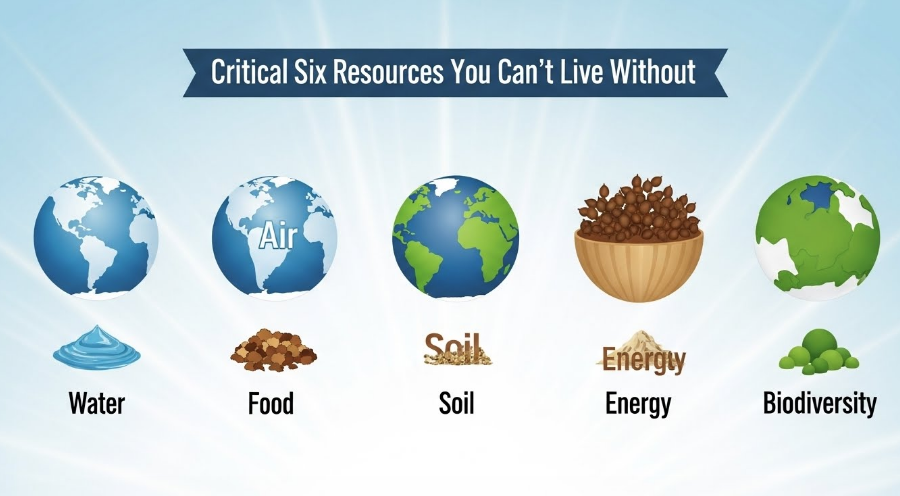
The Six Critical Resources:
Water – You die in 3 days without it. 5 billion people will face scarcity by 2050.
Air – You die in 8 minutes without it. 92% of humanity breathes polluted air now.
Food – You die in 3 weeks without it. Prices doubling, supply unstable globally.
Energy – Powers everything modern life requires. Costs spiking, grids failing worldwide.
Shelter – Essential for survival in most climates. Unaffordable for entire generation globally.
Soil – All food depends on it. Only 60 harvests remaining at current degradation rates worldwide.
These six resources form the foundation of human civilization. When any one fails, everything collapses.
The Perfect Storm: Why All Six Are Failing Simultaneously
The Interconnected Crisis
Here’s what makes this different from past challenges: Everything is connected.
Water scarcity → Affects food production (agriculture uses 70% of water) → Soil degradation worsens (dry soil erodes) → Energy production struggles (hydropower and cooling depend on water) → Drives migration creating housing pressure.
Air pollution → Causes 7 million deaths annually → Healthcare systems strained → Reduces agricultural yields → Drives property values creating housing inequality → Requires energy for purification systems.
Food scarcity → Drives prices up globally → Requires more agricultural land → Accelerates soil depletion → Increases energy use (fertilizers, transport) → Creates water stress (irrigation) → Causes migration straining housing.
Energy crisis → Increases costs of everything (food production, water treatment, heating/cooling homes) → Affects air quality (fossil fuels) → Limits food production (modern agriculture is energy-intensive) → Makes housing more expensive (heating/cooling costs).
Housing crisis → Concentrates people in cities → Increases energy demand → Worsens air quality (urban pollution) → Reduces land for food production → Creates water stress (urban consumption) → Paves over soil (urbanization).
Soil degradation → Reduces food production → Requires more fertilizers (energy-intensive) → Decreases water retention (increasing scarcity) → Reduces carbon sequestration (worsening climate) → Drives food prices → Creates migration pressure (housing).
You cannot solve one without addressing all six. They’re a system, not separate problems.
The Scarcity Timeline: What Happens When
The Next 25 Years Will Determine the Next 75
2026-2030: The Crisis Becomes Undeniable
Water: Half the world enters water stress. Major cities face “Day Zero” regularly from Cape Town to Chennai to Mexico City to São Paulo.
Air: Deaths reach 9 million annually. Wealthy people buying clean air systems like bottled water today. Property premiums for clean air zones expand globally.
Food: Prices increase another 30-40%. Climate-driven crop failures become annual events. Supply chain disruptions more frequent everywhere.
Energy: Electricity costs rise 25-40% globally. Grid blackouts routine in developing countries, spreading to developed nations. Solar becomes cheaper than grid everywhere.
Housing: Prices rise another 30-50% in major cities worldwide. Homeownership rate for under-35s drops below 25% in expensive cities. Multi-generational living becomes necessity globally.
Soil: Half of farmland shows degradation. Yields stagnate or decline despite chemical inputs. Regenerative agriculture grows from fringe to mainstream out of necessity.
2030-2040: The Great Divergence
The gap between those who secured critical resources and those who didn’t becomes defining feature of global inequality.
Resource Haves: Own homes with solar and batteries (energy independent). Have gardens or access to local food (food resilient). Live in areas with clean air and water (health preserved). Property values soaring. Wealth accumulating.
Resource Have-Nots: Rent paying 50%+ of income. Dependent on unreliable grid with spiking costs. Buying expensive degraded food. Breathing polluted air with health consequences. Trapped in cycle of scarcity.
This isn’t dystopian fiction. This is the trajectory we’re on globally based on current trends.
2040-2050: The New Normal
By 2050, having secured critical resources will be the primary determinant of wealth and quality of life globally—more than education, more than career, more than anything else.
Those who acted early (2026-2030): Energy independent, food resilient, breathing clean air, owning property, maintaining health. Living well while costs for others skyrocket.
Those who waited: Spending 60-80% of income on basics (rent, energy, food). Health declining from air pollution. No wealth accumulation. Locked out of ownership permanently.
The window to join the “haves” is open now. It won’t stay open forever.
The Value Proposition: Why Critical Resources Are Your Best Investment
Scarcity Creates Value—Position Yourself Accordingly
Water:
Investment: €400-2,000 for efficiency systems, rainwater harvesting
Return: €200-500 annual savings, property value increase, drought resilience
Market Opportunity: €1 trillion water technology market by 2030
Air:
Investment: €500-3,000 for home air purification and monitoring
Return: Immediate health improvement worth thousands in avoided healthcare, property value protection
Market Opportunity: €93 billion air quality market by 2030
Food:
Investment: €200-500 for home garden setup, €1,000-2,000 annual savings from growing 20% of food
Return: Better nutrition, lower grocery bills, food security
Market Opportunity: €300 billion alternative protein and local food markets
Energy:
Investment: €10,000-25,000 for solar and battery system
Return: Zero electricity bills (saving €50,000-120,000 over 30 years), property value increase, blackout protection
Market Opportunity: €1+ trillion clean energy market annually
Shelter:
Investment: Down payment on property (varies by market)
Return: €400,000-800,000 wealth building over 30 years, inflation hedge, generational wealth
Market Opportunity: €400 billion affordable housing and PropTech markets
Soil:
Investment: €100-500 for soil building (compost, amendments)
Return: 20-30x ROI on food production, property value enhancement
Market Opportunity: €25 billion regenerative agriculture and carbon markets
Total Investment: €12,000-32,000 to secure all six resources
Total Return: €500,000-1,000,000+ over 30 years in savings, property value, and wealth building
That’s 15-80x return on investment. Show me any other investment with that combination of returns plus security.
The Regional Crisis Map: Where Critical Resources Are Failing
No Region Is Safe, But Some Face Multiple Crises Simultaneously
Sub-Saharan Africa:
⚠️ Water: Severe scarcity
⚠️ Air: Indoor pollution from cooking fires
⚠️ Food: 300+ million food insecure
⚠️ Energy: Half lack electricity
⚠️ Housing: 60%+ in informal settlements
⚠️ Soil: Severe degradation
Status: All six resources critical
South Asia:
⚠️ Water: Groundwater depletion crisis
⚠️ Air: World’s most polluted cities
⚠️ Food: Vulnerable to climate shocks
⚠️ Energy: Frequent blackouts
⚠️ Housing: Unaffordable in cities
⚠️ Soil: Intensive ag depleting soils
Status: All six resources under severe stress
Middle East & North Africa:
⚠️ Water: Most water-scarce region
⚠️ Air: Dust plus industrial pollution
⚠️ Food: Import 50%+ of food
⚠️ Energy: Grid stress despite oil wealth
⚠️ Housing: Expensive in cities
⚠️ Soil: Thin, degrading rapidly
Status: Water and food most critical
East Asia:
⚠️ Water: North China Plain depleting
⚠️ Air: Major pollution challenges
⚠️ Food: Increasingly import-dependent
✅ Energy: Massive clean energy buildout
⚠️ Housing: Unaffordable (Hong Kong, Tokyo, Seoul)
⚠️ Soil: Intensive ag degrading soils
Status: Housing and air most critical
Europe:
✅ Water: Generally secure (except Southern Europe)
⚠️ Air: Pollution in Eastern Europe, urban areas
✅ Food: Secure but vulnerable to climate
✅ Energy: Transitioning to renewables
⚠️ Housing: Unaffordable in major cities
⚠️ Soil: Lost 25% organic matter
Status: Housing most critical, soil declining
Americas:
⚠️ Water: Stress in Southwest, Chile, Brazil
⚠️ Air: Urban pollution, wildfire smoke
⚠️ Food: Generally secure but costs rising
⚠️ Energy: Grid aging, costs rising
⚠️ Housing: Unaffordable in major cities
⚠️ Soil: Rapid degradation
Status: Housing and energy most critical
Australia/Pacific:
⚠️ Water: Recurring droughts
✅ Air: Generally clean (except cities)
✅ Food: Export surplus
⚠️ Energy: Grid stress, high costs
⚠️ Housing: Most unaffordable globally (Sydney, Melbourne, Auckland)
⚠️ Soil: Degradation from European practices
Status: Housing and water most critical
Pattern: Every region faces multiple critical resource challenges. Geographic diversification doesn’t eliminate risk.
What You Can Do: The Critical Resources Action Plan
Securing Your Future (Start This Month)
The 90-Day Critical Resources Sprint:
Month 1: Assess and Plan
Week 1: Audit all six resources in your life. Water bill and usage. Air quality at home. Food waste and costs. Energy consumption and bills. Housing situation and costs. Soil condition if you have land access.
Week 2: Calculate your vulnerability. Which resources are you most dependent on? Which are most at risk in your location? Which failures would hurt you most financially?
Week 3: Research solutions available in your area. Water efficiency systems. Air purifiers. Garden space. Solar providers. Housing options. Soil building resources.
Week 4: Create 1-year plan with priorities. Which critical resource to tackle first based on your vulnerability, available resources, and ROI? Set specific goals and timeline.
Month 2: Start Building Resilience
Water: Install efficiency fixtures (€100-200), start rainwater collection planning.
Air: Purchase air quality monitor (€100-300), install bedroom purifier.
Food: Start composting (€50-100), plan garden space even if small.
Energy: Complete efficiency audit, get solar quotes, switch to LEDs.
Housing: Aggressively save for down payment or explore alternative paths.
Soil: Begin composting, build or improve garden bed (€100-400).
Month 3: Lock In Long-Term Solutions
Water: Install major efficiency measures, complete rainwater system.
Air: Purify entire home, seal and ventilate properly.
Food: Plant garden, join CSA or local food network.
Energy: Commit to solar installation timeline, implement efficiency measures.
Housing: Buy property or implement alternative strategy (geographic arbitrage, collective ownership, etc.).
Soil: Establish regenerative practices, achieve visible improvement.
Expected 90-Day Results:
Immediate cost savings: €200-600 monthly from efficiency and waste reduction.
Long-term wealth building: Positioned for €500,000-1,000,000 savings and property value over 30 years.
Security gained: Resilient to blackouts, water shortages, food price spikes, air quality crises.
Health improved: Breathing clean air, eating better food, reduced stress from financial security.
Property value protected: Home improvements increase value, preparation protects against regional crises.
The Business Opportunity: Critical Resources Are Trillion-Dollar Markets
Where the Money Is Flowing Globally
Water Technology: €1 trillion market by 2030
Air Quality: €93 billion market by 2030
Food Tech: €300 billion alternative proteins and local food
Clean Energy: €1+ trillion annually
Housing/PropTech: €400 billion affordable housing and innovation
Soil Regeneration: €25 billion agriculture transition and carbon markets
Total: €2.8+ trillion in annual opportunity across critical resource sectors
Career Opportunities: Millions of jobs globally in critical resource sectors growing 7-15% annually versus 1-2% for overall economy. These aren’t charity jobs—they’re high-paying, growth industries building the 2050 world.
Investment Opportunities: Early investors in critical resource solutions (water tech, air quality, food tech, clean energy, affordable housing, regenerative agriculture) seeing 10-30x returns as markets scale globally.
Entrepreneurship Opportunities: Every critical resource crisis is problem seeking solution. Thousands of startups raising millions, hundreds raising billions. Geographic distribution from Silicon Valley to Bangalore to Nairobi to São Paulo—innovation happening everywhere.
The Pattern: Solving critical resource challenges is the most profitable and impactful thing you can do with your career or capital.
Your Critical Resources Checklist
The Six-Month Transformation
Month 1: Water
Calculate usage, fix leaks, install efficiency fixtures, plan rainwater harvesting.
Expected Result: 30-40% reduction in consumption, €15-40 monthly savings.
Month 2: Air
Measure quality, eliminate pollution sources, install purification, optimize ventilation.
Expected Result: Indoor air consistently “good,” immediate health benefits.
Month 3: Food
Eliminate waste, start growing something, join local food network, preserve harvests.
Expected Result: 20% of food from own sources, €100-200 monthly savings.
Month 4: Energy
Complete efficiency measures, get solar quotes, plan installation, switch to all-electric.
Expected Result: 30-50% reduction in consumption, solar timeline established.
Month 5: Housing
Aggressive savings plan, explore all pathways, make concrete progress toward ownership.
Expected Result: Down payment growing, alternative strategies evaluated, action plan implemented.
Month 6: Soil
Establish composting, build regenerative practices, achieve measurable improvement, expand growing.
Expected Result: Soil visibly healthier, yields up 20-50%, system self-improving.
Six-Month Transformation Results:
Monthly savings: €300-700 from efficiency and self-production.
Annual savings: €3,600-8,400 while improving quality and security.
30-year projection: €500,000-1,000,000 in savings, property value, and wealth building.
Security achieved: Resilient to critical resource crises regardless of region or economic conditions.
Health improved: Clean air, nutritious food, reduced stress, better quality of life.
Wealth building: Property ownership pathway established, multiple income streams from resource efficiency.
The Bottom Line: Critical Means Critical
The six critical resources aren’t called “critical” because they’re nice to have. They’re called critical because without them, everything collapses.
Water, air, food, energy, shelter, soil. Remove any one and civilization fails. Degrade all six simultaneously and you get the crisis we’re in now.
But here’s what separates winners from losers in the 2050 world:
Winners: Recognized the crisis early. Secured critical resources between 2026-2035. Positioned themselves on the right side of scarcity. Built wealth through resource security. Living well while others struggle.
Losers: Ignored the warnings. Waited for things to “get better” or government to solve it. Trapped in cycle of scarcity paying 60-80% of income for basics. No wealth accumulation. No security. Permanent resource poverty.
The choice is binary: Secure critical resources or face permanent scarcity.
The window is open now. It won’t stay open forever. The resource haves are securing their positions today. Every month you wait, they pull further ahead.
Six resources. Six months. €12,000-32,000 investment. €500,000-1,000,000+ return plus security.
The math is simple. The urgency is real. The opportunity is massive.
What you do about critical resources in the next six months will determine your quality of life for the next 50 years.
The tap is running. The air is thinning. The soil is disappearing. The energy is spiking. The housing is closing. The food is doubling.
But for those who act now, every crisis is an opportunity.
Start today. Secure your future. Join the critical resource revolution.
Ready to dive deep into each critical resource? Explore Water, Air, Food, Energy, Shelter, and Soil for comprehensive action plans, market opportunities, and transformation strategies.