Why the Best Waste Is Waste Not Created
ACTIVITY 1: The Week-Long Waste Tracking Challenge
For the next 7 days, weigh and track EVERYTHING you throw away:
Daily Tracking Sheet:
Day 1:
- Trash (landfill): ___ kg
- Recycling: ___ kg
- Compost: ___ kg
- Items that could have been avoided: ___
Days 2-7: Repeat
Week Totals:
- Total trash: ___ kg × 52 weeks = ___ kg annually
- Total recycling: ___ kg annually
- Total compost: ___ kg annually
- Total waste: ___ kg annually
Calculate Financial Impact:
- Waste disposal: ___ kg × €100/ton = €___ annually
- Avoidable waste: % × Total = €_ wasted annually
Most people discover: 50-70% of their waste could have been avoided through better choices.
Categories of avoidable waste:
- Food waste (30-40% of all waste)
- Excessive packaging (20-30%)
- Single-use items (10-20%)
- Broken items that could be repaired (5-10%)
- Impulse purchases never used (5-10%)
Time to complete: 7 days + 1 hour analysis
Cost: Free
What you learned: Exactly where your waste comes from and how much is avoidable
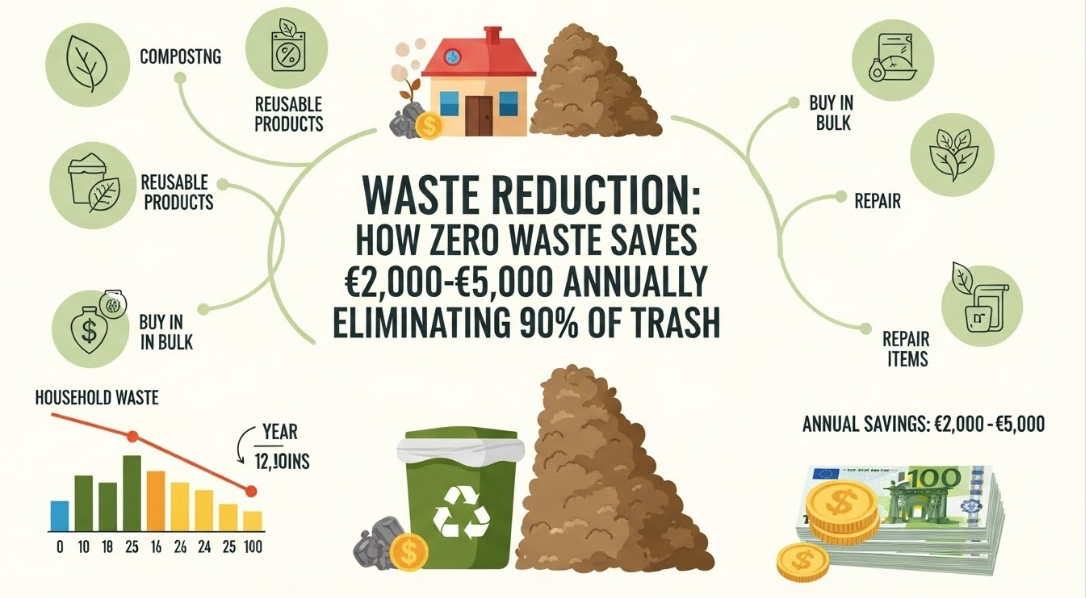
Here’s the waste reduction reality: Average person generates 300-600 kg of trash annually. Zero waste achievers reduce this to under 50 kg (90% reduction). The savings: €2,000-5,000 annually from reduced consumption, waste fees, and avoided purchases.
The waste hierarchy:
- Refuse: Don’t accept what you don’t need (best option)
- Reduce: Minimize what you do need
- Reuse: Use items multiple times
- Repair: Fix instead of replace
- Recycle: Last resort for materials
- Rot: Compost organic waste
- Landfill: Only true waste (target: under 10%)
Zero waste isn’t sacrifice—it’s optimization. Less waste = more money, less clutter, more freedom.
The Value Proposition: Zero Waste = Wealthy + Free
Financial Savings: €2,000-5,000 Annually
Where zero waste saves money:
Food Waste Prevention: €800-1,500 annually
- Average household wastes 30-40% of food purchased
- That’s €800-1,500 of food thrown away annually
- Zero waste strategies: Meal planning (saves €400-800), proper storage (saves €200-400), using leftovers (saves €200-300)
Elimination of Single-Use Items: €300-800 annually
- Reusable water bottle versus buying bottled water: €200-400 saved
- Reusable coffee cup versus disposable: €100-200 saved
- Reusable bags, containers, utensils: €100-200 saved
Reduced Packaging Purchases: €200-500 annually
- Bulk buying reduces packaging and cost per unit: €200-400 saved
- Package-free shopping (farmers markets, refill stores): €100-200 saved
Repair Instead of Replace: €500-1,500 annually
- Clothing repairs versus new purchases: €200-500 saved
- Electronics repairs versus replacement: €200-800 saved
- Appliance repairs: €100-200 saved
Minimalism Dividend: €500-2,000 annually
- Owning less means buying less: €300-1,000 saved
- No storage costs for excess stuff: €100-400 saved
- Less home maintenance: €100-600 saved
Reduced Waste Fees: €100-300 annually
- Smaller trash service or less frequent pickup: €50-150 saved
- Avoid disposal fees for large items: €50-150 saved
Total: €2,400-6,600 annually (conservative estimate €2,000-5,000)
Plus non-financial benefits: Less clutter, more space, less stress, clearer mind, more time (less shopping, less organizing, less cleaning).
ACTIVITY 2: The Zero Waste Shopping Audit
Rate your grocery stores on waste reduction:
Visit 3 Different Stores:
Store 1: _____________
Bulk Options (5 points):
- Extensive bulk bins (rice, beans, nuts, etc.): ___ points
- Bulk produce (no plastic bags required): ___ points
- Bulk cleaning products: ___ points
- Bulk personal care: ___ points
- Own container acceptance: ___ points Bulk Score: ___/5
Packaging (5 points):
- Minimal packaging options available: ___ points
- Plastic-free produce section: ___ points
- Package-free bakery/deli: ___ points
- Reusable container acceptance: ___ points
- Composting/recycling of packaging waste: ___ points Packaging Score: ___/5
Total Score: ___/10
Stores 2-3: Repeat audit
Best Zero Waste Store: _____________ (score: ___/10)
Action Plan:
- Primary shopping: Highest-scoring store
- Supplement: Farmers markets, refill stores, package-free options
- Target: 80% of purchases package-free or minimal packaging
Time to complete: 2-3 hours visiting stores
Cost: Free
Result: Identify best zero-waste shopping options in your area
The Technology Revolution: Making Zero Waste Easy
Digital Tools and Innovations
1. Zero Waste Apps
Too Good To Go: Rescue surplus food from restaurants/stores at 50-70% discount. Prevents food waste, saves money. 100M+ meals saved globally.
Olio: Share surplus food with neighbors. Free food, prevent waste, build community.
Zero Waste Home App: Track waste, get reduction tips, connect with zero waste community.
Buy Nothing Project: Give away items you don’t need, receive items you do. 5M+ members globally building gift economies.
2. Repair Platforms
iFixit: Repair guides for electronics. Fix instead of replace. Saves €200-800 per repair.
Repair Cafes: Community repair events. Volunteers help fix items. Free repairs, learn skills, prevent waste. 2,000+ repair cafes globally.
3. Composting Technology
Smart composters (Lomi, FoodCycler, etc.): Indoor electric composters turn food scraps to compost in 4-20 hours. No smell, no pests, apartment-friendly. Cost: €300-500. Produces €100-400 of compost annually. ROI: 1-5 years.
Community composting apps: Find nearest drop-off, track contributions, receive compost for gardening.
4. Package-Free Shopping Platforms
Loop: Online shopping with reusable packaging. Order products, receive in reusable containers, return empty containers for refill. Major brands participating (Unilever, P&G, Nestlé).
Refill stores: Growing globally. Bring own containers, fill with products (food, cleaning, personal care), pay by weight. Zero packaging waste.
5. Sharing Economy Platforms
Don’t own what you rarely use—share it:
- Tool libraries: Borrow tools instead of buying
- Clothing rental: Rent special occasion clothes
- Equipment rental: Rent camping gear, party supplies, etc.
Result: Access to items when needed without ownership waste. Save €500-2,000 annually.
ACTIVITY 3: The 30-Day Waste Reduction Challenge
Systematically eliminate waste over 30 days:
Week 1: Refuse (Don’t Accept Unnecessary Stuff)
- Day 1-2: Refuse single-use items (straws, plastic bags, etc.)
- Day 3-4: Cancel junk mail and promotional emails
- Day 5-7: Track refused items, celebrate wins
Week 2: Reduce (Minimize What You Need)
- Day 8-10: Meal plan to eliminate food waste
- Day 11-13: Buy only what you’ll actually use
- Day 14: Calculate food waste reduction: ___%
Week 3: Reuse & Repair
- Day 15-17: Set up reusable item kit (bag, bottle, cup, utensils, containers)
- Day 18-20: Repair broken items instead of replacing
- Day 21: Calculate single-use items eliminated: ___
Week 4: Compost & Track
- Day 22-24: Start composting (home or community drop-off)
- Day 25-27: Track week’s waste (compare to Week 1)
- Day 28-30: Calculate total waste reduction: ___%
Expected Results:
- Waste reduction: 50-70%
- Money saved: €150-400 monthly (€1,800-4,800 annually)
- Trash service: Downsize to smaller/less frequent (save €50-150 annually)
- Compost produced: 10-30 kg monthly (worth €20-60 monthly)
Share results: #ZeroWasteChallenge
Time commitment: 30-60 min daily for 30 days
Financial benefit: €1,800-4,800 annual savings
Waste reduction: 50-70% less to landfill
The Crisis Reality: We’re Drowning in Waste
2 Billion Tons of Waste Annually
Global waste generation: 2+ billion tons annually (growing 3-5% yearly). That’s:
- 6 million tons daily
- 250,000 tons hourly
- 4,000+ tons per minute
Breakdown:
- Food waste: 30-40% (€400 billion annually, 1.3 billion tons)
- Packaging: 20-30% (mostly plastic, paper, cardboard)
- Textiles: 10% (92 million tons clothing wasted)
- Electronics: 50 million tons (growing fastest)
- Construction: 1+ billion tons (30% of materials wasted during construction)
- Other: Various consumer goods, yard waste, etc.
Cost of managing this waste: €200-500 billion annually globally (collection, sorting, disposal, environmental damage).
Food Waste: €400 Billion Thrown Away
30-40% of all food produced is wasted:
- Farms: 15% (cosmetic standards, overproduction)
- Transport/processing: 10% (spoilage, spillage)
- Retail: 10% (overstocking, date labels)
- Consumer: 30-40% (over-purchasing, improper storage, confusion over dates)
Result: 1.3 billion tons of food wasted annually while 800 million people are undernourished.
Economic impact: €400 billion in food thrown away (that was paid for!). Environmental impact: Food waste generates 8-10% of global greenhouse gas emissions (methane from decomposing food in landfills).
Individual impact: Average household wastes €800-1,500 in food annually. Zero waste strategies can eliminate 80-90% of this.
Packaging Waste: 40% of Waste Stream
Packaging is 40% of waste by volume (20-30% by weight). Most is single-use:
- Plastic packaging: 146 million tons annually (most isn’t recycled)
- Paper/cardboard: 200+ million tons (better recycling but still wasteful)
- Glass, metal, multi-material packaging: Tens of millions of tons
Environmental cost: Resources extracted to make packaging used once then thrown away. Economic cost: Consumers pay for packaging (often more than product!), then pay again for disposal.
Zero waste alternative: Package-free shopping eliminates this waste entirely while often costing less per unit.
ACTIVITY 4: The Composting ROI Calculator
Calculate value of composting:
Your Organic Waste: Food scraps: ___ kg weekly × 52 = ___ kg annually Yard waste: ___ kg weekly × 52 = ___ kg annually (if applicable) Total organic waste: ___ kg annually
Diversion from Landfill: Landfill cost: ___ kg × €100/ton = €___ saved Methane avoided: ___ kg × 0.5 tons CO₂-equivalent/ton waste = ___ tons CO₂e prevented
Compost Produced: Composting reduces volume 50-70%, so: Compost yield: ___ kg waste × 0.3-0.5 = ___ kg compost
Compost Value: Market price €50-200/ton, so: ___ kg ÷ 1000 × €100/ton = €___ value created annually
If you use compost for gardening:
- Fertilizer saved: €50-150 annually
- Improved yields: 20-40% more productive garden
- Healthier plants: Fewer pest/disease problems
If you don’t garden:
- Sell compost: €50-200 annually to neighbors/gardeners
- Donate to community gardens: Tax deduction + community benefit
Total Annual Value: €150-500+
Setup Costs:
- Outdoor compost bin: €50-150 (lasts 10-20 years)
- Indoor electric composter: €300-500 (for apartments)
- DIY bin: €0-50
- Community drop-off: Free
ROI: 1-3 years, then ongoing value
Time to complete: 20 minutes
Action: Start composting this week
Result: Transform waste into valuable resource
The Minimalism Connection: Less Stuff = Less Waste
Own 50% Less, Save 30% Income
Minimalism financial benefits:
Studies of minimalist households show:
- Own 30-50% fewer possessions than average
- Spend 20-40% less on consumption
- Save 25-35% of income (versus 5-10% average)
- Have smaller homes (save €200-600 monthly on housing)
- Less debt (fewer purchases = less credit use)
- More financial freedom (higher savings rate)
Where minimalism reduces waste:
- Fewer impulse purchases (saved from landfill)
- Higher quality items that last (versus cheap disposable)
- Repair and maintenance culture (versus replace)
- Deliberate purchasing (every item justified)
- Clear space enables clear mind enables better decisions
The paradox: Owning less leads to having more (money, time, freedom, peace).
ACTIVITY 5: The Zero Waste Commitment Contract
Commit to waste reduction:
I, _____________, commit to zero waste starting today.
My Current Stats (from Activity 1):
- Weekly waste: ___ kg
- Annual waste: ___ kg
- Avoidable waste: ___%
- Annual waste cost: €___
My 90-Day Goals:
- Reduce waste: ___%
- Save money: €___
- Compost: 100% of organic waste
- Package-free shopping: ___%
My Actions:
- Refuse: No single-use items
- Reduce: Meal planning, deliberate purchasing
- Reuse: Reusable kit for all occasions
- Repair: Fix before replacing
- Compost: All organic waste
- Target: Under 10% to landfill
My Accountability: Partner: _______________ Monthly check-in: Track waste weekly Public commitment: #ZeroWasteChallenge
My Why: [Write personal motivation – money, environment, values, future]
Expected Results (90 days):
- Waste reduced: 50-70%
- Money saved: €500-1,500
- Compost produced: 50-100 kg
- Lifestyle: Simpler, clearer, freer
Date: ______ Signature: ______
Time to complete: 10 minutes
Impact: Written commitment increases follow-through 65%
The Bottom Line: Zero Waste = Wealth + Freedom
Current system: Buy → Use briefly → Throw away → Buy more → Repeat → Broke + landfills overflowing
Zero waste: Buy less → Use completely → Reuse → Repair → Compost → Save money → Free + clean planet
The value propositions are clear:
Zero waste saves €2,000-5,000 annually. Food waste prevention: €800-1,500. Eliminating single-use: €300-800. Repair over replace: €500-1,500. Minimalism dividend: €500-2,000. Composting creates €100-400 value. Plus reduced waste fees, less clutter, more space, clearer mind.
The crisis is real:
2 billion tons waste annually. Food waste: €400 billion wasted. Packaging: 40% of waste. Landfills reaching capacity. Environmental damage enormous.
The solution works:
Zero waste achievers reduce waste 90%. Technology making it easier (apps, composters, refill stores). Community growing (millions participating). Economics favorable (less waste = more money).
Zero waste isn’t deprivation—it’s liberation. From waste. From excess. From unnecessary consumption. From wasted money.
Reduce waste, increase wealth. Simple equation.
🗑️❌➡️♻️✅