Why “Take-Make-Waste” Is Dead and “Reduce-Reuse-Recycle” Creates Fortunes
ACTIVITY 1: The Personal Waste Audit
For the next 24 hours, save EVERYTHING you throw away. Every wrapper, bottle, bag, container, packaging, food scrap, broken item—everything that goes in the trash or recycling.
After 24 hours, sort your waste into categories:
- Recyclable: ___ items
- Compostable: ___ items
- Reusable/repairable: ___ items
- True waste (no other option): ___ items
Now calculate:
- Recyclable %: ___ (should be 30-50%)
- Compostable %: ___ (should be 20-40%)
- Reusable %: ___ (should be 10-20%)
- True waste %: ___ (should be under 10%)
Most people discover: 60-80% of their “trash” isn’t actually waste—it’s resources in the wrong place.
Time to complete: 24 hours + 30 min sorting
Cost: Free
What you learned: Most of your “waste” is valuable resources you’re throwing away
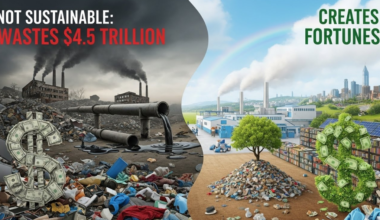
Here’s the circular economy revolution in numbers: The linear “take-make-waste” economy loses $4.5 trillion annually in wasted resources. Meanwhile, circular economy businesses generate 20-30% higher profit margins. The global circular economy market will reach $4.5 trillion by 2030 creating millions of high-paying jobs.
Linear economy: Extract resources → Make products → Use briefly → Throw away → Extract more resources (repeat forever until resources run out)
Circular economy: Use resources → Make products → Use extensively → Repair/refurbish → Use more → Recycle materials → Make new products (loop forever without extracting new resources)
The linear economy is economic insanity. The circular economy is economic genius. And the transition is happening right now.
The Value Proposition: Circular = Profitable
Circular Business Models: 20-30% Higher Margins
Product-as-Service: Selling Use Instead of Ownership
Traditional model: Sell washing machine for €500. Customer owns it. It breaks after 5 years. You sell them another one. Revenue: €100/year.
Circular model: Rent washing machine for €15/month. You own it. You maintain it. It lasts 15 years. Revenue: €180/year (80% more!) plus you keep the materials at end-of-life to make new machines.
Real examples:
- Philips Lighting: Sells “light as a service” to companies. Philips owns lights, maintains them, customers pay per lux-hour. Philips revenue up 30%, customers save 20% on energy, zero waste.
- Michelin: Tire-as-a-service for trucking companies. Michelin owns tires, monitors them, replaces proactively. Revenue up 25%, customers save 15% on tire costs, 100% tire recycling.
- Interface Carpets: Leases carpet tiles, replaces worn sections, recycles old tiles into new ones. Profit margins 40% higher than traditional carpet sales.
The Pattern: Product-as-service creates recurring revenue, higher margins, customer lock-in, material recovery, and lower environmental impact simultaneously.
Remanufacturing: 80% Cost Savings
Remanufacturing (restoring used products to like-new condition) costs 80% less than manufacturing new products. Examples:
- Caterpillar: Remanufactures heavy equipment engines. Costs 40-60% less than new engines, performs identically, generates $2+ billion annually.
- Apple: Refurbished iPhones cost Apple €100 to remanufacture versus €300 for new phones. Sells for €500-700. Margins higher than new phones.
- Automotive: Remanufactured auto parts (starters, alternators, transmissions) are $50+ billion market with 50-60% profit margins.
Resale and Rental Platforms: Zero Inventory Risk
Platform businesses connecting buyers and sellers of used goods or renters and owners capture enormous value with zero inventory:
- ThredUp (clothing resale): $1+ billion valuation, 40% gross margins, zero manufacturing costs
- Rent the Runway (fashion rental): Each dress rented 10-15 times earning 3-5x purchase price
- Airbnb, Turo (asset sharing): Enable owners to monetize idle assets, platform takes 15-25% commission
Recycling and Upcycling: Turning Trash into Treasure
Advanced recycling creates value from waste:
- TerraCycle: Recycles “unrecyclable” materials (chip bags, cigarette butts, coffee pods) into new products. Revenue $40+ million, growing 30% annually.
- Adidas x Parley: Ocean plastic shoes. Marketing value enormous (“Made from ocean plastic” = premium pricing), material cost near zero (trash).
- Precious Plastic: Open-source recycling machines enabling small businesses to recycle plastic locally creating employment and value.
The Pattern: Circular models reduce costs (cheaper materials from recycling), increase revenue (product-as-service recurring income), improve margins (20-30% higher), reduce risk (less commodity price exposure), and attract customers (environmental benefits = marketing advantage).
ACTIVITY 2: The Circular Economy Business Model Generator
Design a circular business model for any industry:
Step 1: Pick an Industry Your industry: _______________
Step 2: Analyze Current Linear Model
- Product sold for: €___
- Product lifespan: ___ years
- End-of-life: Landfill/incineration
- Annual revenue per customer: €___
- Profit margin: ___%
Step 3: Design Circular Alternative
Option A: Product-as-Service
- Monthly subscription: €___
- Lifespan (with maintenance): ___ years
- End-of-life: Recover materials
- Annual revenue per customer: €___ × 12 = €___
- Profit margin: ___% (typically 20-30% higher)
Option B: Remanufacturing
- Buy back used products: €___
- Remanufacturing cost: €___ (typically 80% less than new)
- Resell remanufactured: €___
- Margin improvement: ___%
Option C: Rental/Sharing Platform
- Platform commission: ___% of transactions
- Zero inventory cost
- Scalable with network effects
- Margin: 40-60%
Compare Results: Linear annual revenue: €___ Circular annual revenue: €___ Revenue increase: ___% Environmental impact: Reduce waste ___%, reduce resource extraction ___%
Time to complete: 30 minutes
Cost: Free
Insight: Circular models often MORE profitable than linear
The Technology Revolution: Enabling Circularity at Scale
Digital Platforms Making Circular Economy Mainstream
1. Reverse Logistics Technology
Getting used products back from customers historically expensive and complex. New technology solves this:
- Smart packaging with QR codes: Customers scan code, print return label, ship back free
- Takeback programs: Patagonia, H&M, Apple all accept returns of used products
- Automated sorting: AI-powered robots sort returned products by condition for remanufacturing, recycling, or disposal
Companies like Optoro, Loop, and others provide reverse logistics platforms enabling circular models. Market growing 20% annually reaching $10+ billion by 2030.
2. Material Passports and Digital Twins
Every product gets digital “passport” tracking:
- Materials used (types, quantities, sources)
- Manufacturing process
- Location and usage history
- Optimal end-of-life pathway (remanufacture, recycle, compost)
This enables automatic routing of products to highest-value recovery pathway. Being implemented in construction (Building Circularity Passport), electronics (Material Passport), and fashion (Textile Passport).
3. AI-Powered Waste Sorting
Traditional recycling sorting is manual, slow, expensive, and error-prone. AI-powered robots revolutionize this:
- ZenRobotics, AMP Robotics: Robots identify and sort recyclables 2x faster than humans with 95%+ accuracy
- Reduce contamination: Better sorting = higher-quality recycled materials = higher value
- Process more materials: AI recognizes hundreds of material types humans can’t distinguish
Result: Recycling becomes profitable (not subsidized) as material quality and sorting speed improve.
4. Blockchain for Circular Supply Chains
Tracking materials through circular loops requires transparency. Blockchain provides:
- Provenance tracking: Verify materials are actually recycled (not greenwashing)
- Automated payments: Smart contracts pay suppliers when materials recovered
- Quality assurance: Material certifications verified cryptographically
Companies like Circularise, Provenance, and others deploying blockchain for circular economy. Market nascent but growing rapidly.
5. Biomaterials and Biodegradable Alternatives
Technology creating materials that safely biodegrade replacing problematic plastics:
- PHA bioplastics: Made from bacteria, fully biodegradable in ocean in weeks (versus 400 years for conventional plastic)
- Mycelium materials: Mushroom-based packaging replacing styrofoam (grows in days, composts in weeks)
- Seaweed packaging: Edible packaging replacing plastic wrap
- Bacterial cellulose: Leather alternative that biodegrades
These materials enable products that can safely enter biological cycles when life ends.
ACTIVITY 3: The 30-Day Circular Living Challenge
Transform your consumption from linear to circular:
Week 1: Refuse (Stop Buying Unnecessary Stuff)
- Day 1-3: Track all purchases, identify impulse buys
- Day 4-5: Implement 48-hour rule (wait 48 hours before any non-essential purchase)
- Day 6-7: Calculate money saved by refusing impulse purchases: €___
Week 2: Reduce (Minimize What You Need)
- Day 8-10: Audit possessions, identify unused items (target: 20-50% unused)
- Day 11-13: Sell or donate unused items (revenue: €___)
- Day 14: Declutter creates mental clarity + financial gain
Week 3: Reuse (Extend Product Life)
- Day 15-17: Repair broken items instead of replacing (savings: €___)
- Day 18-20: Buy secondhand for anything needed (savings: 50-80%)
- Day 21: Borrow/rent instead of buy for occasional-use items
Week 4: Recycle (Last Resort)
- Day 22-24: Set up comprehensive recycling + composting at home
- Day 25-27: Track waste reduction (target: 50-70% less trash)
- Day 28-30: Calculate total savings and environmental impact
Expected Results:
- Money saved: €200-800 monthly (€2,400-9,600 annually)
- Waste reduced: 50-70%
- Possessions: 20-50% fewer (less clutter, more space)
- Mental clarity: Improved (less consumption stress)
- Environmental impact: CO₂ reduced 1-3 tons annually
Share results: #CircularLivingChallenge
Time commitment: 30 minutes daily for 30 days
Financial benefit: €2,400-9,600 annual savings
Waste reduction: 50-70% less trash to landfill
The Crisis Reality: Linear Economy Destroying Planet and Profit
$4.5 Trillion Lost Annually to Waste
Linear economy waste is staggering:
- €400 billion: Food waste (1/3 of all food produced wasted)
- €500 billion: Textile waste (clothes worn 7-10 times then discarded)
- €300 billion: Electronics waste (40% of materials in electronics never recovered)
- €1 trillion: Construction waste (30% of building materials wasted during construction)
- €2.3 trillion: Other material waste (packaging, plastics, paper, etc.)
Total: $4.5 trillion in materials and products wasted annually that could be recovered and reused.
This isn’t just environmental crisis—it’s economic catastrophe. These are resources paid for once, used briefly, then thrown away requiring new resources to be extracted and purchased again. Pure economic waste.
Landfills: €100-500 Per Ton to Bury Treasure
Landfilling waste costs €100-500 per ton depending on location. Global waste: 2+ billion tons annually. Cost: €200-1,000 billion annually just to bury materials that could be resources.
Plus external costs:
- Methane emissions from decomposing waste (25x worse than CO₂ for climate)
- Groundwater contamination requiring cleanup (€millions per site)
- Land permanently consumed (can’t be used for anything else for decades)
- Visual blight reducing property values nearby
And we’re paying €200-1,000 billion annually for this privilege while simultaneously paying to extract virgin resources.
Resource Scarcity Driving Prices Up
Linear economy depleting resources:
- Rare earth elements: Critical for electronics, many at risk of shortages within 20-50 years
- Topsoil: Only 60 harvests remaining at current degradation rates
- Freshwater: Approaching limits in many regions
- Minerals: High-grade ores depleted, mining lower-grade ores requiring more energy and creating more waste
Result: Resource prices trend upward long-term. Circular economy insulates from this volatility by reducing virgin material needs 80-90%.
ACTIVITY 4: The Circular Economy Investment Portfolio
Position for circular economy boom:
Current Exposure: Linear economy companies: €___ (%) Circular economy companies: €_ (__%)
Circular Economy Investment Options:
Public Companies:
- Waste Management Leaders: Waste Management Inc, Republic Services (expanding recycling + renewable energy from waste)
- Remanufacturing: Caterpillar (remanufactures equipment), Cummins (remanufactures engines)
- Resale Platforms: ThredUp, Poshmark, RealReal (clothing resale)
- Product-as-Service: Philips (light-as-service), Rolls-Royce (jet engines-as-service – “power by the hour”)
- Biomaterials: Danimer Scientific (PHA bioplastics), Ecovative (mycelium materials)
ETFs and Funds:
- Circular economy ETFs (emerging)
- Cleantech funds (often include circular companies)
- Impact investing funds focused on circular models
Private Investment:
- Circular economy startups (via crowdfunding or angel investing)
- Recycling technology companies
- Sharing economy platforms
- Local repair cafés and makerspaces
Conservative Portfolio (10-15% Returns): 40%: Established waste management companies 30%: Remanufacturing leaders 20%: Circular economy ETFs 10%: Cash/stable
Aggressive Portfolio (20-30% Returns): 30%: High-growth resale platforms 25%: Biomaterials startups 25%: Sharing economy platforms 15%: Recycling technology 5%: Speculative circular startups
10-Year Projections: €10,000 conservative @ 12% = €31,058 €10,000 aggressive @ 25% = €93,132
Plus: Supporting transition to circular economy (environmental impact)
Time to complete: 30 minutes
Action: Reallocate 10-30% of portfolio to circular economy
Expected return: 10-30% annually as circular economy grows
The Bottom Line: Circular Economy = Economic + Environmental Win
Linear economy: Extract → Make → Waste → Repeat forever (impossible, expensive, destructive)
Circular economy: Reuse → Repair → Remanufacture → Recycle → Repeat forever (possible, profitable, sustainable)
The value propositions are compelling:
Circular businesses: 20-30% higher margins. Product-as-service: 80% more revenue than traditional sales. Remanufacturing: 80% cost savings versus new production. Resale platforms: 40% gross margins with zero inventory. Market opportunity: $4.5 trillion by 2030. Personal savings: €2,400-9,600 annually from circular living.
The crisis is real:
$4.5 trillion wasted annually. €200-1,000 billion spent on landfilling. Resources depleting. Prices rising. Environmental destruction.
The transition is happening:
Major companies adopting circular models. Technology enabling circularity at scale. Consumers demanding sustainability. Regulations requiring circularity. Investment flowing to circular economy.
Circular economy isn’t sacrifice—it’s optimization. Better economics. Better environment. Better everything.
🔄♻️🌍