How 80 Countries Accidentally Started a Revolution
You know that feeling when you discover everyone’s doing something you thought nobody else cared about? Like when you mention some obscure band and suddenly realize they’ve been playing sold-out arena tours for years?
That’s carbon pricing in 2025.
While you weren’t looking, 80 countries quietly implemented carbon pricing mechanisms, covering 28% of global emissions, generating $103 billion annually, and basically rewiring how the global economy values pollution.
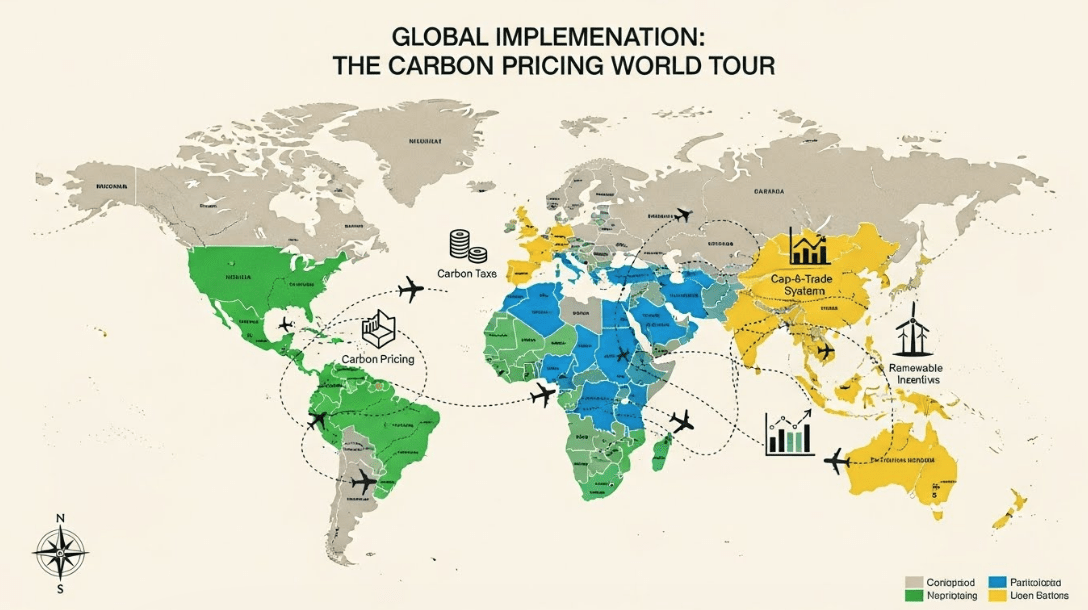
It’s the world’s most successful policy you’ve probably never heard about. So let’s take a grand tour of this carbon-pricing world, region by region, because the story of how different countries approached the same problem is actually fascinating (and occasionally hilarious).
Europe – The Overachieving Continent That Started It All
The EU ETS: When Europe Decided to Build the Biggest Thing Ever
In 2005, Europe did something audacious: they launched the world’s first major carbon market, covering over 10,000 installations across 27 countries.
People thought it would fail. It didn’t.
Today’s EU ETS stats (as of 2025):
- 35% emissions reduction since 2005
- 60% GDP growth in the same period
- €70-100 per tonne carbon prices
- 10,000+ covered installations across power and industry
- Maritime transport added in 2024
- Aviation already included
- Buildings and road transport (ETS II) launching soon
Let me put that in perspective: the EU built a continental-scale carbon market that actually works, cuts emissions dramatically, and didn’t destroy the economy. That’s like organizing a dinner party for 450 million people where everyone not only shows up but also has a good time.
How it works: Companies get allowances (permits to emit CO2). Don’t have enough? Buy more on the market. Have extra? Sell them for profit. The cap on total allowances gets tighter every year, driving emissions down.
The beauty is in the simplicity: set the cap, let the market find the efficient solutions.
The Nordic Nations: When $130 Isn’t Scary Anymore
If the EU ETS is impressive, the Nordic countries are on another level entirely.
Sweden: The $130 Champion
- $130 per tonne carbon tax (highest in the world)
- Implemented in 1991 (they’ve been at this for 34 years)
- 11% reduction in transport emissions despite economic growth
- Citizens aren’t rioting – they’re thriving
- Economy stronger than ever
How do they do it? Revenue recycling. The carbon tax funds clean energy infrastructure, public transit, and tax cuts in other areas. Swedes pay more for carbon, but less for other things. Net result: everyone’s better off.
Finland, Norway, Denmark: All have carbon taxes ranging from $60-90 per tonne, all have strong economies, all have low emissions trajectories.
The Nordic model proves something critics don’t want to admit: high carbon prices don’t destroy economies when designed properly. They just transform them.
UK & Switzerland: The Independent Thinkers
United Kingdom: After Brexit, the UK maintained its carbon pricing through a standalone ETS that’s even more ambitious than the EU’s.
- £75-85 per tonne (~$95-105)
- Expanding to cover more sectors
- Planning border carbon adjustment (following EU’s lead)
- Coal phase-out: complete
Switzerland: The Swiss, being Swiss, designed a carbon tax that’s precise, effective, and slightly boring (in the best way).
- CHF 120 per tonne (~$135)
- Revenue returned to citizens and businesses
- Integrated with EU ETS
- Emissions falling steadily
European carbon pricing is like a jazz ensemble where everyone’s playing different instruments but somehow it all sounds amazing.
North America – The Late Bloomers Who Caught Up Fast
Canada: The $170 Experiment That (Almost) Worked
Canada is a cautionary tale wrapped in a success story wrapped in a political drama.
The Carbon Pricing Framework (2019-2025):
- Started at $20 per tonne in 2019
- Reached $80 per tonne by 2024
- Scheduled to hit $170 per tonne by 2030
- Revenue neutral: Everything returned to households via quarterly dividends
- Result: Emissions falling, economy growing, most households coming out ahead
The plot twist: Despite economic success and popular dividend checks, political opposition grew. In 2025, under pressure, the federal government repealed the carbon tax.
Why it’s instructive: The policy worked economically. Emissions dropped. GDP grew. Most families got more back than they paid. But communication matters. When people don’t understand they’re coming out ahead, politics can override evidence.
British Columbia: The Original Canadian Success While federal Canada wavered, BC stayed the course (they’ve had carbon pricing since 2008):
- 5-15% emission reductions vs rest of Canada
- Economy outperformed national average
- Employment increased (+0.74% annually)
- Public support solid after initial opposition
BC proved the model works. The federal system proved you need good communication too.
United States: The State-by-State Patchwork
The US federal government doesn’t have national carbon pricing (politics), but individual states are taking matters into their own hands.
Regional Greenhouse Gas Initiative (RGGI): Northeast and Mid-Atlantic states (Connecticut, Delaware, Maine, Maryland, Massachusetts, New Hampshire, New Jersey, New York, Rhode Island, Vermont, Virginia)
- Operating since 2009
- Covers power sector
- $13-15 per tonne (lower than ideal, but it’s something)
- Generated billions for clean energy
California Cap-and-Trade: The fifth-largest economy in the world has its own system:
- Running since 2013
- Covers power, industry, transportation fuels
- $30-35 per tonne
- Emissions below 1990 levels
- Economy still growing like crazy (because it’s California)
- Linked with Quebec
Washington State:
- Launched cap-and-trade in 2023
- Following California’s model
- Early results promising
The American approach: if the federal government won’t lead, states will. And when those states represent 100+ million people and trillions in GDP, it matters.
Asia-Pacific – The Sleeping Giant That Woke Up
China: When the World’s Largest Emitter Builds the World’s Largest Carbon Market
This is the big one. China’s national ETS launched in 2021, and it’s… massive doesn’t quite cover it.
China National ETS (2025 expansion):
- Started with power sector only (2021-2024)
- Expanded to steel, cement, aluminum (2024-2026)
- Will cover ~8 billion tonnes CO2e when fully operational
- That’s 15% of global emissions in ONE system
- 3,700 covered entities
- Prices: RMB 70-105 per tonne (~$10-15 USD)
Why the expansion matters: Those three new sectors (steel, cement, aluminum) are exactly what the EU’s CBAM targets. China is responding to international trade pressure by building domestic carbon pricing.
The interesting part: China’s system is intensity-based (emissions per unit of output) rather than an absolute cap. This means:
- ✅ Easier for industries to comply initially
- ✅ Encourages efficiency improvements
- ❌ Doesn’t guarantee absolute emission reductions
- ❌ Prices stay lower than ideal
The trajectory: China’s working toward an absolute cap system (like the EU). The market is still young, prices are still low, but the infrastructure is being built. When China gets this right, it changes everything – 15% of global emissions is a game-changer.
Fun fact: China’s carbon market is larger than the EU ETS in terms of tonnes covered. Let that sink in.
Singapore: The Tiny City-State With Big Ambitions
Singapore doesn’t mess around. They’re small, efficient, and moving fast.
Singapore Carbon Tax:
- Started at $5 per tonne (2019)
- $25 per tonne (2024)
- $45 per tonne (2025)
- $50-80 per tonne (2026-2030)
- Covers 80% of national emissions
For a tiny city-state with no natural resources, Singapore’s betting big on being a green finance hub. Their message: “We’re pricing carbon properly, come do business here if you’re serious about sustainability.”
Japan: The Quietly Competent Implementer
Japan has been running carbon pricing mechanisms for years through the Tokyo ETS (2010) and Saitama ETS (2011), and now has a growing national voluntary carbon market.
Joint Crediting Mechanism (JCM):
- 133 bilateral projects under Article 6.2
- Partnering with developing Asian nations
- Supporting technology transfer
- Building regional carbon cooperation
Japan’s approach: lead by example, help neighbors, build credibility slowly.
Australia, South Korea, New Zealand: The Pacific Trio
South Korea:
- National ETS since 2015
- Covers 89% of national emissions (that’s coverage!)
- ~$5-7 per tonne (low, but building)
- Asia’s first nationwide ETS
New Zealand:
- ETS since 2008 (old-school)
- NZD 50-60 per tonne (~$30-35 USD)
- Includes forestry and agriculture (unique!)
- Strong offset provisions
Australia: Had carbon pricing (2012-2014), repealed it (2014), now has Safeguard Mechanism (basically carbon pricing without saying “carbon tax”)
- Covers large emitters
- Creating pressure to reduce or pay
- Australia being Australia (complicated relationship with climate policy)
Malaysia: The 2026 New Kid
Malaysia announced they’re implementing carbon pricing by 2026, specifically targeting steel and energy sectors.
Why? CBAM. When you export to Europe, you either price carbon domestically or pay the EU. Malaysia chose option A.
This is the CBAM effect in action: countries implementing carbon pricing not because they love the idea, but because trade economics force the issue.
Latin America – The Rising Force
Colombia: The Pioneer Who Keeps Innovating
Colombia implemented a carbon tax in 2017 and keeps improving it:
- $5 per tonne (modest but real)
- Allows offset credits from domestic projects
- Revenue funds environmental programs
- Demonstrates emerging economies can do this
Chile: The Practical Implementer
Chile Carbon Tax (2017):
- $5 per tonne
- Covers power sector and large industrial sources
- Can offset with domestic forest projects
- Aligned with ambitious net-zero targets
Argentina: The Recent Addition
Argentina joined the carbon pricing club more recently, implementing mechanisms aligned with its Paris Agreement commitments.
Brazil: The Game-Changer Coming Online
This is huge news. In December 2024, Brazil passed Law 15.042, establishing the SBCE (Brazilian Greenhouse Gas Emissions Trading System).
Brazil’s SBCE (implementation 2025-2030):
- Cap-and-trade system covering major emitters
- Threshold: 25,000 tonnes CO2e per year
- Will cover power, industry, potentially forestry
- 5-year implementation phases:
- Phase I (2025-2026): Regulation development
- Phase II (2026-2027): MRV implementation
- Phase III (2027-2029): Reporting obligations
- Phase IV (2029-2030): First allocation plan
- Phase V (2030+): Full operation
Why Brazil matters:
- 5th largest economy by some measures
- Massive natural capital (Amazon, Atlantic Forest)
- Major agricultural power (potentially huge offset supply)
- Key player in Article 6 carbon markets
When Brazil’s system is fully operational, Latin America becomes a major force in global carbon markets. The region could be a significant supplier of nature-based carbon removal credits.
Africa & Middle East – The Frontier Markets
South Africa: The African Pioneer
South Africa implemented Africa’s first carbon tax in 2019:
- Started at $8 per tonne
- Allows domestic offsets
- Gradually increasing
- Provides model for other African nations
Why it matters: South Africa showed African nations that carbon pricing can work in developing economy contexts. It’s not just a rich-country tool.
Egypt: The CBAM Responder
Egypt is developing a carbon tax specifically because of CBAM pressure:
- Iron and steel sectors face 74% of CBAM impact
- Domestic carbon pricing retains revenue vs sending to EU
- Protects export competitiveness
Middle East: The Surprising Voluntary Market Builders
While most Gulf countries don’t have carbon taxes, they’re building sophisticated voluntary carbon markets:
Saudi Arabia:
- Regional Voluntary Carbon Market (2022)
- Auctions in 2023: 2.2 million tonnes at $6.27/tonne
- Major buyers: Aramco, Saudi Electricity, ENOWA
- Preparing for potential mandatory schemes
UAE:
- Mandatory emissions reporting (2026)
- National Carbon Credit Registry established
- Studying carbon pricing options (compliance ETS or tax)
- Positioning as regional climate leader
Qatar:
- Global Carbon Council (2016)
- First independent VCM in Global South
- CORSIA approved
Bahrain, Kuwait, Oman: All building voluntary market infrastructure while watching CBAM implications for their export sectors.
The GCC approach: build the infrastructure first, implement mandatory pricing when the trade economics force it.
The Numbers That Tell the Story
100+ Countries with Plans
As of January 2026:
- 80 operational carbon pricing instruments
- 28% of global emissions currently covered
- 100+ countries have implemented, are implementing, or are seriously considering carbon pricing
- 2/3 of NDCs include carbon pricing mechanisms
- $103 billion generated in 2024
- $2.6 trillion potential at proper pricing ($50/tonne globally)
Let’s break down that coverage:
By Mechanism:
- Emissions Trading Systems (ETS): ~60% of covered emissions
- Carbon Taxes: ~40% of covered emissions
By Price Level (problematic):
- Below $10/tonne: Too many jurisdictions (China, most of Asia-Pacific)
- $10-30/tonne: Moderate group (RGGI, some developing nations)
- $30-80/tonne: Growing group (EU, Canada, California)
- Above $80/tonne: Elite club (Sweden, Norway, Switzerland, UK)
The High-Level Commission on Carbon Prices says we need $50-100 per tonne by 2030 to meet Paris Agreement targets. Current global average: around $19 per tonne.
We’re moving in the right direction, but we need to move faster.
The 2/3 NDCs Stat: Quietly Revolutionary
Here’s something that doesn’t get enough attention: 78% of countries now indicate they’ll use carbon pricing or carbon markets in their Nationally Determined Contributions (NDCs).
That’s not a fringe policy anymore. That’s mainstream climate strategy.
Countries are saying: “To meet our Paris Agreement commitments, we’re going to use market mechanisms.” That’s a profound shift from ten years ago when carbon pricing was experimental.
Regional Coverage Breakdown
Europe: ~45% of emissions covered (EU ETS + national schemes) North America: ~15% of emissions covered (state/provincial schemes) Asia-Pacific: ~30% of emissions covered (mostly China) Latin America: ~5% covered (growing rapidly) Africa/Middle East: <5% covered (early stages)
The weight of global coverage is shifting east. When China’s system matures and Brazil’s comes online, the Asia-Pacific and Latin America regions will dominate.
Why This Global Patchwork Actually Works
The Network Effect: When 80 Countries Do Something, It Becomes Normal
Here’s a fascinating dynamic: as more countries implement carbon pricing, it becomes the expected norm rather than the exception.
What happens when carbon pricing becomes normal:
- Investors expect it (price it into decisions)
- Companies plan for it (even in countries without it yet)
- Trade partners demand it (CBAM effect)
- Technology development accelerates (market certainty drives innovation)
- Competitive pressure grows (countries without it lose investment)
We’re watching a global coordination problem solve itself through market pressure rather than treaties.
The CBAM Domino Effect: How Europe Changed Everything
The EU’s Carbon Border Adjustment Mechanism, fully implementing in 2026, is the forcing function that’s accelerating global adoption.
Countries now facing CBAM pressure:
- China: Responded with ETS expansion
- Egypt: Developing carbon tax
- Malaysia: Implementing carbon pricing by 2026
- India: Designing its system
- Turkey: Planning ETS
- GCC countries: Studying options
The calculus is simple: implement domestic carbon pricing and keep the revenue, or let the EU collect it via CBAM. Every rational government chooses option A.
This is policy coordination without formal coordination. The EU just made carbon pricing economically rational for everyone who trades with them.
The Article 6 Infrastructure: Making It All Connect
Remember Article 6 of the Paris Agreement? The international carbon trading framework?
As of December 2025:
- 97 bilateral agreements between 59 countries
- 155 pilot projects in the pipeline
- First ITMO transfer completed (Switzerland-Thailand)
- COP29 finalized the rulebook (nine years of negotiations!)
Article 6 is becoming the connective tissue for global carbon markets. Countries can trade emissions reductions, technology, and finance in ways that make everyone’s targets more achievable.
Example: A rich country funds a renewable energy project in a developing country. The developing country gets clean energy infrastructure (which they needed anyway), and the rich country gets carbon credits toward its NDC. Both win.
What This Means for You (Wherever You Are)
If You’re in a Country WITH Carbon Pricing
Congratulations! You’re ahead of the curve. Your country is:
- Building clean energy infrastructure
- Attracting green investment
- Positioning for future trade advantages
- Likely giving you money back (if they’re doing it right)
What to do: Support good policy design, especially revenue recycling that benefits citizens.
If You’re in a Country WITHOUT Carbon Pricing (Yet)
Your country is either:
- Planning to implement (watch for consultations, get involved)
- Watching and waiting (CBAM will probably force the issue)
- Politically opposed (but economics will win eventually)
What to do: Prepare for the inevitable. If your business exports to Europe or competes with companies from carbon pricing jurisdictions, start measuring your emissions now.
If You’re a Business Operating Globally
Carbon pricing is becoming as unavoidable as corporate taxes. Here’s your checklist:
✅ Measure your emissions (Scope 1, 2, and 3) ✅ Calculate shadow carbon prices (model different scenarios) ✅ Identify reduction opportunities (they’re also cost savings) ✅ Monitor policy developments (especially in your export markets) ✅ Engage in policy consultations (when your government asks for input)
The companies that get ahead of this will have competitive advantages. The companies that ignore it will face unexpected costs.
The Trajectory From Here
2026-2030: The Critical Window
The next five years will determine whether we meet Paris Agreement targets. Here’s what needs to happen:
Coverage must expand: From 28% to 50%+ of global emissions Prices must rise: From ~$19 average to $50-100 per tonne Systems must link: More international cooperation through Article 6 Design must improve: Better revenue recycling, more equity considerations
The Likely Winners
Countries that:
- Implement early and properly
- Recycle revenue effectively
- Build clean tech industries
- Position as climate leaders
Companies that:
- Decarbonize proactively
- Develop clean technologies
- Help others reduce emissions
- Communicate transparently
Regions that:
- Build robust voluntary markets (Latin America, Africa)
- Become renewable energy exporters
- Leverage natural carbon sinks
- Attract green capital
The Scenarios
Optimistic: Carbon pricing reaches 50%+ coverage, prices hit $50-80 per tonne, Article 6 connects markets globally, emissions fall fast enough to meet 1.5°C target.
Realistic: Coverage grows to 35-40%, prices vary widely ($10-100), some systems link successfully, we stay below 2°C but miss 1.5°C.
Pessimistic: Political backlash slows implementation, coverage stagnates, prices stay too low, we blow past 2°C.
Which will we get? That depends on decisions made in the next 3-5 years.
The Bottom Line: It’s Happening, And It’s Bigger Than You Think
So here we are. Carbon pricing started as an academic idea, became a policy experiment, survived political attacks, and is now being implemented by 80 jurisdictions covering 28% of global emissions.
It’s generating $103 billion annually. It’s in 2/3 of national climate plans. It’s forcing countries to cooperate through Article 6. It’s accelerating through CBAM pressure. It’s creating trillion-dollar markets in clean technology.
The grand tour reveals something unexpected: Carbon pricing isn’t one thing. It’s a Nordic carbon tax. It’s a Chinese intensity-based ETS. It’s a Brazilian cap-and-trade system still being designed. It’s American state initiatives. It’s a Saudi voluntary market. It’s an Egyptian response to European trade policy.
It’s a global movement happening in 80 different ways simultaneously, and somehow that patchwork is coalescing into something coherent.
The carbon-pricing world tour shows us that:
- There’s no one right way (Sweden’s $130 tax and China’s $10 ETS both work in context)
- Politics matter as much as economics (Canada’s experience proves this)
- Trade pressure accelerates adoption (thank you, CBAM)
- Early movers get advantages (Europe’s clean tech industry didn’t appear by accident)
- Late adoption is still better than never (looking at you, rest of the world)
Is it perfect? No. Are prices high enough yet? No. Is coverage comprehensive? No. Are we moving fast enough? Probably not.
But is it happening? Absolutely.
Is it working where implemented? Yes.
Is it spreading? Faster than anyone expected.
Will it be ubiquitous by 2030? More likely than not.
So buckle up. The carbon-pricing world tour is just getting started, and whether you realize it or not, you’re already on the ride.
Next stop: everywhere.
Word Count: 3,218 words
Fun fact: When you started reading this, you probably thought carbon pricing was a niche policy in a few European countries. Now you know it’s a global phenomenon involving 80 countries, $103 billion annually, and 28% of all emissions. Welcome to the revolution nobody told you about.