━━━━━━━━━━━━━━━━━━━━━━━━━━━━━━
| A Transmission from 2050 “The decisions you make today about AI will shape the next 25 years of human civilization.” |
2026 EDITION
Your Complete Educational Guide to AI Technologies
Table of Contents
Table of Contents
A Letter from 2050
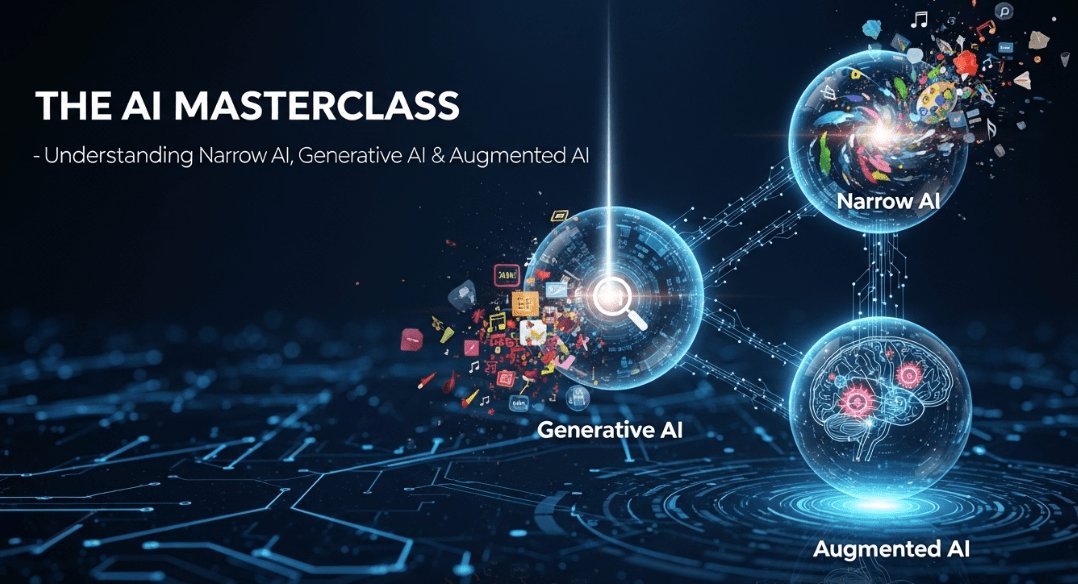
This masterclass will take you on a journey through the three most important categories of AI that are reshaping our world. Whether you’re a business leader, developer, educator, or curious learner—understanding these technologies isn’t optional anymore. It’s essential.
Let’s begin.
1.1 What is Narrow AI?
Think of Narrow AI as the world’s most dedicated specialist. A heart surgeon doesn’t deliver babies. A tax accountant doesn’t argue court cases. Similarly, Narrow AI excels brilliantly at ONE thing—and only that thing.
Here’s the mind-blowing truth: Every single AI system you’ve ever interacted with is Narrow AI. Yes, even ChatGPT, Claude, and the most impressive AI tools of 2025—they’re all technically Narrow AI, designed for specific tasks like text generation or conversation.
1.2 How Does Narrow AI Work?
Narrow AI operates through a fascinating combination of these core components:
1.3 The Two Faces of Narrow AI
Within Narrow AI, there are two fundamental subtypes based on memory capabilities:
🔴 Reactive Machines
The simplest form of AI. They have NO memory and cannot learn from past experiences. They respond only to current inputs with pre-programmed responses.
🟢 Limited Memory AI
The dominant form of AI today. These systems can store and learn from past data to make better decisions—but only temporarily.
1.4 Real-World Examples That Surround You
You interact with Narrow AI dozens of times daily—often without realizing it:
1.5 Industry Use Cases
🏥 HEALTHCARE
1.6 Limitations: What Narrow AI Cannot Do
1.7 Future Outlook: Where Narrow AI is Heading
By 2030 and beyond, expect Narrow AI to become:
2.1 What is Generative AI?
If Narrow AI is the analyst, Generative AI is the artist.
November 2022 changed everything. When OpenAI released ChatGPT, it sparked the fastest technology adoption in human history—100 million users in just two months. Suddenly, AI wasn’t just analyzing data; it was writing poetry, generating art, composing music, and coding software.
2.2 How Does Generative AI Work?
The magic behind Generative AI involves several groundbreaking technologies:
🧠 Foundation Models & Large Language Models (LLMs)
At the heart of modern Generative AI are massive neural networks trained on enormous datasets. Here’s the process:
2.3 Types of Generative AI Models
2.4 What Can Generative AI Create?
2.5 Industry Use Cases
✍️ CONTENT & MARKETING
2.6 Limitations: The Reality Check
2.7 Future Outlook: The Next Frontier
The generative AI revolution is just beginning. Here’s what’s coming:
3.1 What is Augmented AI?
Here’s the paradigm shift: Augmented AI doesn’t ask “How can AI replace humans?” It asks “How can AI make humans superhuman?”
3.2 How Does Augmented AI Work?
Augmented AI operates on the principle of complementary strengths—combining what humans do best with what machines do best:
The magic happens in the collaboration. Augmented AI creates a feedback loop where:
3.3 Types of Augmentation
3.4 Real-World Examples
🏥 HEALTHCARE: The Augmented Doctor
AI doesn’t replace doctors—it makes them superhuman. Radiologists using AI-assisted imaging can detect cancers earlier and more accurately. The AI highlights potential anomalies; the doctor makes the diagnosis and treatment decisions.
3.5 Industry Use Cases
3.6 Limitations: Where Augmented AI Falls Short
3.7 Future Outlook: The Augmented Era
The future isn’t about AI replacing humans—it’s about AI-human teams outperforming both. Here’s what’s coming:
Conclusion: Your AI-Powered Future
You’ve just completed a journey through the three pillars of modern AI. Let’s recap what you’ve learned:
━━━━━━━━━━━━━━━━━━━━━━━━━━━━━━
AI MASTERCLASS 2025
Prepared for the Leaders of Tomorrow
A Letter from 2050
| Dear Friend from 2025, I’m writing to you from a world transformed. In 2050, AI isn’t just a tool—it’s woven into the fabric of human existence. But here’s what I wish someone had told us back in your time: the AI revolution wasn’t about machines becoming smarter. It was about humans becoming wiser in how we work WITH machines. The three pillars we built our future on? Narrow AI that handles the specifics. Generative AI that creates alongside us. And Augmented AI that makes us superhuman together. Master these, and you’ll be ready for what’s coming. — Your Future Self |
This masterclass will take you on a journey through the three most important categories of AI that are reshaping our world. Whether you’re a business leader, developer, educator, or curious learner—understanding these technologies isn’t optional anymore. It’s essential.
Let’s begin.
| PART ONE NARROW AI The Specialist: Master of One |
1.1 What is Narrow AI?
| 📖 DEFINITION Artificial Narrow Intelligence (ANI), also called Weak AI or Narrow AI, refers to AI systems designed to perform specific, well-defined tasks within a limited domain. Unlike hypothetical general AI, Narrow AI cannot think, learn, or make decisions beyond its programmed scope. |
Think of Narrow AI as the world’s most dedicated specialist. A heart surgeon doesn’t deliver babies. A tax accountant doesn’t argue court cases. Similarly, Narrow AI excels brilliantly at ONE thing—and only that thing.
Here’s the mind-blowing truth: Every single AI system you’ve ever interacted with is Narrow AI. Yes, even ChatGPT, Claude, and the most impressive AI tools of 2025—they’re all technically Narrow AI, designed for specific tasks like text generation or conversation.
1.2 How Does Narrow AI Work?
Narrow AI operates through a fascinating combination of these core components:
| Component | How It Works |
| 🎯 Task Definition | The AI is programmed with a specific goal—recognize faces, translate languages, or play chess. It cannot deviate from this purpose. |
| 📊 Training Data | Massive datasets teach the AI to recognize patterns. A spam filter learns from millions of emails; a facial recognition system studies millions of faces. |
| 🧠 ML Algorithms | Machine learning models (neural networks, decision trees, etc.) process inputs and produce outputs based on learned patterns. |
| 🔄 Feedback Loop | The system improves through continuous feedback—corrected predictions, user interactions, and new data refine its accuracy over time. |
1.3 The Two Faces of Narrow AI
Within Narrow AI, there are two fundamental subtypes based on memory capabilities:
🔴 Reactive Machines
The simplest form of AI. They have NO memory and cannot learn from past experiences. They respond only to current inputs with pre-programmed responses.
- IBM’s Deep Blue — Defeated chess champion Garry Kasparov but couldn’t remember previous games
- Basic spam filters — Apply rules without learning from new spam patterns
- Simple recommendation engines — “Customers who bought X also bought Y” (no personalization)
🟢 Limited Memory AI
The dominant form of AI today. These systems can store and learn from past data to make better decisions—but only temporarily.
- Self-driving cars — Remember recent traffic patterns, nearby vehicles, and road conditions
- ChatGPT & Claude — Remember your conversation context (but forget between sessions)
- Netflix recommendations — Learn from your viewing history to suggest new content
1.4 Real-World Examples That Surround You
You interact with Narrow AI dozens of times daily—often without realizing it:
| 🏠 AT HOME • Siri, Alexa, Google Assistant • Smart thermostats (Nest) • Robot vacuums (Roomba) • Face ID on your phone • Email spam filters | 💼 AT WORK • Email prioritization • Meeting transcription • Document search • CRM lead scoring • Fraud detection systems | 🌐 ONLINE • Google Search rankings • YouTube recommendations • Social media feeds • Dynamic pricing (airlines) • Autocomplete & autocorrect |
1.5 Industry Use Cases
🏥 HEALTHCARE
- Medical imaging analysis (detecting tumors, fractures, anomalies)
- Drug interaction warnings in pharmacy systems
- Patient triage and symptom checkers
💰 FINANCE
- Credit scoring and loan approval algorithms
- Real-time fraud detection (blocking suspicious transactions)
- Algorithmic trading and market analysis
🏭 MANUFACTURING
- Quality control through computer vision
- Predictive maintenance (knowing when machines will fail)
- Supply chain optimization
1.6 Limitations: What Narrow AI Cannot Do
| ⚠️ CRITICAL LIMITATIONS TO UNDERSTAND No Transfer Learning: A chess AI cannot play checkers. A translation AI cannot write poetry. No Common Sense: It can’t reason about the world like humans do. Brittleness: Small changes in input can cause catastrophic failures. No Creativity: It optimizes within boundaries but cannot think outside them. Data Dependency: Garbage in = garbage out. Biased training data = biased outputs. |
1.7 Future Outlook: Where Narrow AI is Heading
By 2030 and beyond, expect Narrow AI to become:
- More Specialized: Hyper-focused AI for niche tasks (analyzing specific legal clauses, diagnosing rare diseases)
- More Embedded: Invisible AI in every device, appliance, and service you use
- More Efficient: Edge AI running on devices without cloud connectivity
- More Interconnected: Multiple Narrow AIs working together as “swarms” to solve complex problems
PART TWO
GENERATIVE AI
The Creator: Building Worlds from Words
2.1 What is Generative AI?
| 📖 DEFINITION Generative AI refers to artificial intelligence systems that can create NEW, original content—including text, images, video, audio, code, and 3D models—based on patterns learned from training data. Unlike traditional AI that classifies or predicts, Generative AI produces something that didn’t exist before. |
If Narrow AI is the analyst, Generative AI is the artist.
November 2022 changed everything. When OpenAI released ChatGPT, it sparked the fastest technology adoption in human history—100 million users in just two months. Suddenly, AI wasn’t just analyzing data; it was writing poetry, generating art, composing music, and coding software.
2.2 How Does Generative AI Work?
The magic behind Generative AI involves several groundbreaking technologies:
🧠 Foundation Models & Large Language Models (LLMs)
At the heart of modern Generative AI are massive neural networks trained on enormous datasets. Here’s the process:
- Pre-training: The model ingests terabytes of text, images, or other data from the internet, books, and other sources.
- Pattern Learning: It learns statistical relationships—which words follow other words, which pixels create coherent images.
- Fine-tuning: The model is refined for specific tasks through additional training and human feedback (RLHF).
- Generation: Given a prompt, the model predicts and generates the most probable next tokens to create coherent output.
2.3 Types of Generative AI Models
| Model Type | How It Works | Best For |
| Transformers | Attention mechanisms process all input at once, understanding context bidirectionally | Text generation, translation, code (GPT, Claude, Gemini) |
| Diffusion Models | Learn to reverse noise—starting from pure noise and gradually refining into coherent output | Image generation (Stable Diffusion, DALL-E, Midjourney) |
| GANs | Two networks compete: Generator creates, Discriminator judges. Both improve through competition | Photorealistic images, deepfakes, style transfer |
| VAEs | Compress data to essential features, then reconstruct with variations | Image variation, anomaly detection, data augmentation |
| Autoregressive | Generate one element at a time, using previous outputs to inform the next | Sequential content—music, video frames, long-form text |
2.4 What Can Generative AI Create?
| 📝 TEXT • Articles, blogs, stories • Emails, reports, summaries • Marketing copy, ads • Code & documentation Tools: ChatGPT, Claude, Gemini | 🎨 IMAGES • Digital art & illustrations • Product mockups • Marketing visuals • Concept designs Tools: Midjourney, DALL-E, Stable Diffusion |
| 🎬 VIDEO • Short clips from text prompts • Video editing & effects • Avatar animations • Film pre-visualization Tools: Sora, Runway, Pika Labs | 🎵 AUDIO • Music composition • Voice cloning & synthesis • Sound effects • Podcast narration Tools: Suno, ElevenLabs, AIVA |
2.5 Industry Use Cases
✍️ CONTENT & MARKETING
- Automated blog posts, social media content, and ad copy at scale
- Personalized email campaigns generated for each customer segment
- Product descriptions for thousands of SKUs in minutes
💻 SOFTWARE DEVELOPMENT
- Code generation, completion, and debugging (GitHub Copilot)
- Automated documentation and test case generation
- Converting legacy code between programming languages
🎬 ENTERTAINMENT & MEDIA
- Game asset creation (characters, environments, textures)
- Film pre-production visualization and storyboarding
- Music production and soundtrack generation
🔬 SCIENCE & RESEARCH
- Drug discovery—generating novel molecular structures
- Protein structure prediction (AlphaFold)
- Synthetic data generation for training other AI models
2.6 Limitations: The Reality Check
| 🚨 CRITICAL LIMITATIONS & RISKS Hallucinations: GenAI confidently generates false information that sounds completely believable. Copyright Concerns: Models trained on copyrighted content raise legal and ethical questions. Deepfakes & Misinformation: Easy creation of fake but realistic content poses societal risks. Resource Intensive: Training and running large models requires enormous compute and energy. No True Understanding: Despite appearances, these systems don’t actually “understand”—they predict patterns. Bias Amplification: Training data biases get reflected and sometimes amplified in outputs. |
2.7 Future Outlook: The Next Frontier
The generative AI revolution is just beginning. Here’s what’s coming:
- Multimodal by Default: One model handling text, image, video, audio, and 3D seamlessly
- Real-time Generation: Live video generation, instant music creation, real-time world building
- Personalized Models: AI that learns your style and creates content matching your unique voice
- Physical World Generation: AI-designed products, architecture, and even biological structures
- Collaborative Creation: Human-AI creative partnerships becoming the norm across all industries
PART THREE
AUGMENTED AI
The Partner: Humans + Machines United
3.1 What is Augmented AI?
| 📖 DEFINITION Augmented AI (also called Intelligence Augmentation or AI Augmentation) refers to AI systems designed to ENHANCE human capabilities rather than replace them. It’s a human-centric approach where AI serves as a powerful collaborator, keeping humans in control of final decisions while amplifying their intelligence, creativity, and productivity. |
Here’s the paradigm shift: Augmented AI doesn’t ask “How can AI replace humans?” It asks “How can AI make humans superhuman?”
| 💡 THE KEY DISTINCTION Automation AI: “AI does the task instead of humans” Augmented AI: “AI helps humans do the task better, faster, and smarter” |
3.2 How Does Augmented AI Work?
Augmented AI operates on the principle of complementary strengths—combining what humans do best with what machines do best:
| 🧠 HUMANS EXCEL AT | 🤖 AI EXCELS AT |
| • Creativity & imagination • Ethical judgment • Emotional intelligence • Complex reasoning • Contextual understanding • Handling novel situations | • Processing vast data quickly • Pattern recognition at scale • 24/7 consistency • Precise calculations • Parallel processing • Never forgetting details |
The magic happens in the collaboration. Augmented AI creates a feedback loop where:
- AI analyzes massive amounts of data and surfaces insights
- Humans interpret the insights using judgment and context
- Humans decide on the course of action with full accountability
- AI learns from human feedback to improve future recommendations
3.3 Types of Augmentation
| Augmentation Type | How It Works |
| 🧠 Cognitive | Enhances decision-making by analyzing complex data, identifying patterns, and providing actionable insights. Examples: business intelligence dashboards, diagnostic support systems. |
| ⚙️ Operational | Streamlines workflows by automating routine tasks while humans focus on high-value work. Examples: automated scheduling, smart inbox management, process automation. |
| 🎨 Creative | Amplifies human creativity by generating options, variations, and starting points. Examples: design tools, writing assistants, brainstorming partners. |
| 💬 Communicative | Improves human-to-human communication through real-time translation, transcription, summarization, and sentiment analysis. Examples: meeting assistants, language tools. |
3.4 Real-World Examples
🏥 HEALTHCARE: The Augmented Doctor
AI doesn’t replace doctors—it makes them superhuman. Radiologists using AI-assisted imaging can detect cancers earlier and more accurately. The AI highlights potential anomalies; the doctor makes the diagnosis and treatment decisions.
- AI scans thousands of medical images in seconds
- Doctor reviews flagged cases with full context
- Patient gets faster, more accurate diagnosis
⚖️ LEGAL: The Augmented Lawyer
Legal AI tools can review thousands of contracts in hours instead of weeks, highlighting risks and anomalies. But lawyers make the judgment calls, negotiate terms, and advise clients.
💻 SOFTWARE: The Augmented Developer
GitHub Copilot doesn’t replace programmers—it makes them 55% more productive. The AI suggests code; the developer decides what’s right for the architecture, security, and maintainability.
3.5 Industry Use Cases
| Industry | AI Does | Human Does |
| Finance | Analyzes market data, detects fraud patterns, calculates risk scores | Makes investment decisions, reviews suspicious cases, advises clients |
| Customer Service | Handles routine inquiries, surfaces customer history, suggests responses | Handles complex issues, builds relationships, exercises empathy |
| Education | Personalizes learning paths, grades routine work, identifies struggling students | Mentors, inspires, handles complex questions, provides emotional support |
| HR & Recruiting | Screens resumes, schedules interviews, analyzes candidate data | Conducts interviews, assesses culture fit, makes hiring decisions |
3.6 Limitations: Where Augmented AI Falls Short
| 🤔 CHALLENGES TO CONSIDER Over-reliance Risk: Humans may trust AI suggestions too much, leading to “automation complacency.” Skill Atrophy: If AI always does the groundwork, human expertise may decline over time. Division of Labor Challenges: Finding the optimal human-AI split requires experimentation. Trust Calibration: Knowing when to trust AI vs. override it is a learned skill. Integration Complexity: Embedding AI into existing workflows requires significant change management. |
3.7 Future Outlook: The Augmented Era
The future isn’t about AI replacing humans—it’s about AI-human teams outperforming both. Here’s what’s coming:
- Seamless Integration: AI assistants embedded invisibly into every tool you use
- Personalized AI Partners: AI that learns your work style, preferences, and strengths
- Augmented Reality + AI: Real-time AI insights overlaid on the physical world
- Continuous Learning: AI that improves from every interaction with you
- Hybrid Intelligence Teams: Organizations structured around human-AI collaboration as the default
Conclusion: Your AI-Powered Future
You’ve just completed a journey through the three pillars of modern AI. Let’s recap what you’ve learned:
| NARROW AI | GENERATIVE AI | AUGMENTED AI |
| The Specialist Excels at ONE task Powers most AI today Invisible but everywhere | The Creator Creates new content Text, images, video, code Transforming creativity | The Partner Enhances humans Human + AI teams The future of work |
| 🚀 YOUR MISSION The AI revolution isn’t coming—it’s here. The question isn’t whether AI will change your industry, your job, or your life. It will. The question is: Will you be leading that change or reacting to it? Those who understand these technologies—who can work WITH AI, not against it—will thrive in ways previous generations never imagined. You now have that understanding. The future belongs to the augmented human. Welcome to the team. |
━━━━━━━━━━━━━━━━━━━━━━━━━━━━━━
AI MASTERCLASS 2026
Prepared for the Leaders of Tomorrow