Adopting Generation 2050 – School-Wide Climate Education
This guide is for school administrators, curriculum coordinators, and leadership teams considering school-wide or system-wide adoption of Generation 2050.
🎯 EXECUTIVE SUMMARY
What is Generation 2050?
A comprehensive, age-appropriate climate and transformation education curriculum covering ages 5-18 (K-12), specifically adapted for UAE context.
Components:
- 40 articles (11 for ages 5-10, 15 for ages 11-14, 14 for ages 15-18)
- 120+ hands-on activities
- Teacher implementation guides
- Parent support materials
- Assessment rubrics
- UAE-specific career pathways
- Arabic translation available
Alignment:
- ✅ UAE Vision 2050
- ✅ UAE AI Strategy 2031
- ✅ Ministry of Education Standards
- ✅ 21st Century Skills Framework
- ✅ Islamic values + environmental stewardship
🏆 WHY SCHOOLS SHOULD ADOPT GENERATION 2050
1. Government Alignment
UAE Strategic Priorities:
- UAE Vision 2050: “Sustainable environment and infrastructure”
- Net Zero 2050: Commitment requires educated population
- UAE AI Strategy 2031: Prepares students for AI climate careers
- National Climate Change Plan: Education pillar essential
Adopting Generation 2050 = demonstrating commitment to national goals
2. Competitive Advantage
Schools with comprehensive climate education:
- ✅ Attract environmentally-conscious families
- ✅ Differentiate from competitors
- ✅ Appeal to international accreditation bodies
- ✅ Align with global educational trends
- ✅ Prepare students for future job market
Marketing angle: “First school in [Emirate] with complete K-12 climate curriculum aligned with UAE 2050”
3. Student Outcomes
Research shows climate education improves:
- Science literacy (+30% in studies)
- Critical thinking (systems analysis)
- Math skills (data analysis, calculations)
- Engagement (relevant, real-world content)
- College readiness (emerging field)
- Career preparation (growing job sector)
Plus: Reduced anxiety (solution-focused approach)
4. Parent Satisfaction
Parents increasingly want:
- Schools preparing kids for real future
- Climate education (88% of parents globally)
- Career-focused learning
- UAE-relevant content
- 21st century skills
Generation 2050 delivers all of this
5. Cost-Effective
Compared to developing in-house:
- ✅ Ready-made curriculum (saves 1,000+ hours development)
- ✅ Tested content (no trial-and-error)
- ✅ Teacher training included
- ✅ Assessment tools provided
- ✅ Updates included
- ✅ Support available
ROI: Implementation cost < Development cost + Better outcomes
📚 IMPLEMENTATION MODELS
Model A: Full Integration (Recommended)
Description:
- All students, all grades (K-12 or subset)
- Dedicated class time (1-2 hours/week)
- Required curriculum
- Assessed
Schedule options:
Option 1: Standalone Course
- “Environmental Studies” or “Sustainability” course
- 1 period/week for K-8
- Full semester course for grades 9-12
Option 2: Integrated into Science
- Replace/supplement existing environmental units
- Aligns with science standards
- 20-30% of science curriculum
Option 3: Interdisciplinary
- Science, Math, Language Arts, Social Studies all participate
- Coordinated units
- Team teaching
Pros:
- Maximum impact
- All students reached
- Consistent implementation
- Clear accountability
Cons:
- Requires schedule adjustment
- All teachers need training
- More initial investment
Best for: Schools with curriculum autonomy, strong leadership buy-in
Model B: Pilot Program
Description:
- Start with 1-2 grade levels
- Test for 1 year
- Evaluate results
- Scale if successful
Suggested pilots:
Elementary: Grade 4-5 (Earth Explorers) Middle: Grade 7 (Earth Champions) High School: Grade 10 (Earth Leaders)
Process:
- Year 1: Pilot with selected grades
- Evaluation: Collect data, feedback
- Year 2: Expand to adjacent grades
- Year 3: Full K-12 implementation
Pros:
- Lower risk
- Manageable change
- Can demonstrate success before scaling
- Adjust based on learning
Cons:
- Slower rollout
- Some students miss content
- May lose momentum
Best for: Large schools, risk-averse administrations, budget constraints
Model C: Enrichment/Elective
Description:
- Offered as optional program
- After-school, club, or elective course
- Student self-selection
Formats:
Climate Club:
- Meet weekly after school
- Work through articles
- Projects and competitions
- 20-50 students
Elective Course (High School):
- “Green Careers” or “Sustainability Leadership”
- Full semester
- Counts toward graduation
- 15-30 students
Summer Program:
- Intensive 2-4 week course
- Deep dive into content
- Project-based
Pros:
- No curriculum disruption
- Highly motivated students
- Easy to start
- Low cost
Cons:
- Reaches fewer students
- Requires interested teacher
- Not systematic
- May be seen as “extra” not “essential”
Best for: Testing interest, supplementing existing curriculum, specialized programs
Model D: Professional Development Track
Description:
- Train teachers in climate education
- Let them integrate into existing courses
- Provide resources, support
- Flexible implementation
Process:
- Offer PD workshops (Generation 2050 training)
- Provide curriculum access
- Teachers use as fits their courses
- Share best practices
- Gradual organic adoption
Pros:
- Teacher autonomy
- Natural integration
- Low resistance
- Flexible
Cons:
- Inconsistent implementation
- Depends on teacher initiative
- Harder to assess impact
- May be spotty coverage
Best for: Schools with strong teacher culture, decentralized curriculum
🛠️ IMPLEMENTATION STEPS
Phase 1: Decision & Planning (Months 1-3)
Month 1: Form Committee
- Principal/Head of School
- Curriculum Coordinator
- Department Heads (Science, Social Studies)
- Teacher representatives (1-2 per division)
- Parent representative
- Student representative (if high school)
Month 2: Review & Decide
- Committee reviews Generation 2050 content
- Pilot lesson with students (optional)
- Decide: Which model? (Full, Pilot, Enrichment, PD)
- Get leadership approval
- Budget allocation
Month 3: Plan Implementation
- Timeline (when to start?)
- Which grades first?
- Schedule adjustments needed?
- Teacher selection/assignment
- Training schedule
- Parent communication plan
- Assessment strategy
Phase 2: Preparation (Months 3-6)
Teacher Training:
Initial training (2 days):
- Day 1: Content overview, pedagogical approach, UAE context
- Day 2: Lesson planning, assessment, resources, practice
Ongoing support:
- Monthly teacher meetings (1 hour)
- Online teacher community
- Office hours (Q&A sessions)
- Classroom observations (optional)
Materials Preparation:
- Print student workbooks (or digital access)
- Set up online platform accounts
- Gather supplies for activities
- Create classroom displays
- Organize resource library
Parent Communication:
- Information session (evening event)
- Written materials (brochure, FAQs)
- Website content
- Opt-in/out process (if applicable)
Schedule Integration:
- Finalize schedule changes
- Coordinate with other departments
- Ensure assessment periods aligned
Phase 3: Launch (Month 6+)
Soft Launch:
- Start with teacher readiness, not calendar
- Build momentum gradually
- Celebrate early wins
- Troubleshoot issues quickly
First Month:
- Teachers implement first 1-2 articles
- Students do activities
- Gather initial feedback
- Adjust as needed
First Semester:
- Regular implementation rhythm
- Monthly teacher check-ins
- Student surveys (engagement, learning)
- Parent feedback
- Data collection (for evaluation)
First Year:
- Complete planned articles/units
- End-of-year assessment
- Teacher reflection
- Student showcase (presentations, projects, exhibition)
- Parent survey
- Decision on year 2 (continue, expand, adjust)
Phase 4: Evaluation & Iteration (Year 1 End)
Measure:
Student Outcomes:
- Climate literacy (pre/post test)
- Engagement surveys
- Academic performance (science grades, etc.)
- Behavioral changes (reported by parents)
- Competition participation/wins
Teacher Feedback:
- What worked well?
- What challenges?
- What support needed?
- Would you continue?
Parent Satisfaction:
- Survey (5-point scale)
- Open feedback
- Attendance at events
School Impact:
- Media coverage (positive PR?)
- Admissions inquiries (mentioning climate program?)
- Accreditation benefits
- Community partnerships developed
Based on results: Refine, expand, or adjust
💰 BUDGETING & COSTS
One-Time Costs:
Curriculum License:
- Platform access: Variable (contact for pricing)
- Typically: Per-student annual fee OR school-wide license
Training:
- Initial 2-day training: $2,000-5,000 (trainer fees + materials)
- Can be in-house or off-site
Materials:
- Student workbooks: $10-15/student/year (if print)
- Or digital access (included in license)
- Activity supplies: $500-1,000/classroom/year
- Classroom setup: $200-500/classroom (posters, displays)
Technology:
- If not already equipped: Projector, tablets, etc.
- Most schools have this
Marketing:
- Website updates, brochures: $1,000-2,000
Total Year 1: $50-150K for 500-student school (varies widely by model)
Ongoing Costs:
Annual:
- License renewal: Per-student or flat fee
- Materials replenishment: $500-1,000/classroom
- Teacher PD: $1,000-3,000/year (ongoing training)
- Platform updates: Often included
Total Ongoing: $20-50K/year
Cost-Benefit Analysis:
Benefits:
Quantifiable:
- Tuition premium ($500-2,000/student if positioned as differentiator)
- Enrollment increase (5-10% growth if marketed well)
- Energy savings (students influence home/school behavior: $5-10K/year)
- Grant opportunities (environmental education grants)
Non-quantifiable:
- Student outcomes (better prepared for future)
- Parent satisfaction (retention)
- Teacher morale (meaningful work)
- School reputation (alignment with national priorities)
- Accreditation benefits
ROI: Positive within 2-3 years for most schools
🇦🇪 UAE-SPECIFIC CONSIDERATIONS
Ministry Alignment:
UAE Ministry of Education priorities:
- Innovation
- STEAM education
- Critical thinking
- Emirati identity
- 21st century skills
- Environmental stewardship
Generation 2050 addresses all of these
Accreditation: ADEK, KHDA, MOE inspections look favorably on comprehensive sustainability programs
Islamic Values Integration:
Content includes:
- Stewardship (khalifa) concept
- Avoiding waste (israf) teachings
- Water conservation (Prophetic hadiths)
- Animal welfare
- Community responsibility
Culturally appropriate, values-aligned
Language Options:
Available in:
- English (primary)
- Arabic (translation in progress)
- Bilingual delivery possible
For Arabic-medium schools: Full Arabic version ensures accessibility
Career Focus:
UAE-specific opportunities highlighted:
- MBZUAI (free AI university!)
- G42, Core42, Presight (AI companies)
- Masdar, ADNOC, DEWA (energy sector)
- Khalifa Fund, Hub71 (entrepreneurship)
- Government careers (Ministry of Climate, etc.)
Prepares students for UAE’s growing green economy
📊 MEASURING SUCCESS
Key Performance Indicators:
Student Level:
- Climate literacy scores (+30% target)
- Science grade improvement (+10% target)
- Competition participation (10+ students/year)
- Career interest in green fields (+20%)
Teacher Level:
- Confidence teaching climate (+50%)
- Satisfaction with curriculum (8/10 avg)
- Continued use year-over-year (90%+)
School Level:
- Parent satisfaction (85%+ positive)
- Media mentions (5+ positive articles/year)
- Enrollment impact (+5% inquiries)
- Award/recognition (accreditation praise, etc.)
Community Level:
- Partnerships formed (3+ organizations)
- Events hosted (2+ per year)
- Student projects with real impact (measurable)
🤝 SUPPORT PROVIDED
From Platform:
Included with license:
- Full curriculum access (all articles, activities)
- Teacher training (initial 2 days)
- Online resources (videos, presentations, worksheets)
- Assessment tools (rubrics, tests, surveys)
- Parent materials (guides, newsletters)
- Updates and improvements (continuous)
Ongoing support:
- Teacher community forum
- Monthly webinars (new topics)
- Office hours (Q&A sessions)
- Email/phone support
- Custom PD (additional cost)
Optional add-ons:
- On-site coaching
- Customization for your school
- Arabic translation acceleration
- Integration with your LMS
- Student achievement tracking dashboard
📋 DECISION-MAKING CHECKLIST
Before Adopting, Consider:
☐ Alignment with school mission/vision? ☐ Leadership buy-in? (Principal, board) ☐ Teacher interest? (survey them) ☐ Parent support? (gauge interest) ☐ Budget availability? ☐ Schedule flexibility? ☐ Training time available? ☐ Clear implementation model chosen? ☐ Success metrics defined? ☐ Timeline realistic?
If 8+ checked: Strong candidate for adoption If 5-7 checked: Consider pilot first If <5 checked: More groundwork needed
🚀 GETTING STARTED
Next Steps:
1. Request Full Preview
- Complete curriculum tour
- Sample lessons
- Student workbook samples
- Assessment examples
2. Schedule Consultation
- Discuss your school’s needs
- Review implementation models
- Custom proposal
- Pricing
3. Teacher Focus Group (Recommended)
- Share content with 3-5 teachers
- Get their feedback
- Assess readiness
4. Parent Information Session (Recommended)
- Gauge parent interest
- Address concerns
- Build support
5. Trial Period (Optional)
- One quarter/semester pilot
- 1-2 grades
- Limited commitment
- Evaluate before full adoption
6. Full Implementation
- Contract signed
- Training scheduled
- Launch date set
- Communication plan executed
💚 WHY GENERATION 2050 FOR YOUR SCHOOL
Your students will be 30-40 years old in 2050.
The world they’ll inherit is being shaped NOW.
Your school can either:
- Prepare them for that world (equip them with knowledge, skills, mindset)
- Or not (and they’ll be unprepared)
Generation 2050 is the comprehensive, UAE-aligned, future-focused curriculum that prepares your students for THEIR 2050.
It’s not just about climate. It’s about:
- Critical thinking
- Systems analysis
- Career readiness
- Innovation mindset
- Leadership development
- Preparing students for the world they’ll actually live in
Your school can be part of building UAE’s sustainable future.
One generation at a time.
Starting with Generation 2050.
📞 CONTACT & INQUIRIES
For School Adoption:
- Email: schools@2050planet.com
- Phone: [Contact Number]
- Website: 2050planet.com/schools
Schedule:
- ☐ Curriculum preview call
- ☐ Custom proposal request
- ☐ Pilot program discussion
- ☐ Training workshop inquiry
We’re here to make implementation smooth and successful.
Let’s build the future together. 🇦🇪🌍💚
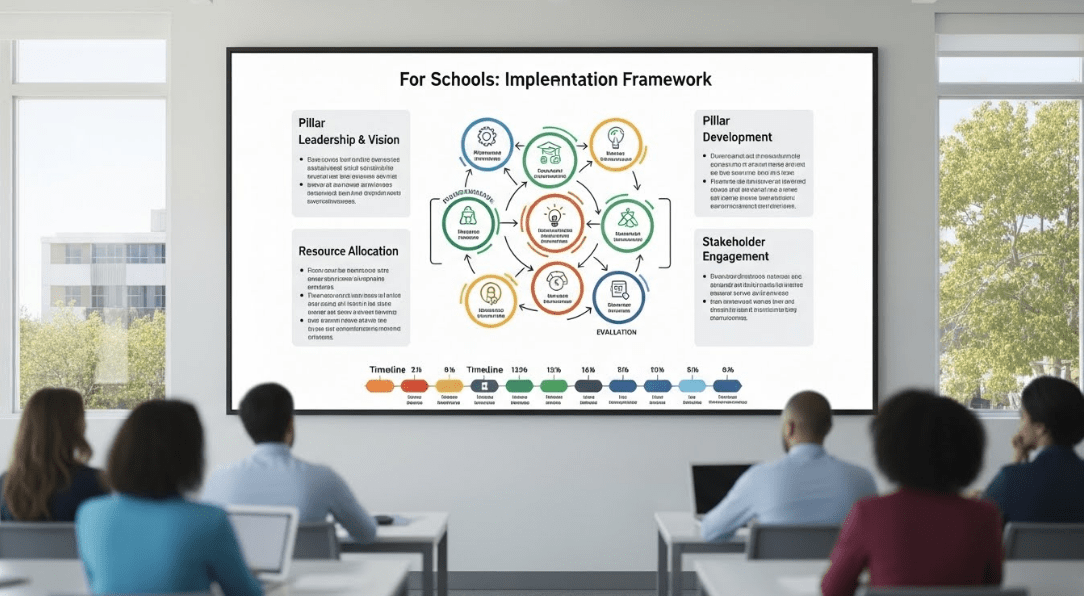
Generation 2050 – For Schools Implementation Framework
Empowering schools to educate the climate-literate generation
Last Updated: January 2026
📎 APPENDICES
Appendix A: Sample Timeline (Full Implementation)
Year 0 (Pre-Launch):
- Q1: Committee formation, review
- Q2: Decision, budget allocation
- Q3: Planning, teacher selection
- Q4: Training, materials prep
Year 1 (Launch):
- Q1: Soft launch, grades 4-7
- Q2: Expand to grades 3, 8
- Q3: Full K-12 implementation
- Q4: Evaluation, planning year 2
Year 2 (Refinement):
- Continue full program
- Adjust based on year 1 learning
- Add enrichment (competitions, projects)
- Student leadership programs
Year 3+ (Maturity):
- Established program
- Student outcomes evident
- School reputation solidified
- Consider: Training other schools (consulting revenue!)
Appendix B: Sample Parent Communication
Email Subject: Introducing Generation 2050 – Climate Education for Our Students
Dear Parents,
We’re excited to announce that [School Name] is implementing Generation 2050, a comprehensive climate and transformation education curriculum for grades K-12.
What is Generation 2050? An age-appropriate program that teaches students about climate science, sustainable solutions, and prepares them for green careers – all aligned with UAE Vision 2050.
Why are we doing this?
- Prepares students for the future job market (green jobs growing 10x faster!)
- Aligns with UAE national priorities
- Develops critical 21st-century skills
- Solution-focused (not anxiety-inducing)
What will your child learn? [Age-specific overview]
How can you support?
- Do activities at home (sent weekly)
- Discuss what they’re learning
- Attend our parent information session: [Date]
Questions? Please contact [Coordinator Name] at [Email]
We’re excited about this program and believe it will prepare our students for their future!
Warm regards, [Principal Name]
Appendix C: Sample Assessment Rubric
Earth Explorers (Grades K-5) – Activity Assessment
Criteria:
- Completion (Did they do all parts?)
- Understanding (Can they explain the concept?)
- Creativity (Did they add personal touches?)
- Effort (Did they try their best?)
Scoring:
- 4: Exceeds expectations
- 3: Meets expectations
- 2: Approaching expectations
- 1: Needs support
Not about perfection – about engagement and learning!
END OF FOR SCHOOLS GUIDE
Total Implementation Framework: Complete! 🎊