Raising Generation 2050 – Your Child’s Future Starts at Home
Your child will be in their 30s-40s in 2050. This guide helps you support their journey to becoming climate-literate, future-ready adults.
🎯 WHY GENERATION 2050 MATTERS FOR YOUR FAMILY
This Isn’t Just School Content – It’s Your Child’s Future
Your child’s age now → Their age in 2050:
- 5 years old now → 29 in 2050
- 10 years old now → 34 in 2050
- 15 years old now → 39 in 2050
- 18 years old now → 42 in 2050
In 2050, your child will be:
- At the peak of their career
- Maybe raising their own children
- Living in the world we’re building NOW
Climate isn’t a distant problem – it’s THEIR life.
💚 WHAT GENERATION 2050 TEACHES
Not Traditional “Save the Planet” Education:
What it’s NOT:
- ❌ Doom and gloom
- ❌ Guilt-based messaging
- ❌ “Adults ruined everything”
- ❌ Scary predictions without solutions
What it IS:
- ✅ “Build YOUR world” empowerment
- ✅ Solution-focused learning
- ✅ Career pathways (green jobs = future jobs!)
- ✅ Personal agency (you CAN make a difference)
- ✅ UAE-specific opportunities (MBZUAI, G42, Masdar, etc.)
Result: Your child feels empowered, not anxious. Prepared, not paralyzed.
👶 BY AGE: HOW TO SUPPORT YOUR CHILD
EARTH EXPLORERS (Ages 5-10) – Parent Guide
Your child is learning: Basic earth systems, energy, care for environment
At Home Support:
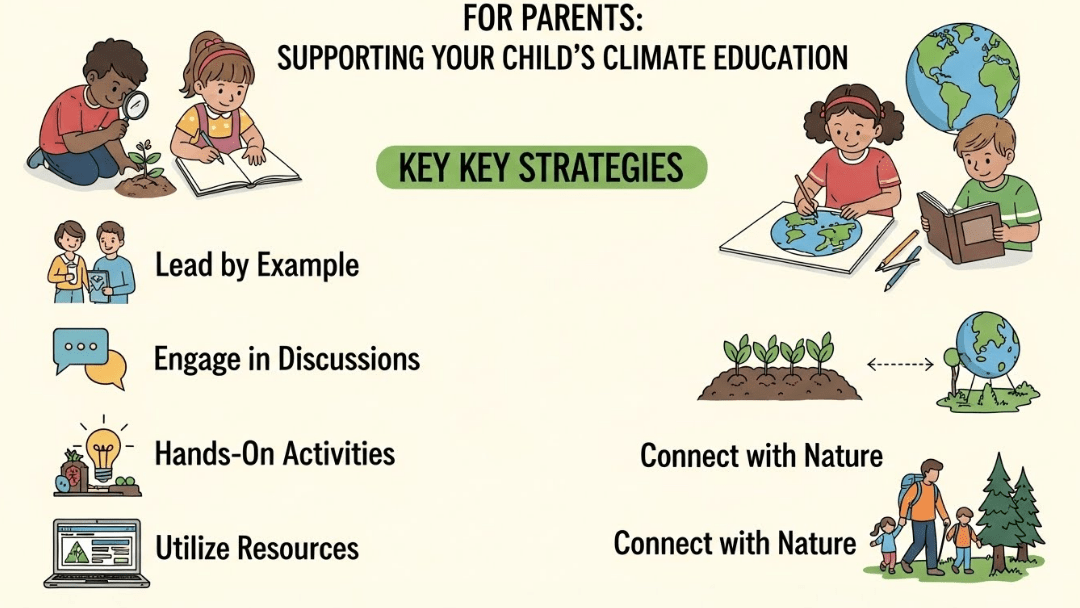
1. Do the Activities Together Every article has 3 hands-on activities. Do them as family!
Example activities:
- Draw your 2050 planet (art night!)
- Solar oven s’mores (science + treats!)
- Water cycle in a bag (kitchen experiment)
- Tree planting (family project)
Why together:
- Quality time + learning
- Shows you value it
- Reinforces concepts
- Creates memories
Time commitment: 30-60 min per activity, 1-2 times per week
2. Make It Daily
Simple daily habits:
- Morning: “Did you turn off your bedroom light?” (energy awareness)
- Meals: “Where did this food come from?” (food systems)
- Errands: “Should we walk or drive?” (transportation choices)
- Bedtime: “What did you do to help Earth today?” (reflection)
Not lectures – conversations!
3. Model Behavior
Your child copies YOU more than listens to you.
They notice:
- Do you recycle?
- Do you waste water?
- Do you turn off lights?
- What do you buy?
- How do you commute?
You don’t have to be perfect. But be conscious.
4. Celebrate Progress
When your child:
- Remembers to turn off lights → Praise!
- Asks to recycle → Celebrate!
- Teaches siblings → Wow!
- Completes activity → Recognize!
Positive reinforcement = behavior change
5. Answer Questions Honestly
Common questions:
“Are we going to run out of water?” → “Some places have water challenges, but we’re learning to use less and save more. And YOU’RE helping!”
“Will polar bears die?” → “Some are in trouble, yes. But people are working to help them. And when you grow up, you can too!”
“Is Earth going to be okay?” → “If people like YOU keep learning and taking action, yes! We can fix this.”
Be honest but hopeful. Solutions exist.
What NOT to Do:
❌ Don’t:
- Dismiss their concerns (“Don’t worry about that”)
- Overwhelm with problems (“Everything’s dying!”)
- Make it political (“Those people don’t believe in climate”)
- Expect perfection (“You didn’t recycle that wrapper!”)
✅ Do:
- Listen to concerns
- Focus on solutions
- Keep it factual
- Celebrate effort
EARTH CHAMPIONS (Ages 11-14) – Parent Guide
Your child is learning: Climate science, technology, circular economy, careers
At Home Support:
1. Engage with Their Learning
Weekly check-in: “What are you learning about climate this week?”
Not: “Did you do your homework?”
But: “What’s something interesting you learned?” “Can you explain that carbon cycle thing?” “What activity are you doing?”
Let them teach YOU. Teaching = best learning.
2. Support Their Experiments
Champions do hands-on activities: carbon footprint calculations, experiments, challenges.
Your role:
- Provide materials (usually household items)
- Give space/time
- Don’t do it for them (let them figure it out!)
- Celebrate results
Example: If they’re calculating family carbon footprint, help find utility bills but let THEM do the math.
3. UAE Opportunities Discussion
This age explores careers. Talk about:
- “Did you know MBZUAI offers free university?” (Plant seed early!)
- “G42 is hiring AI people – what’s AI?” (Career awareness)
- “Masdar works on solar – that’s engineering” (Connect interests)
Not pressure – exposure.
4. Support Their Initiatives
If they want to:
- Start school environmental club → Help with logistics
- Organize beach cleanup → Drive them, participate
- Enter competition → Help with registration, practice presentation
- Reduce family waste → Support their ideas
They’re developing leadership. Encourage it!
5. Family Challenges
Try together:
- 30-day energy reduction (track utilities before/after)
- Meatless Mondays (everyone!)
- Zero waste week (see how little trash you can generate)
- Water saving challenge
Make it competitive but fun. Track results. Celebrate savings!
Addressing Anxiety:
Ages 11-14 = more aware of problems, can feel helpless
If your child seems anxious:
Signs:
- Crying about climate
- Refusing to eat (food waste anxiety)
- Obsessing over recycling
- Expressing hopelessness
What to do:
- Acknowledge feelings: “I understand why you’re concerned”
- Emphasize solutions: “Here’s what people are doing to fix it”
- Focus on agency: “YOU have power through your choices”
- Limit news exposure: Not every climate disaster needs detailed discussion
- Seek professional help if severe: Therapist can help with eco-anxiety
Generation 2050 is designed to prevent this (solution-focused!) but some kids more sensitive.
EARTH LEADERS (Ages 15-18) – Parent Guide
Your child is learning: Leadership, careers, investing, college planning, entrepreneurship
At Home Support:
1. Career Conversations
This age = career preparation. Discuss:
“What interests you?”
- Engineering? → Renewable energy engineer ($80K-150K)
- Law? → Environmental lawyer ($70K-180K)
- Business? → Sustainability consultant ($80K-150K)
- Science? → Climate scientist ($80K-130K)
- Tech? → AI climate specialist ($100K-180K)
Show them green careers = good careers!
“What are you good at?” Match skills to climate careers. Every skill useful!
- Good at math → Engineering, data science
- Good at writing → Policy, journalism, education
- Good at persuasion → Sales (green tech), consulting
- Good at organizing → Project management, entrepreneurship
“Where do you see yourself in 2050?” Make it real! They’ll be 40. What life do they want?
2. College Planning Support
MBZUAI Discussion (Critical!):
- “This is 100% FREE including living expenses”
- “World’s first AI university in Abu Dhabi”
- “$200,000 scholarship value”
- “Climate AI research happening there”
- “You should apply” (Even if not #1 choice, good option!)
Other UAE universities:
- Khalifa (engineering + energy)
- UAEU (largest local option)
- NYU Abu Dhabi (if they can get in – need-blind admissions!)
International:
- If studying abroad, UAE scholarships available
- Sheikh Mohammed bin Rashid Scholarship (Emiratis)
- ADNOC Scholarship (job guarantee!)
Your role:
- Research together
- Visit campuses
- Help with applications (but don’t write essays!)
- Discuss finances openly
3. Entrepreneurship Support
If they want to start business:
Encourage it! Even if it fails, learning is huge.
Your role:
- Small seed funding if you can ($100-1,000)
- Advice (if you have business experience)
- Connections (introduce to people in your network)
- Emotional support (they’ll face rejection)
- NOT running it for them!
Point them to:
- Khalifa Fund (Emiratis, up to AED 5M)
- Hub71 (tech startups, AED 2M incentives)
- DTEC/in5 (incubators)
- Youth competitions (Zayed Prize, etc.)
4. Financial Literacy
Leaders learn investing. Support this:
If 18+:
- Help them open brokerage account
- Match their first investment (e.g., they put AED 500, you add AED 500)
- Discuss your own investments
- Review together quarterly
If under 18:
- Open custodial account
- Start with small amount (AED 200-500)
- ESG funds recommended (VFTAX, ESGV)
- Let them make decisions (even mistakes!)
This isn’t gambling – it’s building wealth. Starting early = massive advantage.
5. Give Them Autonomy
Ages 15-18 need independence:
Let them:
- Make their own college choices (within financial reality)
- Manage their own schedule
- Take risks (calculated ones!)
- Fail sometimes (learning!)
Your role: Safety net, advisor, supporter. Not controller.
The “My Child Isn’t Interested” Problem:
If your teen seems disengaged:
Possible reasons:
- Feels overwhelmed (too much doom)
- Doesn’t see personal relevance
- Peer pressure (not “cool”)
- Busy with other things
Solutions:
- Connect to their interests: Gaming? Climate games. Fashion? Sustainable fashion. Music? Climate concerts.
- Show the money: “Green jobs pay well – look at these salaries”
- UAE specific: “MBZUAI is free! G42 is hiring!”
- Don’t force: Expose, don’t impose. Plant seeds.
Some teens late bloomers. That’s okay.
🏠 MAKING YOUR HOME SUSTAINABLE (TOGETHER!)
Projects to Do as Family:
1. Home Energy Audit
- Walk through house together
- Identify energy waste (lights on, air leaks, old appliances)
- Calculate costs
- Make improvement plan
- Track savings!
Educational + saves money!
2. Solar Panels (If Homeowner)
- Research together
- Get quotes
- Calculate payback period
- UAE has Shams Dubai program (DEWA pays you!)
- Long-term: Free electricity + helping climate
3. Waste Reduction Challenge
- Track family waste for 1 week
- Weigh it!
- Set goal: reduce 30%
- Try for 1 month
- Measure again
Turns it into game!
4. Garden/Composting
- Start small: herbs on balcony
- Or full garden if space
- Compost food scraps
- Grow food together
Kids love seeing things grow!
5. Transportation Shift
- Calculate: Car costs vs. alternatives
- Try: Walking/biking for some trips
- Public transit experiment
- When ready: EV discussion
💰 THE MONEY CONVERSATION
Climate Action Often Saves Money:
Show your kids the math:
LED bulbs:
- Cost: AED 20
- Saves: AED 200 over lifetime
- ROI: 10x
Solar panels (if you install):
- Cost: AED 50,000 (typical home)
- Saves: AED 5,000/year
- Payback: 10 years
- Then: Free electricity for 15+ years!
EV vs. gas car:
- EV: AED 0.11/km
- Gas: AED 0.44/km
- Savings: 75%
“Green” = “Smart with money”
Allowance Linked to Impact:
Consider:
- Base allowance as normal
- Bonus: AED 10-20/week for meeting family sustainability goals
- Lights off consistently
- No food waste
- Water saving
- Bike instead of car rides
Teaches: Actions have value
🇦🇪 UAE-SPECIFIC PARENT ACTIONS
Take Advantage of UAE Resources:
1. Government Programs
- Shams Dubai: Get paid for rooftop solar
- DEWA smart meters: Track usage in real-time
- Dubai Can: Reduce plastic campaign
- Various recycling programs: Check municipality
2. UAE Opportunities for Kids
- MBZUAI summer programs: Free AI camps for high schoolers
- FIRST Robotics UAE: Join team
- Youth competitions: Zayed Prize, UAE AI Award
- Emirates Environmental Group: Youth programs
3. UAE Culture Integration
- Islamic environmental principles: Discuss stewardship (khalifa), avoiding waste (israf)
- Majlis tradition: Family discussions about climate
- Community engagement: Mosque programs, neighborhood initiatives
4. Leverage Dubai’s Infrastructure
- Museum of the Future: Visit! Climate exhibits
- Masdar City tours: See sustainable city
- Solar Park tours: Mohammed bin Rashid Solar Park
- Expo 2020 legacy: Sustainability pavilions still accessible
📱 MANAGING SCREEN TIME & CLIMATE
Not All Screen Time Equal:
Good climate screen time:
- Generation 2050 articles/activities (obviously!)
- Climate documentaries (“Our Planet,” “My Octopus Teacher”)
- Educational YouTube (Kurzgesagt, TED-Ed climate videos)
- Climate apps/games
- MBZUAI online resources
Less productive:
- Doomscrolling climate news (increases anxiety)
- Arguing on social media
- Passive consumption
Balance: 30-60 min educational screen time = okay. 3 hours doomscrolling = not okay.
🤝 PARTNERING WITH SCHOOL
If School Using Generation 2050:
Support teacher by:
- Doing home activities
- Asking your child what they learned
- Attending presentations/events
- Volunteering if needed
- Positive feedback to school (they need to know parents approve!)
If School NOT Using It:
You can still use at home:
- Read articles together
- Do activities on weekends
- Suggest to school (share website!)
- Find other families interested (home learning group!)
❓ COMMON PARENT QUESTIONS
“Is this going to make my child anxious about climate?”
No – designed specifically to prevent anxiety! Solution-focused, empowering, age-appropriate. If child seems anxious, that’s unusual and should be addressed (see anxiety section above).
“Isn’t this political? I don’t want school teaching politics.”
Climate science isn’t political – it’s science. We teach facts, solutions, skills. No political parties mentioned. Just like evolution or gravity – scientific consensus.
“My child is too young to worry about this.”
We don’t teach “worry” – we teach understanding and care. Age-appropriate. 5-year-olds learn “turn off lights” not “civilization collapse.”
“Won’t this make them hate me/past generations?”
No! We don’t blame. We focus on: Past did their best with knowledge they had. Now WE have better knowledge. Let’s build better future. Forward-looking, not backward-blaming.
“What if the career advice is wrong? Jobs change!”
Green jobs are GROWING 10x faster than overall economy. Renewable energy, sustainability, AI climate – these are long-term trends. Safe bets. And skills (problem-solving, systems thinking, creativity) transfer regardless.
“We can’t afford solar/EV/etc.”
Many climate actions FREE (behavior changes). Some save money (LED bulbs, water conservation). Big investments (solar, EV) are optional and have payback. Start small, scale up.
“What about my industry? (Oil/gas/conventional)”
Transition doesn’t mean overnight. And oil/gas companies hiring sustainability people! ADNOC has AI climate division. Your expertise valuable in green transition. Model: “Industries evolve. We evolve with them.”
“This seems UAE-focused. We’re expat planning to leave.”
Skills and knowledge transfer globally. MBZUAI degree recognized worldwide. Climate literacy useful everywhere. UAE just happening to lead right now.
🎯 QUICK START FOR BUSY PARENTS
Week 1: ☑️ Read one article with your child (their age level) ☑️ Discuss: “What do you think about this?” ☑️ Do one activity together
Week 2: ☑️ Implement one new household habit (from article) ☑️ Check: Is child noticing/participating? ☑️ Praise engagement
Week 3: ☑️ Read another article ☑️ Try another activity ☑️ Discuss: “How does this connect to YOUR 2050?”
Week 4+: ☑️ Regular rhythm established (one article every 1-2 weeks) ☑️ Household changes sticking ☑️ Child becoming more aware ☑️ Impact growing!
Not overwhelming. Just consistent.
💚 THE BOTTOM LINE
Your child will be in their prime in 2050.
The world they inherit = result of actions taken in next 10 years.
You can’t control government policy or corporate decisions.
But you CAN:
- ✅ Educate your child
- ✅ Model sustainable living
- ✅ Support their climate journey
- ✅ Connect them to opportunities (MBZUAI, competitions, etc.)
- ✅ Make your household more sustainable
- ✅ Celebrate their efforts
Your role isn’t to save the planet alone.
Your role is to raise a human who will help save it.
And that starts at home, today, with Generation 2050.
Thank you for supporting your child’s climate education. 🇦🇪🌍💚
Monthly webinars:
- “Supporting Your Climate-Conscious Child”
- “UAE Opportunities for Youth”
- “Managing Eco-Anxiety”
- Register: 2050planet.com/parents/events
Generation 2050 – For Parents Guide
Supporting families raising the climate-literate generation
Last Updated: January 2026