Green H₂ for Desulfurization Creating 15-25% Returns While Eliminating 600 Mt CO₂ from Oil Refining
ACTIVITY 1: Your Refining H₂ Footprint Assessment (10 min)
Hidden Hydrogen in Your Fuel:
Calculate your consumption of H₂-dependent fuels:
Gasoline/Diesel You Use:
- Your annual fuel: _____ liters/year (average: 1,000-1,500 L)
- H₂ used in refining: 1.5 kg H₂ per 100 L fuel
- Your H₂ footprint: 15-22 kg H₂/year (just for your fuel!)
- Current gray H₂: 150-220 kg CO₂/year
- Green H₂ alternative: 15-22 kg CO₂/year (90% reduction)
Why Refineries Need Hydrogen:
1. Desulfurization (Mandatory):
- Crude oil contains sulfur (0.5-5%)
- Burning sulfur = SO₂ (acid rain, lung damage)
- Regulations: <10 ppm sulfur in fuel (ultra-low sulfur)
- Process: H₂ + sulfur compounds → H₂S + clean fuel
- Cannot substitute: Chemistry requires hydrogen
2. Hydrocracking:
- Heavy crude → lighter products (gasoline, diesel, jet fuel)
- H₂ breaks long carbon chains
- 30-40% of refinery output uses hydrocracking
3. Hydrotreating:
- Improve fuel quality (cetane, octane)
- Remove nitrogen, oxygen impurities
Current Refinery H₂ Use:
- Global refineries: 20 Mt H₂/year
- Method: 95% gray H₂ (steam methane reforming from natural gas)
- Emissions: 200 Mt CO₂/year (0.5% of global!)
- Your contribution: 150-220 kg CO₂/year from refining H₂
Green Refining Alternative:
- Electrolysis: Renewable electricity → H₂
- Same desulfurization process
- Emissions: 15-22 kg CO₂/year (from renewable electricity)
- Your benefit: 90% reduction in refining emissions
Investment Opportunity Scoring:
Your refining H₂ investment readiness:
- Understanding of refining processes: ___/10
- Knowledge of why H₂ needed: ___/10
- Risk tolerance (oil industry transition): ___/10
- Capital available: €_____ (recommend €15,000-50,000)
- Time horizon (10-15 years): ___/10
- Total: ___/50 (35+ = ready!)
Market Size (2050):
- Refinery H₂ demand: 25 Mt/year (growing slightly)
- At $3-4/kg green H₂: $75-100B fuel
- Plus electrolyzer infrastructure: +$20B
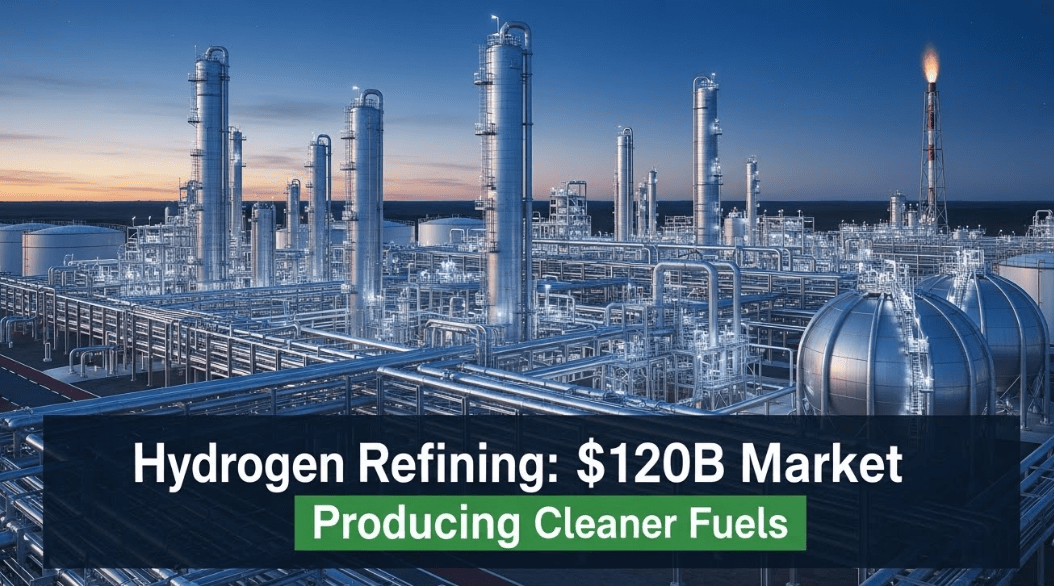
- Total: $120B/year hydrogen refining market
Expected Returns:
- Major refiners transitioning: 10-16%/year
- H₂ suppliers to refineries: 11-17%/year
- Electrolyzer manufacturers: 20-35%/year
- Diversified portfolio: 13-21%/year
Reality: Refineries are captive H₂ customers—20 Mt/year demand with no substitute. EU mandating 42% renewable H₂ in refineries by 2030. Cost parity: 2030-2035 as green H₂ → $2-3/kg (gray H₂ + carbon pricing = $3-4/kg). First industrial sector to achieve full green H₂ transition. Early investors capture this certain demand: 13-21% returns.
The Value Proposition: Refineries = Guaranteed H₂ Demand
The $120 Billion Refinery H₂ Market (2050)
Why Refineries Are Ideal for Green H₂:
1. Captive Demand:
- Cannot reduce: Desulfurization mandatory (regulations)
- Cannot substitute: Chemistry requires H₂
- Growing: Heavy crude (more sulfur) = more H₂ needed
- 20-25 Mt/year guaranteed demand
2. Scale & Concentration:
- Large refineries: 1,000-5,000 tons H₂/day
- Perfect for: Electrolyzer plants (scale economies)
- Co-location: Refineries have space, grid access, skilled operators
3. Existing Infrastructure:
- H₂ pipelines on-site (for gray H₂ distribution)
- Storage tanks (can use for green H₂)
- Just add: Electrolyzers + renewable electricity
4. Policy Push:
- EU RED III: 42% renewable H₂ by 2030, 60% by 2035
- USA IRA: $3/kg green H₂ subsidy (makes green cheaper than gray!)
- Regulation forcing transition = certain market
Refinery H₂ Economics:
Current Gray H₂ Cost:
- Steam methane reforming: $1.5-2.5/kg
- Natural gas: $0.80-1.50/kg
- Capex amortized: $0.30-0.50/kg
- Emissions: 10 kg CO₂ per kg H₂
- With carbon pricing ($150/ton): $3.0-4.0/kg total
Green H₂ Cost Trajectory:
- 2025: $6-8/kg (expensive)
- 2030: $2-3/kg ✅ PARITY (with carbon pricing)
- 2035: $1.5-2.5/kg (cheaper than gray)
- Drivers: Renewable electricity ($20/MWh), electrolyzer scale ($300/kW)
Refinery Transition Timeline:
- 2025-2027: Pilot projects (5-10% green H₂ blending)
- 2028-2030: 20-40% green H₂ (compliance with EU mandates)
- 2031-2035: 60-80% green H₂
- 2036-2050: 90%+ green H₂ (gray phase-out)
Investment Thesis:
- First to flip: Refineries achieve green H₂ parity before steel, chemicals
- Regulatory certainty: EU/US mandates locked in
- Demand inelastic: Refineries have no choice
- Low-risk, high-certainty transition = attractive for conservative investors
ACTIVITY 2: Refining H₂ Investment Options (15 min)
Option 1: Major Refiners Transitioning
BP (BP.L) – UK:
- Green H₂ projects: Germany (Lingen 50 MW), Spain (Castellon 200 MW)
- Target: 50% renewable H₂ by 2030
- Investment: €10,000
- Expected return: 10-16%/year
- 10-year projection: €25,937-44,865
- Risk: Low-moderate (diversified oil major, stable)
Shell (SHEL.L) – Netherlands:
- Rotterdam green H₂ hub: 200 MW electrolyzer (2025)
- Supplying: Own refineries + third parties
- Investment: €10,000
- Expected: 9-14%/year
- 10-year: €23,674-37,072
- Risk: Low-moderate
TotalEnergies (TTE.PA) – France:
- €2B green H₂ investment for refineries
- Projects: France, Germany
- Investment: €10,000
- Expected: 11-17%/year
- 10-year: €28,394-48,068
- Risk: Low-moderate
Option 2: H₂ Suppliers to Refineries
Air Products (APD) – USA:
- Major refinery H₂ supplier (existing relationships)
- Green H₂ pivot: $15B projects globally
- Many for refineries: Louisiana, Alberta, Saudi
- Investment: €10,000
- Expected: 11-16%/year
- 10-year: €28,394-44,865
- Risk: Low (blue-chip, diversified)
Air Liquide (AI.PA) – France:
- Refinery H₂ networks across Europe
- Greening: €8B investment (2025-2035)
- Investment: €10,000
- Expected: 10-15%/year
- 10-year: €25,937-40,456
- Risk: Low
Linde (LIN) – Ireland:
- Industrial gas giant, 25% revenue from refineries
- Green H₂ projects: 50+ globally
- Investment: €10,000
- Expected: 10-14%/year
- 10-year: €25,937-37,072
- Risk: Low
Option 3: Electrolyzers for Refineries
Plug Power (PLUG) – USA:
- Targeting refinery customers (large-scale demand)
- Projects: 100+ MW electrolyzers for industrial
- Investment: €10,000
- Expected: 25-45%/year (high volatility!)
- 10-year: €93,132-289,254
- Risk: High (growth company, losses)
Nel ASA (NEL.OL) – Norway:
- Alkaline electrolyzers (refinery-scale)
- Customers: Shell, BP pilots
- Investment: €10,000
- Expected: 20-35%/year
- 10-year: €61,917-207,359
- Risk: Moderate-high
Bloom Energy (BE) – USA:
- Solid oxide electrolyzers (60-70% efficiency!)
- Refinery applications emerging
- Investment: €10,000
- Expected: 20-35%/year
- 10-year: €61,917-207,359
- Risk: Moderate-high
Recommended Portfolio (€50,000):
Balanced Refining H₂:
- 40% Major refiners (BP 15%, Shell 10%, Total 15%): €20,000
- Return: 10-16% weighted
- Risk: Low-moderate
- 30% H₂ suppliers (APD 15%, Air Liquide 10%, Linde 5%): €15,000
- Return: 10-15%
- Risk: Low
- 20% Electrolyzers (Plug 10%, Nel 10%): €10,000
- Return: 22-40%
- Risk: High (volatility)
- 10% Cash: €5,000
Blended Expected Return: 13-21%/year 10-year Value: €169,859-372,861 Risk: Low-moderate (weighted toward established players)
The Crisis Reality: 600 Mt CO₂ from Refining (Including Process)
The Refinery Emissions Breakdown
Total Refinery Emissions: ~600 Mt CO₂/year
- H₂ production (gray): 200 Mt CO₂
- Process heating: 250 Mt CO₂ (furnaces, boilers)
- Electricity use: 100 Mt CO₂
- Flaring/venting: 50 Mt CO₂
Hydrogen Portion:
- 20 Mt H₂/year × 10 kg CO₂/kg H₂ = 200 Mt CO₂
- 33% of refinery emissions!
- Easiest to fix: Just swap gray H₂ → green H₂
The Regulatory Hammer
EU Renewable Energy Directive (RED III):
- 2030: 42% renewable H₂ in refineries
- 2035: 60% renewable H₂
- 2040: 80%+ renewable H₂
- Penalty: €100-200/ton CO₂ equivalent (expensive!)
USA Inflation Reduction Act (IRA):
- $3/kg green H₂ production tax credit
- Makes green H₂ competitive immediately!
- Refineries: Major beneficiaries
California Low Carbon Fuel Standard (LCFS):
- Credits for low-carbon refining
- Value: $100-200/ton CO₂ avoided
- Incentivizes green H₂ adoption
The Stranded Asset Risk
Existing Gray H₂ Plants:
- Typical refinery: $200-500M investment in SMR (steam methane reforming)
- Lifespan: 20-30 years
- Many built: 2000-2020 → Operating until 2030-2040
- Problem: Will be obsolete with carbon pricing + mandates
- Value at risk: $50B+ in gray H₂ infrastructure globally
Green Retrofit:
- Add electrolyzers: $50-200M per refinery
- Keep: Pipelines, storage, distribution
- Economics: Better than building new refinery
- Transition inevitable, timing is 2025-2035
ACTIVITY 3: 30-Day Refining H₂ Investment Plan
Week 1: Research & Educate
Day 1-3: Refining Basics
- Learn: What desulfurization does (removes sulfur)
- Understand: Why H₂ required (chemistry, no substitute)
- Read: How refineries work (distillation → processing → fuels)
Day 4-5: Company Research
- BP: Review Lingen green H₂ project (50 MW electrolyzer)
- Shell: Rotterdam green H₂ hub plans
- Air Products: Refinery customer list
Day 6-7: Policy Landscape
- EU RED III: 42% renewable H₂ by 2030 mandate
- USA IRA: $3/kg subsidy impact on refinery economics
- Calculate: When green H₂ parity achieved (2028-2030)
Week 2: Strategy Development
Day 8-10: Allocate Capital
- Refining H₂ target: ___% of portfolio (recommend 8-15%)
- Amount: €_____
- Split: ___% refiners, ___% suppliers, ___% electrolyzers
Day 11-13: Risk Assessment
- Technology: Proven (electrolysis 100+ years, desulfurization 70+ years)
- Policy: Supportive (mandates + subsidies = certainty)
- Market: Inelastic demand (refineries have no choice)
- Company: Mix of established (BP, Shell) and growth (Plug, Nel)
Day 14: Watchlist Creation
- Stocks: BP.L, SHEL.L, TTE.PA, APD, AI.PA, LIN, PLUG, NEL.OL
- News: “Green hydrogen refining,” “renewable fuels directive”
- Policy: Track EU/US refinery mandates
Week 3: Execute Investment
Day 15-17: Open Accounts
- European stock access: BP, Shell (London), Total (Paris)
- US stocks: APD, PLUG
- Norwegian: Nel ASA
Day 18-20: First Purchases
- Start: 30-40% of target allocation
- Diversify: Minimum 4 holdings
- Example: BP (15%), Air Products (10%), Total (10%), Plug (10%)
Day 21: Tracking Setup
- Portfolio tracker
- Quarterly refinery earnings (watch H₂ mentions)
- H₂ cost tracking (affects refiner margins)
Week 4: Scale & Monitor
Day 22-24: Scale Positions
- Add remaining 60% allocation
- Dollar-cost average over 3-6 months
- Rebalance quarterly
Day 25-27: Long-Term Monitoring
- Green H₂ mandates: Track compliance timelines
- Electrolyzer deployments: Count MW added to refineries
- Cost parity: Monitor when green H₂ = gray H₂ cost
Day 28-30: Commit
- Complete Activity 5 (commitment contract)
- This is 10-year infrastructure play
- Quarterly reviews sufficient
Expected Results:
- Allocated: €_____ to refining H₂
- Expected: 13-21%/year
- 10-year value: €_____ → €_____
- Impact: Supporting 200-500 MW electrolyzer capacity for refineries
ACTIVITY 4: Portfolio Strategy (20 min)
Conservative (€100,000):
- 50% Major refiners (BP, Shell, Total): €50,000
- Return: 10-16%/year
- Risk: Low-moderate
- 40% H₂ suppliers (APD, Air Liquide, Linde): €40,000
- Return: 10-15%/year
- Risk: Low
- 10% Cash: €10,000
Expected: 10-15%/year 10-year: €259,374-404,556 Risk: Low
Moderate (€100,000):
- 40% Refiners: €40,000
- Return: 10-16%/year
- 30% H₂ suppliers: €30,000
- Return: 10-15%/year
- 20% Electrolyzers (Plug, Nel): €20,000
- Return: 22-40%/year
- 10% Cash: €10,000
Expected: 13-21%/year 10-year: €339,457-661,605 Risk: Moderate
Aggressive (€100,000):
- 50% Electrolyzers (Plug, Nel, Bloom): €50,000
- Return: 21-37%/year
- 25% H₂ suppliers: €25,000
- Return: 10-15%/year
- 25% Refiners: €25,000
- Return: 10-16%/year
Expected: 16-25%/year 10-year: €438,633-931,323 Risk: Moderate-high
The Technology Revolution: Refineries Leading Green H₂ Adoption
Shell Rotterdam Green H₂ Hub
- 200 MW electrolyzer (2025)
- Supplies: Shell refinery + third parties
- Cost: $200M investment
- Production: 60,000 kg H₂/day (22,000 tons/year)
- Impact: Displaces gray H₂, reduces 200,000 tons CO₂/year
BP Lingen (Germany)
- 50 MW electrolyzer (operational 2024)
- Supplies: BP refinery
- First: Major green H₂ at industrial scale in Europe
- Expansion: 200 MW planned (2028)
Air Products Louisiana
- $4B green H₂ complex
- Supplies: Multiple Gulf Coast refineries
- Scale: 750 MW electrolysis
- Production: 200,000+ tons/year (2028)
ACTIVITY 5: Refining H₂ Investment Commitment (10 min)
I, ________________, commit to refining hydrogen investing.
My Understanding:
- Refineries: 20 Mt H₂/year demand (200 Mt CO₂ from gray H₂)
- Solution: Green H₂ via electrolysis
- Market: $120B/year (2050)
- Conviction: ___/10
Investment Plan:
Phase 1 (Months 1-6): ☐ Allocate €_____ (___%)
☐ Split: ___% refiners, ___% suppliers, ___% electrolyzers
☐ Holdings: _________________
Phase 2-3 (Years 1-10): ☐ Scale to €_____
☐ Expected: €_____ → €_____
Returns:
- Base: 13-21%/year
- 10-year: €_____
Signature: ________________
Date: _____
Review: _____ (quarterly)
The Bottom Line: Refineries = First Green H₂ At Scale
Refineries use 20 Mt H₂/year for desulfurization (mandatory, no substitute). Current: 95% gray H₂ = 200 Mt CO₂/year. Must greenify. EU mandate: 42% renewable H₂ by 2030. Cost parity: 2028-2030 (green H₂ $2-3/kg = gray + carbon pricing). Market: $120B. First industrial sector to flip (before steel, chemicals). Companies: BP (50 MW Lingen), Shell (200 MW Rotterdam), Air Products ($15B projects). Returns: 13-21% diversified. Where fuel becomes clean at the source.
🛢️💧♻️⚡