Long-Duration H₂ Storage + Fuel Cells Creating 18-30% Returns While Solving Renewable Intermittency
ACTIVITY 1: Your Energy Storage Need Assessment (10 min)
Current Energy Vulnerability Check:
Calculate your dependence on grid reliability:
Power Outages You’ve Experienced:
- Last year: _____ hours without power
- Cause: Storm / Grid failure / Heat wave demand
- Cost to you: Food spoilage €, lost productivity €, inconvenience
Renewable Intermittency in Your Region:
- Solar capacity: ___% of grid (check your utility)
- Wind capacity: ___% of grid
- Problem: Solar produces zero at night (12 hours daily gap!)
- Problem: Wind varies 0-100% (multi-day calm periods)
The Storage Gap:
- Summer day: Solar produces 150% of demand (surplus!)
- Summer night: Solar produces 0% (need storage 12 hours)
- Winter night: Heating demand 200%, solar 0% (need 14+ hours storage)
- Multi-day storms: No solar/wind for 2-5 days (need 48-120 hours storage!)
Current Storage Solutions Fall Short:
- Lithium-ion batteries: 4-8 hours maximum (economic limit)
- Cost: $300-500/kWh
- Beyond 8 hours: Prohibitively expensive
- Pumped hydro: Limited geography (need mountains + water)
- Only 3% of locations suitable
- Most sites already used
Hydrogen Long-Duration Storage:
- Duration: Unlimited (days, weeks, months!)
- Summer surplus: Electrolysis stores excess renewable energy as H₂
- Winter demand: Fuel cells or turbines convert H₂ back to electricity
- Cost: $100-150/kWh (8-12 hours equivalent) dropping
Your Seasonal Storage Need:
- Summer electricity: _____ kWh/month
- Winter electricity: _____ kWh/month (higher – heating)
- Gap: Winter – summer = _____ kWh/month deficit
- At €0.15/kWh: €_____ seasonal cost increase
- With H₂ storage: Flatten costs, store summer surplus for winter
Investment Opportunity Scoring:
Your H₂ power storage readiness:
- Understanding of grid challenges: ___/10
- Knowledge of fuel cells: ___/10
- Risk tolerance (energy infrastructure): ___/10
- Capital available: €_____ (recommend €15,000-75,000)
- Time horizon (10-15 years): ___/10
- Total: ___/50 (35+ = ready!)
Market Size (2050):
- Long-duration storage need: 100-200 GW globally
- H₂ fuel cell plants: $150B market
- H₂ turbines: $60B market
- Underground storage: $40B market
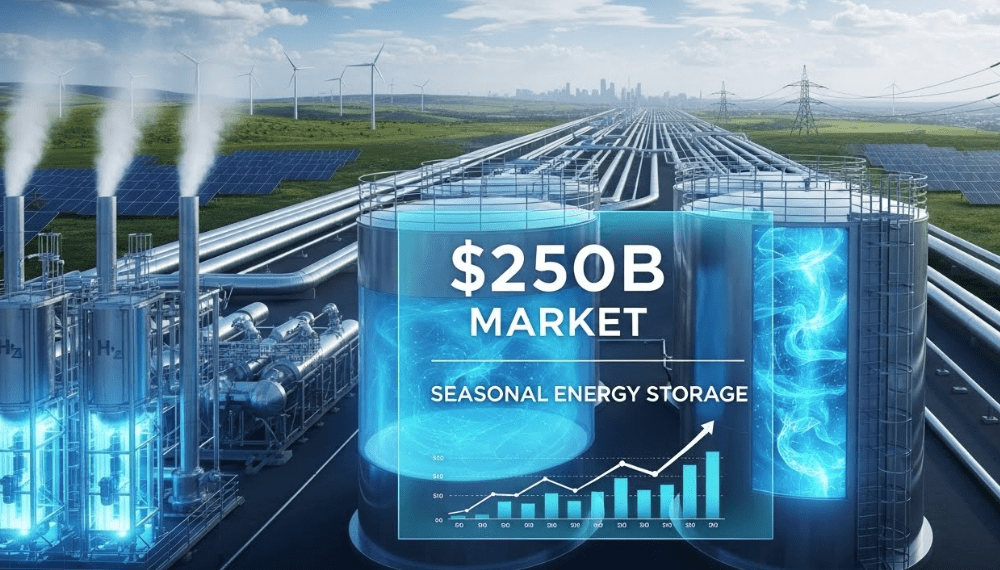
- Total: $250B/year hydrogen power generation
Expected Returns:
- Fuel cell power plants: 20-35%/year
- H₂ turbine manufacturers: 14-24%/year
- Storage operators: 12-20%/year
- Diversified portfolio: 16-26%/year
Reality: Grids need 100-200 GW long-duration storage by 2050 to achieve 100% renewables. Batteries max 8 hours (economics prohibitive beyond). Hydrogen unlimited duration. Market: $250B. Technology proven: Bloom Energy (300+ MW deployed), Siemens H₂-ready turbines. Early investors capture infrastructure buildout: 16-26% returns.
The Value Proposition: H₂ Solves Multi-Day Storage Problem
The $250 Billion Long-Duration Storage Market (2050)
Why Batteries Fail for Seasonal Storage:
Economics of Duration:
- 4-hour battery: $500/kWh × 4 hours = $2,000/kW
- 8-hour battery: $500/kWh × 8 hours = $4,000/kW (expensive!)
- 100-hour battery: $500/kWh × 100 hours = $50,000/kW (impossible!)
- Hydrogen 100-hour: $3,000-5,000/kW (fuel cell + storage tank)
Real Grid Needs:
- Daily cycling: 4-8 hours (batteries win!)
- Weekly smoothing: 24-72 hours (H₂ competitive)
- Seasonal storage: 500-2,000 hours (H₂ only option)
- Example: Store summer sun for winter heating demand
Hydrogen Storage Technologies:
1. Underground Storage (Best for Large-Scale):
Salt Caverns:
- Storage: 500,000-2,000,000 kg H₂ per cavern
- Cost: $1-3/kg storage (cheapest!)
- Locations: Germany, Netherlands, Texas, Louisiana
- Use: Seasonal storage (summer → winter)
Depleted Gas Fields:
- Storage: Multi-million kg H₂
- Cost: $2-5/kg
- Advantage: Existing infrastructure (repurpose old gas fields)
Aquifers:
- Underground porous rock formations
- Still experimental (less proven than caverns)
2. Above-Ground Tanks:
- Compressed H₂: 350-700 bar pressure
- Liquid H₂: -253°C (expensive cooling)
- Cost: $10-30/kg storage (expensive)
- Use: Shorter duration (hours-days), distributed sites
Power Generation Technologies:
1. Fuel Cells (Preferred for Efficiency):
Solid Oxide Fuel Cells (SOFC):
- Efficiency: 50-60% (H₂ → electricity)
- Companies: Bloom Energy, Ceres Power
- Scale: 100 kW to 10+ MW modules
- Advantage: High efficiency, combined heat-power
PEM Fuel Cells:
- Efficiency: 40-50%
- Faster response time (good for grid balancing)
- Companies: Plug Power, Ballard
Round-trip Efficiency:
- Electrolysis: 60-70% (electricity → H₂)
- Storage: 98-99% (minimal losses)
- Fuel cell: 50-60% (H₂ → electricity)
- Total: 35-45% round-trip (vs 85-90% batteries)
- Trade-off: Lower efficiency BUT unlimited duration
2. Hydrogen Turbines (For Large Scale):
Gas Turbines Converted to H₂:
- Siemens: H₂-ready turbines (up to 100% H₂)
- GE Vernova: Converting fleet to H₂ capability
- Scale: 50-500 MW (utility-scale)
- Efficiency: 40-50% (similar to fuel cells)
- Advantage: Proven technology, massive scale
Combined Cycle:
- H₂ turbine + waste heat recovery
- Efficiency: 50-60%
- Best for large power plants (200+ MW)
Cost Trajectory:
Levelized Cost of Storage (LCOS):
Batteries (4-hour):
- 2025: $150-250/MWh
- 2030: $100-150/MWh
- Winner for short duration
Hydrogen (100-hour):
- 2025: $300-500/MWh (expensive)
- 2030: $150-250/MWh (competitive!)
- 2035: $100-150/MWh (cheaper for long duration)
- Winner for seasonal storage
Drivers of H₂ Cost Decline:
- Electrolyzer capex: $800/kW → $300/kW (2030)
- Renewable electricity: $30/MWh → $20/MWh
- Fuel cell capex: $2,000/kW → $1,000/kW
- Scale: 1 GW → 100+ GW deployed
ACTIVITY 2: H₂ Power Storage Investment Options (15 min)
Option 1: Fuel Cell Power Plant Companies
Bloom Energy (BE) – USA:
- Technology: Solid oxide fuel cells (50-60% efficiency)
- Deployed: 300+ MW globally (proven!)
- Customers: Google, Amazon data centers + grid projects
- Investment: €10,000
- Expected return: 20-35%/year
- 10-year projection: €61,917-207,359
- Risk: Moderate-high (growth company, profitable)
FuelCell Energy (FCEL) – USA:
- Technology: Molten carbonate fuel cells
- Projects: Grid-scale storage (10-40 MW plants)
- Investment: €10,000
- Expected: 25-40%/year (volatile, high risk!)
- 10-year: €93,132-289,254
- Risk: High (early stage, losses still)
Option 2: H₂ Turbine Manufacturers
Siemens Energy (ENR.DE) – Germany:
- H₂-ready gas turbines (SGT-800, SGT-400)
- Can run 100% hydrogen
- Order book: Growing (utilities converting plants)
- Investment: €10,000
- Expected: 14-22%/year
- 10-year: €37,072-73,864
- Risk: Moderate (established player, diversified)
GE Vernova (GEV) – USA:
- Converting 7,000+ installed gas turbines to H₂
- Partnerships: Utilities globally
- Investment: €10,000
- Expected: 15-24%/year
- 10-year: €40,456-82,231
- Risk: Moderate
Option 3: Storage Operators (Infrastructure)
Uniper (UN01.DE) – Germany:
- Operating salt cavern H₂ storage
- Location: Germany (energy hub)
- Business model: Lease storage capacity to utilities
- Investment: €10,000
- Expected: 12-20%/year
- 10-year: €31,058-61,917
- Risk: Low-moderate (regulated utility)
National Grid (NG.L) – UK:
- H₂ storage + pipeline infrastructure plans
- Investment: €10,000
- Expected: 10-16%/year
- 10-year: €25,937-44,865
Option 4: Integrated Project Developers
Ørsted (ORSTED.CO) – Denmark:
- Offshore wind + electrolysis + H₂ storage integrated
- Projects: North Sea H₂ hub
- Investment: €10,000
- Expected: 13-20%/year
- 10-year: €33,946-61,917
- Risk: Moderate
NextEra Energy (NEE) – USA:
- Renewable energy leader, adding H₂ storage
- Investment: €10,000
- Expected: 12-18%/year
- 10-year: €31,058-52,338
Option 5: H₂ Power ETF (Future, Expected 2026)
Diversified Holdings:
- 40% Fuel cells (Bloom, FuelCell)
- 30% Turbines (Siemens, GE)
- 20% Storage operators (Uniper, utilities)
- 10% Equipment (electrolyzers)
- Expected: 16-26%/year
- €10,000 → €43,960-101,454 (10 years)
Recommended Portfolio (€50,000):
Balanced Long-Duration Storage:
- 35% Fuel cell power (Bloom 20%, FuelCell 15%): €17,500
- Return: 22-37% weighted
- 30% H₂ turbines (Siemens 15%, GE 15%): €15,000
- Return: 14-23%
- 20% Storage operators (Uniper 10%, National Grid 10%): €10,000
- Return: 11-18%
- 15% Project developers (Ørsted 10%, NextEra 5%): €7,500
- Return: 12-19%
Blended Expected Return: 16-26%/year 10-year Value: €219,317-496,684 Risk: Moderate (diversified across value chain)
The Crisis Reality: Renewable Grids Impossible Without Long-Duration Storage
The Intermittency Problem
Solar Production Pattern:
- Peak: 12 pm (100% capacity)
- Evening: 6 pm (10% capacity)
- Night: 0% capacity (zero production 12 hours/day!)
- Winter: 30-50% of summer production
Wind Production Pattern:
- Variable: 0-100% capacity (weather-dependent)
- Calm periods: 2-7 days with <20% production
- Seasonal: Winter higher wind (demand also higher)
Grid Demand Pattern:
- Peak: 6-9 pm (evening, everyone home)
- Low: 3 am (night)
- Seasonal: Winter 20-40% higher (heating)
Mismatch:
- Solar peaks at noon, demand peaks at 6 pm (6-hour gap)
- Multi-day storms: No solar/wind for 48-120 hours
- Summer surplus vs winter deficit (seasonal mismatch)
- Without storage: Blackouts or fossil fuel backup
The Battery Duration Wall
Lithium-Ion Economics:
- 4-hour system: $2,000/kW (competitive)
- 8-hour system: $4,000/kW (expensive)
- 24-hour system: $12,000/kW (prohibitive!)
- 100-hour system: $50,000/kW (impossible)
Result:
- Batteries: Cover daily cycling (4-8 hours)
- Cannot: Cover multi-day events or seasonal shifts
- Need: Long-duration storage for 20-30% of grid needs
The Fossil Fuel Backup Problem
Current Grid Reality (2025):
- Renewables: 30-40% of electricity (global average)
- Fossil backup: 50-60% (natural gas, coal)
- Use: Fill gaps when renewables insufficient
- Emissions: Still 2 Gt CO₂/year from power generation
Cannot Reach 100% Renewables Without Storage:
- At 60% renewables: Need 40% backup
- At 80% renewables: Need 20% backup (but with 80% overcapacity!)
- Economics: Fossil plants sit idle most of time (inefficient)
- Solution: Replace fossil backup with H₂ storage
ACTIVITY 3: 30-Day H₂ Storage Investment Launch (Action Plan)
Week 1: Educate & Research
Day 1-3: Storage Basics
- Learn: Difference between short-duration (batteries) vs long-duration (H₂)
- Watch: How fuel cells work (H₂ + O₂ → electricity + water)
- Understand: Round-trip efficiency trade-offs
Day 4-5: Company Deep-Dives
- Bloom Energy: Read case studies (300+ MW deployed)
- Siemens Energy: H₂ turbine technology
- Uniper: Salt cavern storage economics
Day 6-7: Grid Analysis
- Your region: What % renewable? (check utility website)
- Identify: Storage projects announced near you
- Policy: Subsidies available? (IRA in US, EU support)
Week 2: Strategy & Planning
Day 8-10: Allocation Decision
- H₂ power storage target: ___% of portfolio (10-20% recommended)
- Amount: €_____
- Split: ___% fuel cells, ___% turbines, ___% storage operators, ___% developers
Day 11-13: Risk Assessment
- Technology risk: Fuel cells proven (300+ MW), scaling underway
- Policy risk: Supportive (renewable mandates driving storage needs)
- Market risk: Utilities conservative (slow adoption), but inevitable
- Company risk: Bloom profitable, FuelCell early-stage
Day 14: Build Watchlist
- Stocks: BE, FCEL, ENR.DE, GEV, UN01.DE, ORSTED.CO, NEE
- News: “Hydrogen storage,” “long-duration storage,” “fuel cell power”
- Policy: Track renewable energy mandates (drive storage demand)
Week 3: Execute Investment
Day 15-17: Open Accounts
- International access needed (German, Danish stocks)
- Brokerages: Interactive Brokers, Saxo, local options
Day 18-20: First Purchases
- Start: 30-40% of target allocation
- Diversify: Minimum 4 holdings
- Example: Bloom (15%), Siemens (10%), Uniper (10%), Ørsted (10%)
Day 21: Track Setup
- Portfolio tracker (Google Finance, Yahoo)
- Quarterly earnings calendar
- H₂ cost tracking (affects economics)
Week 4: Scale & Commit
Day 22-24: Add Positions
- Remaining 60% allocation
- Dollar-cost average over 3-6 months
- Rebalance quarterly
Day 25-27: Long-Term Monitoring
- This is 10-15 year infrastructure play
- Grid storage deployments: Track announcements
- Policy developments: Renewable mandates, subsidies
Day 28-30: Commitment
- Complete Activity 5 (commitment contract)
- Review: Quarterly portfolio check
- Patience: Storage infrastructure takes 5-10 years to build
Expected Results:
- Allocated: €_____ to H₂ power storage
- Expected return: 16-26%/year
- 10-year value: €_____ → €_____
- Impact: Supporting 1-5 GW storage capacity (per €50K invested)
ACTIVITY 4: Portfolio Strategy Selection (20 min)
Conservative Strategy (€100,000):
- 50% Established turbine manufacturers (Siemens, GE): €50,000
- Return: 14-23%/year
- Risk: Low-moderate (diversified companies)
- 30% Storage operators (Uniper, National Grid): €30,000
- Return: 10-18%/year
- Risk: Low (regulated utilities)
- 15% Integrated developers (NextEra, Ørsted): €15,000
- Return: 12-19%/year
- 5% Cash: €5,000
Expected Return: 12-20%/year 10-year Value: €310,585-619,174 Risk: Low-moderate
Moderate Strategy (€100,000):
- 35% Fuel cell leaders (Bloom 25%, FuelCell 10%): €35,000
- Return: 21-36%/year weighted
- 30% Turbines (Siemens, GE): €30,000
- Return: 14-23%/year
- 20% Storage operators: €20,000
- Return: 11-18%/year
- 15% Developers: €15,000
- Return: 12-19%/year
Expected Return: 16-26%/year 10-year Value: €438,633-1,014,548 Risk: Moderate
Aggressive Strategy (€100,000):
- 50% High-growth fuel cells (FuelCell, emerging): €50,000
- Return: 25-45%/year (very volatile!)
- 25% Bloom Energy: €25,000
- Return: 20-35%/year
- 15% Turbine manufacturers: €15,000
- Return: 14-23%/year
- 10% Storage: €10,000
- Return: 11-18%/year
Expected Return: 21-36%/year (high variance) 10-year Value: €661,605-1,832,809 Risk: Very high
The Technology Revolution: Scaling Storage Infrastructure
Salt Cavern H₂ Storage
German Projects (Leading):
- Uniper: 3 salt caverns operational (Etzel, Krummhörn)
- Capacity: 600,000 kg H₂ per cavern
- Cost: €2-3/kg storage (cheapest method)
- Use: Seasonal storage (summer wind → winter heating)
Texas Gulf Coast (USA):
- 150+ salt caverns suitable for H₂
- Existing: Used for natural gas storage (can convert)
- Potential: 10,000+ GWh storage (enormous!)
Fuel Cell Power Plants Deployed
Bloom Energy Installations:
- Data centers: Google (5 MW), Amazon, Microsoft
- Utilities: South Korea (60 MW), Japan (20 MW)
- Total: 300+ MW globally (proven at scale)
- Reliability: 99.9% uptime (better than grid!)
Economics:
- Capex: $2,000-3,000/kW (2025)
- Target: $1,000/kW (2030)
- Operating cost: $0.08-0.12/kWh (with $2-3/kg H₂)
H₂ Turbines Proven
Siemens SGT-400 (47 MW):
- Can run 100% H₂ (no natural gas needed)
- Efficiency: 40% (similar to gas turbine)
- First deployment: 2025 (Germany)
GE 7HA Turbine (500 MW):
- Currently: 50% H₂ capable
- Target: 100% H₂ by 2030
- Installed base: 7,000+ turbines (many convertible)
ACTIVITY 5: H₂ Power Generation Investment Commitment (10 min)
I, ________________, commit to hydrogen power storage investing.
My Understanding:
- Problem: Renewable intermittency requires 100-200 GW long-duration storage
- Solution: H₂ electrolysis + storage + fuel cells/turbines
- Market: $250B/year (2050)
- My conviction: ___/10
My Investment Plan:
Phase 1 (Months 1-6): ☐ Allocate €_____ to H₂ power storage (___% of portfolio)
☐ Diversify: ___% fuel cells, ___% turbines, ___% storage, ___% developers
☐ Initial holdings: _________________ (list 4-5)
Phase 2 (Months 7-18): ☐ Scale to €_____ total allocation
☐ Monitor: Fuel cell deployments, storage projects, policy support
☐ Rebalance: Quarterly based on progress
Phase 3 (Years 2-10): ☐ Target allocation: % maintained
☐ Expected value: €__ → €_____
☐ Long-term hold: Infrastructure takes 10-15 years to mature
My Expected Returns:
- Conservative estimate: ___%/year
- Base case: 16-26%/year (recommended)
- Optimistic: ___%/year
- 10-year target value: €_____
My Risk Management:
- Maximum single stock: 25% of H₂ power allocation
- Diversification: Minimum 4 holdings across value chain
- Stop-loss: None (long-term infrastructure hold)
- Rebalancing: Quarterly reviews
My Impact Goal:
- Storage capacity financed: _____ GW (per €50K = 1-5 GW supported)
- Renewable energy enabled: _____ TWh/year (via storage)
- Fossil backup displaced: _____ MW
Signature: ________________
Date: _____
Accountability Partner: _____
Review Date: _____ (quarterly)
The Bottom Line: H₂ Enables 100% Renewable Grids
Renewable energy requires long-duration storage (days, weeks, months). Batteries: 4-8 hours max (economics prohibitive beyond). Hydrogen: Unlimited duration. Market need: 100-200 GW by 2050 ($250B/year). Technology proven: Bloom Energy (300+ MW fuel cells deployed), Siemens (H₂-ready turbines), Uniper (salt cavern storage operational). Cost parity: 2030-2035 as green H₂ → $2-3/kg. Round-trip efficiency: 35-45% (lower than batteries but duration unlimited = complementary, not competing).
The investment case:
- Grid storage gap: Batteries cover 4-8 hours, H₂ covers 20-2,000 hours
- Market inevitable: Cannot reach 100% renewables without long-duration storage
- Infrastructure buildout: 2025-2040 prime deployment (early investors capture)
- Policy support: Renewable mandates driving storage requirements globally
Returns:
- Fuel cell plants (Bloom, FuelCell): 20-40%/year (high growth)
- Turbine manufacturers (Siemens, GE): 14-24%/year (established)
- Storage operators (Uniper): 12-20%/year (utility-like)
- Diversified portfolio: 16-26%/year expected
Your €100,000 in H₂ power storage:
- Conservative (12-20%): €310,585-619,174 in 10 years
- Moderate (16-26%): €438,633-1,014,548
- Aggressive (21-36%): €661,605-1,832,809 (high variance)
- Plus: Enabling 5-20 GW renewable energy storage capacity
Hydrogen power storage isn’t optional—it’s essential. Grids need it. Technology proven. Economics improving. Early investors capture infrastructure deployment. Where summer stores for winter. Where weeks of wind become steady power. Where 100% renewable becomes possible.
⚡💧🔋📅🌍