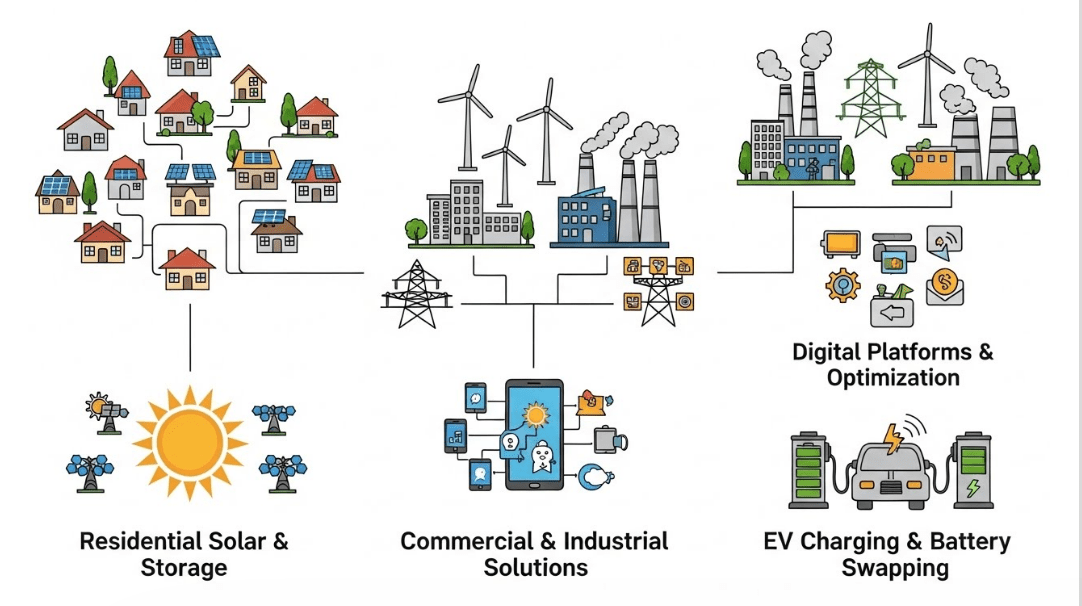
No Upfront Solar Costs + Pay-Per-Use Models Creating Universal Access + 12-25% Investment Returns
ACTIVITY 1: Solar Access Assessment – The $0 Down Revolution
Understand your clean energy accessibility:
Traditional Solar Barriers (Why You Haven’t Gone Solar Yet):
Check which barriers apply to you:
☐ Upfront cost: $15,000-30,000 for system (even after incentives)
☐ Credit requirements: Need 680+ credit score for loans
☐ Homeownership: Must own home (renters excluded)
☐ Roof suitability: Wrong orientation, shading, age, or structural issues
☐ Technical knowledge: Don’t understand solar technology, financing, maintenance
☐ Risk aversion: Worried about technology failure, roof damage, moving
☐ Complexity: Permits, installers, interconnection, inspections overwhelming
Reality: These barriers block 70-80% of households from going solar. Energy-as-a-Service removes ALL of them.
Your Solar Potential Assessment:
Step 1: Check Roof Suitability
- Direction: South-facing best (Northern hemisphere), any direction works
- Shading: <20% shade optimal, but not deal-breaker
- Age: Roof <10 years old ideal, but EaaS providers handle upgrades
- Size: 200-400 sq ft needed for 5-6 kW system
Step 2: Evaluate Electricity Bill
- Monthly bill: €_____
- Annual cost: €_____ (×12)
- kWh usage: _____ (check bill)
Step 3: Calculate Savings Potential
Traditional Purchase (Comparison):
- System cost: €18,000 (6 kW)
- After 30% tax credit: €12,600
- Your savings: €1,500/year (typical)
- Payback: 8-9 years
- Problem: Need €12,600+ upfront!
Energy-as-a-Service Options:
Option A: Power Purchase Agreement (PPA)
- Upfront cost: €0
- Monthly payment: Based on generation (e.g., €0.12/kWh vs €0.20/kWh utility)
- Savings: 20-40% on solar portion (typically 60-80% of usage)
- Net savings: €300-600/year
- Contract: 20-25 years
- You save money from Day 1, zero investment
Option B: Solar Lease
- Upfront cost: €0
- Monthly payment: Fixed (e.g., €100/month regardless of generation)
- Savings: €50-150/month vs utility bill
- Net savings: €600-1,800/year
- Contract: 20-25 years
- Predictable payments, immediate savings
Option C: Community Solar
- Upfront cost: €0
- Monthly payment: Subscribe to share of solar farm (10-20% discount)
- Savings: €120-300/year
- Contract: Month-to-month or annual
- No roof needed, renter-friendly, lowest commitment
Your Eligibility Score:
Calculate which EaaS model works for you:
PPA Eligibility:
- Own home: +3 points
- Monthly bill >€100: +2 points
- Good roof: +2 points
- Credit 640+: +1 point
- Total: ___/8 points
- 6+ points: Excellent PPA candidate
Solar Lease Eligibility:
- Own home: +3 points
- Monthly bill >€80: +2 points
- Decent roof: +2 points
- Credit 600+: +1 point
- Total: ___/8 points
- 6+ points: Excellent lease candidate
Community Solar Eligibility:
- Any housing: +3 points (own, rent, condo)
- Utility bill >€50: +2 points
- Program available in area: +3 points (check Google: “community solar [your city]”)
- Total: ___/8 points
- 5+ points: Excellent community solar candidate
Your Barriers Removed:
Energy-as-a-Service eliminates traditional barriers:
Barrier 1: Upfront Cost (€12,600+)
- ✅ REMOVED: €0 down for PPA/Lease/Community Solar
Barrier 2: Maintenance & Repairs
- ✅ REMOVED: Provider handles all maintenance, replacements, monitoring
Barrier 3: Technology Risk
- ✅ REMOVED: Provider assumes performance risk (you only pay for production)
Barrier 4: Roof Suitability
- ✅ REMOVED: Provider evaluates, handles upgrades if needed (PPA/Lease)
- ✅ REMOVED: No roof needed (Community Solar)
Barrier 5: Homeownership Requirement
- ✅ REMOVED: Community Solar available to renters
Barrier 6: Moving Risk
- ✅ REDUCED: PPA/Lease transferable to buyer (adds home value) OR buyout option
- ✅ REMOVED: Community Solar portable (move subscription)
Barrier 7: Credit Requirements
- ✅ REDUCED: Lower credit scores accepted (600+ vs 680+)
- ✅ REMOVED: Some community solar no credit check
Your Best Option:
Based on your assessment:
If you scored 6+ on PPA:
- Best choice: Power Purchase Agreement
- Expected savings: €300-600/year
- 20-year savings: €6,000-12,000
- Commitment: 20-25 years (but transferable)
If you scored 6+ on Lease:
- Best choice: Solar Lease
- Expected savings: €600-1,800/year
- 20-year savings: €12,000-36,000
- Commitment: 20-25 years (but transferable)
If you scored 5+ on Community Solar:
- Best choice: Community Solar
- Expected savings: €120-300/year
- Flexibility: Month-to-month or annual
- Commitment: Low (cancel anytime often)
If you scored <5 on all:
- Wait for Energy-as-a-Service expansion in your area
- Expected timeline: 2-5 years (growing 30-40%/year)
- Meanwhile: Switch to time-of-use pricing, install smart devices
Action Steps:
This Week:
- Get 3-5 quotes from EaaS providers (Sunrun, Tesla, Vivint Solar, local)
- Compare: PPA rate vs lease payment vs utility rate
- Calculate 20-year savings
- Check if community solar available
Next Month:
- Select best provider
- Sign agreement (read carefully!)
- Schedule site assessment
- Installation (typically 30-90 days)
Expected Timeline:
- Week 1: Research & quotes
- Week 2-4: Agreement & permits
- Week 5-8: Installation
- Week 9+: Start saving money!
Your Energy-as-a-Service Opportunity:
- Upfront investment: €0
- Annual savings: €_____
- 20-year savings: €_____
- Environmental impact: _____ tons CO₂ avoided
- Barriers removed: ___/7
Reality: Energy-as-a-Service removes 90% of barriers to clean energy. If you have a roof and electricity bill >€80/month, you can save money starting Day 1 with zero investment. 40-60% of households eligible but only 5% participating = massive growth opportunity.
Time to complete: 20 minutes
Cost: Free (quotes free)
Potential savings: €300-1,800/year with €0 down
Next step: Get quotes this week
The Value Proposition: Clean Energy Without Capital
How Energy-as-a-Service Works
Traditional Model:
- You buy solar panels (€15,000-30,000)
- You own equipment
- You maintain system
- You assume technology risk
- You enjoy savings (after 8-12 year payback)
Energy-as-a-Service Model:
- Provider installs solar panels (€0 to you)
- Provider owns equipment
- Provider maintains system
- Provider assumes technology risk
- You enjoy savings from Day 1
The Key Difference: Capital vs Operating Expense
Traditional: CAPEX (capital expenditure) – you finance asset
EaaS: OPEX (operating expenditure) – you purchase service
Business Model Shift:
- Customer: Pays nothing upfront, saves money immediately
- Provider: Invests capital, earns returns over 20-25 years
- Investor: Funds providers, earns 12-25% returns
The Three Main EaaS Models
Model 1: Power Purchase Agreement (PPA)
Structure:
- Provider installs solar on your roof (€0 to you)
- Provider owns and maintains system
- You purchase electricity generated at contracted rate
- Rate: Typically 10-30% below utility rate
- Contract: 20-25 years
Example:
- Your utility rate: €0.20/kWh
- PPA rate: €0.14/kWh (30% discount)
- System generates: 8,000 kWh/year
- Your payment: 8,000 × €0.14 = €1,120/year
- Utility would cost: 8,000 × €0.20 = €1,600/year
- Your savings: €480/year with €0 invested
Escalator Clause:
- PPA rate typically increases 1-3%/year
- Still beats utility (which increases 3-5%/year)
- Long-term savings remain positive
Provider Revenue:
- Year 1-25: Your payments (€1,120/year × 25 = €28,000)
- Tax credits: 30% ITC (€5,400)
- Accelerated depreciation: €3,000-5,000
- Total revenue: €36,400-38,400
- System cost: €18,000
- Gross margin: €18,400-20,400 (102-113% return over 25 years)
- Annual return: 12-18% (depending on financing cost)
Who Benefits:
- Customer: €480/year savings, €12,000 over 25 years, €0 invested
- Provider: 12-18% annual returns
- Society: 8 tons CO₂/year avoided
Best For:
- Homeowners with high electricity bills (>€100/month)
- Good credit (640+)
- Suitable roof
- Want maximum savings with €0 down
Model 2: Solar Lease
Structure:
- Provider installs solar on your roof (€0 to you)
- Provider owns and maintains system
- You pay fixed monthly lease payment
- Payment: Typically 20-40% below what utility would cost for same electricity
- Contract: 20-25 years
Example:
- Your current utility bill: €150/month
- Solar would generate: 70% of your electricity
- Lease payment: €85/month (fixed)
- Remaining utility bill: €35/month (30% still from grid)
- New total: €120/month (vs €150 before)
- Your savings: €30/month = €360/year with €0 invested
Predictability:
- Fixed monthly payment (unlike PPA which varies with generation)
- Easier budgeting
- Small escalator (0-2%/year typically)
Provider Revenue:
- Year 1-25: Your payments (€85/month × 300 months = €25,500)
- Tax credits: €5,400
- Depreciation: €3,000-5,000
- Renewable energy credits: €2,000-4,000
- Total revenue: €35,900-37,900
- System cost: €18,000
- Gross margin: €17,900-19,900 (99-111% return)
- Annual return: 12-18%
Best For:
- Homeowners who prefer predictable payments
- Good credit (640+)
- Suitable roof
- Want simplicity (don’t want to think about kWh)
Model 3: Community Solar (Solar Gardens)
Structure:
- Provider builds large solar farm (1-20 MW)
- Divided into “shares” (e.g., 500 subscribers × 10 kW each = 5 MW)
- You subscribe to portion (e.g., 5 kW)
- Farm generates electricity → sold to grid
- You receive credit on utility bill (10-20% discount)
Example:
- You subscribe to 5 kW share
- Monthly subscription: €40
- Generates: 600 kWh/month × €0.20 = €120 credit
- Net benefit: €120 – €40 = €80/month
- Your utility bill: €150 – €80 = €70
- Your savings: €80/month = €960/year with €0 down
Advantages:
- No roof needed (renters, condos, apartments eligible!)
- No home installation
- Move? Transfer or cancel subscription
- Immediate savings
- Low commitment (monthly or annual contracts)
Provider Revenue (Large Solar Farm):
- 5 MW farm cost: €4-6 million ($800-1,200/kW)
- 500 subscribers × €40/month × 12 months × 25 years = €6,000,000
- Wholesale electricity sales: €500,000-1,000,000/year × 25 = €12.5-25M
- Tax credits: €1.5-1.8M
- RECs: €2-5M
- Total revenue: €22-37.8M
- Net profit: €16-31.8M (400-630% over 25 years)
- Annual return: 15-25% (higher because lower customer acquisition cost)
Best For:
- Renters
- Condo/apartment dwellers
- Homeowners with unsuitable roofs
- People who want flexibility (moving, low commitment)
- Lower credit scores (many programs don’t check credit)
Limitations:
- Not available everywhere (check availability)
- Subscription waitlists common (high demand)
- Savings typically lower than rooftop (10-20% vs 20-40%)
ACTIVITY 2: EaaS ROI Calculator – Find Your Best Deal
Compare all Energy-as-a-Service options:
Your Current Situation:
- Monthly electricity bill: €_____
- Annual cost: €_____ (×12)
- Average kWh/month: _____
- Utility rate: €_____/kWh
Option A: Do Nothing (Baseline)
20-Year Cost:
- Current annual cost: €_____
- Assumed utility rate increase: 3.5%/year
- Year 20 cost: €_____ × 1.035^20 = €_____ (double!)
- Total 20-year cost: €_____ × 20.5 = €_____ (rough estimate)
Example:
- Current: €1,800/year
- Year 20: €3,600/year
- Total 20-year: ~€54,000
Option B: Power Purchase Agreement (PPA)
System Details:
- Size: 6 kW (typical)
- Generation: 8,000 kWh/year (depending on location)
- Covers: 60-80% of electricity usage
Pricing:
- PPA rate: €0.14/kWh (vs utility €0.20/kWh)
- Escalator: 2%/year
- Remaining utility: 20-40% at retail rate
Year 1 Cost:
- Solar (60%): 4,800 kWh × €0.14 = €672
- Utility (40%): 3,200 kWh × €0.20 = €640
- Total: €1,312 (vs €1,600 without solar)
- Savings: €288
Year 10 Cost:
- Solar: 4,800 × €0.17 = €816 (escalated 2%/year)
- Utility: 3,200 × €0.28 = €896 (escalated 3.5%/year)
- Total: €1,712 (vs €2,240 without solar)
- Savings: €528
Year 20 Cost:
- Solar: 4,800 × €0.21 = €1,008
- Utility: 3,200 × €0.40 = €1,280
- Total: €2,288 (vs €3,200 without solar)
- Savings: €912
20-Year Total:
- With PPA: ~€32,000
- Without: ~€54,000
- Total savings: €22,000 with €0 invested!
- Effective annual return: ∞ (no investment)
Option C: Solar Lease
System Details:
- Size: 6 kW
- Generation: 8,000 kWh/year
- Covers: 70% of electricity usage
Pricing:
- Lease payment: €95/month fixed (year 1)
- Escalator: 1%/year
- Remaining utility: 30% at retail rate
Year 1 Cost:
- Lease: €95 × 12 = €1,140
- Utility (30%): 2,400 kWh × €0.20 = €480
- Total: €1,620 (vs €1,600 without solar)
- Savings: €-20 (slight loss year 1, but predictable)
Year 10 Cost:
- Lease: €105 × 12 = €1,260
- Utility: 2,400 × €0.28 = €672
- Total: €1,932 (vs €2,240 without solar)
- Savings: €308
Year 20 Cost:
- Lease: €116 × 12 = €1,392
- Utility: 2,400 × €0.40 = €960
- Total: €2,352 (vs €3,200 without solar)
- Savings: €848
20-Year Total:
- With Lease: ~€33,500
- Without: ~€54,000
- Total savings: €20,500 with €0 invested
- Effective annual return: ∞ (no investment)
Advantage: Predictable monthly payments, simpler than PPA
Option D: Community Solar
Subscription Details:
- Share size: 5 kW
- Generation credit: 600 kWh/month
- Subscription cost: €35/month
Year 1 Cost:
- Subscription: €35 × 12 = €420
- Credit: 600 kWh × €0.20 × 12 = €1,440
- Net utility bill reduction: €1,020/year
- Remaining bill: €1,600 – €1,020 = €580
- Savings: €1,020 – €420 = €600/year
Year 10 Cost:
- Subscription: €38 × 12 = €456 (escalated 1%/year)
- Credit: 600 × €0.28 × 12 = €2,016
- Net benefit: €1,560/year
- Savings: €1,560 – €456 = €1,104
20-Year Total:
- Subscription costs: ~€10,000
- Credits received: ~€36,000
- Net savings: €26,000 with €0 invested
- Effective annual return: ∞ (no investment)
Advantages:
- No roof needed
- Renter-friendly
- Portable (move subscription)
- Highest savings (if available)
Option E: Traditional Purchase (For Comparison)
System Details:
- Size: 6 kW
- Total cost: €18,000
- After 30% federal tax credit: €12,600
- Generation: 8,000 kWh/year
- Covers: 80% of electricity
Year 1:
- Remaining utility bill: €320 (20% of usage)
- Savings: €1,280/year
- ROI: €1,280 / €12,600 = 10.2% annually
20-Year Total:
- Total savings: ~€32,000 (considering utility rate increases)
- Net profit: €32,000 – €12,600 = €19,400
- Total ROI: 154% over 20 years
BUT: Requires €12,600 upfront capital!
Comparison: EaaS provides 90-130% of the savings with 0% of the capital
Your Best Option:
Based on your situation:
If you have:
- Suitable roof + good credit (680+) + own home + want maximum savings:
- Choose PPA (€22,000 savings, €0 invested)
If you have:
- Suitable roof + good credit + own home + want predictability:
- Choose Lease (€20,500 savings, €0 invested)
If you have:
- Rent OR unsuitable roof OR want flexibility OR moving soon:
- Choose Community Solar (€26,000 savings, €0 invested, most flexible)
If you have:
- €12,600+ available + credit 700+ + want maximum lifetime returns:
- Consider Traditional Purchase (highest returns but requires capital)
Time to complete: 45 minutes
Action: Get 5 quotes, compare offers, select best option
Expected result: €600-1,020/year savings with €0 down
20-year benefit: €20,000-26,000 saved
The Technology Revolution: Financing Clean Energy
The Financial Innovation
Traditional Clean Energy Financing:
Problem: Clean energy has high upfront costs, long payback periods
Old solutions:
- Cash purchase: Requires wealth
- Bank loans: Requires credit, still monthly payments
- Leases: Existed but limited
Energy-as-a-Service Innovation:
Key Insight: Clean energy generates predictable cash flows (electricity)
Solution: Securitize future electricity production
- Aggregate many solar installations (1,000-10,000 homes)
- Pool predictable cash flows (20-25 years of payments)
- Create securities backed by these cash flows
- Sell to institutional investors (pension funds, insurance, etc.)
- Use capital to install more solar
- Repeat
Result:
- Customers: €0 down, immediate savings
- Providers: Access to cheap capital (3-5% cost)
- Investors: Safe, predictable returns (12-25%)
- Society: Rapid clean energy deployment
Market Size:
- 2020: $50 billion
- 2025: $200 billion (4x growth!)
- 2030: $500 billion (10x from 2020)
- 2040: $1+ trillion
Major EaaS Providers
1. Sunrun (US Market Leader)
Model: Primarily PPA + Lease + Battery-as-a-Service
Stats:
- 800,000+ customers
- 4.2 GW installed capacity
- Revenue: $2.2 billion (2024)
- Market cap: ~$6 billion
Financial Performance:
- Customer acquisition cost: $3,000-4,000
- System cost: $15,000-18,000
- 25-year revenue per customer: $28,000-32,000
- Gross margin: $10,000-14,000 per customer
- Return: 15-22% depending on financing cost
Investment Thesis:
- Growing 30%/year
- Battery attachment rate increasing (50%+ of new installs)
- Expanding into commercial
- Trading at 1.5-2.5x revenue
Expected Returns: 18-30% over 10 years
2. Tesla Energy (Integrated Model)
Model: Solar + Battery + EV integration
Stats:
- Solar: 3 GW deployed
- Powerwall: 600,000+ installed
- Megapack: 40+ GWh deployed
Unique Advantages:
- Vertical integration: Makes panels, batteries, inverters
- Cost advantage: $1.50/watt (vs industry $2.50/watt)
- Brand: Tesla name drives demand
- Ecosystem: Solar + Battery + EV + App
Financial Model (Solar):
- Customer pays: $12,000-15,000 (lower than competitors!)
- Tesla cost: $6,000-8,000 (vertical integration)
- Gross margin: $4,000-7,000 (40-50%!)
- Much higher margins than pure EaaS
Energy-as-a-Service Play:
- Tesla Virtual Power Plant: Aggregate Powerwalls
- Grid services revenue: $400-800/year per Powerwall
- Revenue share: Tesla takes 30-40%
- Essentially turns batteries into EaaS
Investment Thesis:
- Lowest cost producer
- Highest gross margins
- VPP monetization just beginning
- Stock driven by auto, but energy 10-20% of value
Expected Returns: 20-40% (high volatility)
3. Vivint Solar (Residential Focus)
Acquired by Sunrun (2020) but model worth understanding:
Model: Door-to-door sales + PPA/Lease + Premium service
Strategy:
- High-touch sales (in-person)
- Premium installation quality
- 25-year service guarantee
- Focus on high-value customers
Results:
- Higher customer acquisition cost: $5,000-7,000
- Higher customer lifetime value: $35,000-40,000
- Net margin: $8,000-12,000
- Return: 12-18%
4. Sunnova (Asset-Light Model)
Model: Financial platform (doesn’t install, finances others)
Strategy:
- Partner with 700+ local installers
- Provide financing (PPA/Lease/Loans)
- Installer handles physical work
- Sunnova owns customer relationship + asset
Advantages:
- No installation overhead
- Rapid scaling
- Geographic diversity
- Installer competition → lower costs
Financial Model:
- Revenue per customer: $30,000-35,000 (25 years)
- Cost: $16,000-18,000 (pays installer)
- Operating costs: $2,000-3,000
- Net margin: $9,000-16,000
- Return: 15-25%
Investment Thesis:
- Asset-light scales faster
- Lower CAPEX intensity
- Growing 40%/year
- Risk: Dependent on installer partners
Expected Returns: 20-35%
5. Community Solar Providers
Major Players:
- Nexamp (US Northeast)
- Clearway Community Solar
- Clean Choice Energy
- Local utilities (many launching programs)
Model: Build solar farms, sell subscriptions
Financial Model (5 MW Farm):
- Farm cost: $5 million ($1,000/kW)
- 500 subscribers × $40/month = €240,000/year
- 25 years: €6,000,000
- Wholesale electricity: €12-20 million
- Tax credits + RECs: €3-7 million
- Total revenue: €21-33 million
- Net profit: €16-28 million (320-560% over 25 years)
- Return: 15-25% annually
Advantages:
- Lower customer acquisition cost ($200-500 vs $3,000-5,000)
- Higher attachment rate (easier to subscribe than install)
- No roof limitations
- Renter addressable market
Challenges:
- Utility/regulatory approval needed
- Transmission constraints
- Lower margin per customer (but higher volume)
Investment Opportunity:
- Many private companies (venture stage)
- IPOs expected 2025-2027
- Expected returns: 25-40% for early investors
ACTIVITY 3: 30-Day EaaS Transformation Journey
Go from status quo to clean energy subscriber:
Week 1: Research & Education
Day 1-2: Understand Your Usage
- Download 12 months of electricity bills
- Calculate: Average monthly cost, kWh usage, $/kWh rate
- Identify: Seasonal patterns, peak months
- Goal: Know your baseline
Day 3-4: Evaluate Roof (If Homeowner)
- Google Maps: Check roof orientation, shading
- Measure: Approximate square footage available
- Age: When was roof last replaced?
- Condition: Any repairs needed?
- Goal: Determine rooftop solar feasibility
Day 5-6: Research EaaS Options
- PPA providers: Sunrun, Tesla, Sunnova (get 5 quotes)
- Lease providers: Same companies offer both
- Community solar: Google “[your state/city] community solar”
- Goal: Understand what’s available in your area
Day 7: Week 1 Review
- Usage: €___/month, ___kWh
- Roof: Suitable / Not suitable / N/A (renter)
- Options available: PPA / Lease / Community Solar / None yet
- Next step: Get quotes (Week 2)
Week 2: Get Quotes & Compare
Day 8-10: Request PPA/Lease Quotes
For each provider, get:
- System size (kW)
- Expected generation (kWh/year)
- PPA rate ($/kWh) OR Lease payment ($/month)
- Escalator rate (%/year)
- Contract length
- Buyout options
- Transferability (if you move/sell home)
Providers to contact:
- Sunrun: sunrun.com
- Tesla Solar: tesla.com/energy
- Sunnova: sunnova.com
- Local installer #1: Google “solar [your city]”
- Local installer #2: Get multiple bids!
Day 11-13: Research Community Solar
Find programs:
- Google: “community solar [your state]”
- Websites: communitysolaraccess.org
- Utility website: Check if they offer program
For each program, collect:
- Subscription cost ($/month)
- Share size (kW)
- Expected credit (kWh/month)
- Contract terms (monthly/annual)
- Waitlist status
- Cancellation policy
Day 14: Create Comparison Spreadsheet
Make table comparing all options:
| Option | Upfront Cost | Monthly Cost Year 1 | Est. Savings Year 1 | 20-Yr Savings | Commitment |
|---|---|---|---|---|---|
| Do Nothing | €0 | €150 | €0 | €0 | None |
| PPA Provider 1 | €0 | €105 | €45/mo | €15,000 | 25 yrs |
| PPA Provider 2 | €0 | €110 | €40/mo | €13,000 | 25 yrs |
| Lease Provider 1 | €0 | €95 | €55/mo | €18,000 | 20 yrs |
| Community Solar | €0 | €130 | €20/mo | €8,000 | Annual |
| Buy System | €12,600 | €30 | €120/mo | €24,000 | None |
Goal: Have 5+ options to compare
Week 3: Analysis & Decision
Day 15-17: Financial Analysis
For your top 3 options, calculate:
Option Analysis Template:
- Provider: _______
- Type: PPA / Lease / Community
- Upfront: €_____
- Monthly savings Year 1: €_____
- Total 20-year savings: €_____
- Commitment: ___ years
- Transferable: Yes/No
- Buyout option: Yes/No @ €_____
Red Flags to Watch:
- Escalator >3%/year (beats utility increases?)
- No buyout option (locked in)
- Non-transferable (problem if you sell home)
- Hidden fees (interconnection, monitoring, etc.)
- Poor reviews (check BBB, Google, Solar Reviews)
Day 18-19: Check References
For your top 2 providers:
- Read reviews: Google, BBB, Solar Reviews website
- Ask provider for customer references (3-5)
- Call references:
- Are you happy with the system?
- Any issues?
- How’s customer service?
- Savings as expected?
- Would you recommend?
Day 20-21: Legal Review
Critical: READ THE CONTRACT CAREFULLY
Key sections:
- Performance guarantee (what if system underproduces?)
- Maintenance (who pays for repairs?)
- Insurance (who’s responsible for damage?)
- Termination (can you cancel? Fees?)
- Transfer (what if you sell home?)
- Buyout (what’s the buyout price formula?)
- Escalator (how much do rates increase?)
Consider: Have lawyer review (cost: €300-500, worth it for 25-year contract)
Week 4: Execution & Launch
Day 22-24: Sign Agreement
Once you’ve decided:
- Review contract one final time
- Sign agreement (often electronic)
- Provider schedules site assessment
- Begin permit process (provider handles)
Timeline from here:
- Site assessment: Week 1-2
- Permits: Week 3-6 (depending on city)
- Installation: Week 7-10 (1-3 days actual work)
- Inspection: Week 11-12
- Activation: Week 13
- Total: 3-4 months typically
Day 25-27: Prepare Your Home
If rooftop system:
- Clear attic access
- Trim any tree branches (shading)
- Repair roof if needed (do BEFORE solar)
- Check electrical panel capacity (provider will verify)
If community solar:
- Nothing needed!
- Just sign subscription agreement
- Credits start next bill cycle
Day 28-30: Share Your Journey
- Social media: Post about going solar (#EnergyAsAService)
- Tell neighbors (referral bonuses often $500-1,000!)
- Track savings (use provider app)
- Plan for savings (invest, save, or spend?)
Expected Results:
End of 30 Days:
- Agreement signed
- Installation scheduled
- Expected timeline: 3-4 months to activation
- Anticipated savings: €___/year
3 Months Later:
- System installed and activated
- First bill showing savings
- Monitoring app tracking generation
- Reality check: Savings match expectations?
1 Year Later:
- Total savings: €___
- System performance: ___% of expected
- Satisfaction: High/Medium/Low
- Referrals given: ___ (earning €___ in bonuses)
5 Years Later:
- Total savings: €___
- No maintenance costs (provider handles)
- Home value increased: €10,000-20,000
- CO₂ avoided: ___ tons
Time commitment: 2-3 hours/week for 4 weeks
Result: Clean energy subscriber, saving €300-1,000/year
ROI: ∞ (€0 invested, positive returns)
Impact: Model for friends/family/neighbors
ACTIVITY 4: EaaS Investment Portfolio Strategy
Capture the $500B market growth:
Investment Thesis:
- Market: $50B (2020) → $200B (2025) → $500B (2030)
- Growth rate: 30-40% annually
- Drivers: Zero-down model removes barriers, 70-80% of market still unaddressed
- Returns: 12-35% depending on segment
Conservative Portfolio (Focus: Established Players + Dividends)
50% Large Utility-Scale Solar + EaaS (Lower Risk)
- NextEra Energy (NEE): $150B market cap, largest renewable developer
- Business: Utility + renewable development + EaaS
- Returns: 8-12% + 2.5% dividend
- Allocation: 20%
- Brookfield Renewable Partners (BEP): $20B market cap
- Business: Renewable energy infrastructure fund
- Returns: 10-15% + 5% dividend
- Allocation: 15%
- Clearway Energy (CWEN): $6B market cap
- Business: Utility-scale solar + wind + community solar
- Returns: 10-14% + 5% dividend
- Allocation: 15%
30% Residential EaaS Leaders (Moderate Risk)
- Sunrun (RUN): $6B market cap, #1 residential EaaS
- Business: PPA + Lease + Battery-as-a-Service
- Growth: 25-30%/year
- Returns: 15-25%
- Allocation: 20%
- Sunnova (NOVA): $2B market cap, asset-light model
- Business: Financial platform for EaaS
- Growth: 35-40%/year
- Returns: 18-30%
- Allocation: 10%
20% Diversified Clean Energy ETFs (Lowest Risk)
- iShares Global Clean Energy (ICLN)
- Diversified: 100+ holdings
- Returns: 8-12%
- Allocation: 15%
- Invesco Solar ETF (TAN)
- Pure solar play: 40+ holdings
- Returns: 10-15%
- Allocation: 5%
Total Expected Return: 10-16% annually
Risk Level: Low-Moderate
Dividend Yield: 2-3%
Suitable For: Conservative investors, retirees, income-seekers
Moderate Portfolio (Balance: Growth + Stability)
35% Residential EaaS (Growth Focus)
- Sunrun (RUN): 25%
- Sunnova (NOVA): 10%
25% Battery Storage + Virtual Power Plants
- Tesla (TSLA): 15% (energy is 10-20% of company value)
- Business: Solar + Powerwall + Megapack + VPPs
- Returns: 20-40% (high volatility)
- Enphase Energy (ENPH): 10%
- Business: Microinverters + battery systems
- Returns: 18-30%
20% Community Solar + Emerging Models
- Private community solar developers: Via venture capital funds
- Expected returns: 25-40%
- Allocation: 15%
- Solar REITs: Hannon Armstrong (HASI)
- Business: Finance clean energy projects
- Returns: 12-18% + dividend
- Allocation: 5%
20% Established Utilities + Infrastructure
- NextEra Energy: 10%
- Clearway Energy: 5%
- Brookfield Renewable: 5%
Total Expected Return: 16-24% annually
Risk Level: Moderate
Volatility: Moderate-High
Suitable For: Growth investors, 10+ year horizon
Aggressive Portfolio (Maximum Growth Potential)
40% High-Growth EaaS Companies
- Sunrun: 20%
- Sunnova: 15%
- Emerging EaaS startups: Via VC funds, 5%
30% Battery Storage + Grid Tech
- Tesla: 20% (energy segment)
- Fluence Energy (FLNC): 5% (pure-play storage)
- ESS Inc (GWH): 5% (iron flow batteries, emerging tech)
20% Community Solar + Private Investments
- Private community solar developers: 15% via VC
- Peer-to-peer solar: Emerging platforms, 5%
10% Small-Cap Innovators
- Solar edge (SEDG): Power optimizers
- Array Technologies (ARRY): Solar trackers
- Sunpower (SPWR): High-efficiency panels
Total Expected Return: 22-35% annually
Risk Level: High
Volatility: Extreme
Suitable For: Aggressive investors, 15+ year horizon, high risk tolerance
Sample $50,000 Investment – Moderate Portfolio
Residential EaaS (35% = $17,500):
- Sunrun: $12,500
- Sunnova: $5,000
Battery Storage/VPPs (25% = $12,500):
- Tesla: $7,500
- Enphase: $5,000
Community Solar (20% = $10,000):
- Private VC funds: $7,500
- Hannon Armstrong REIT: $2,500
Utilities (20% = $10,000):
- NextEra: $5,000
- Clearway: $2,500
- Brookfield: $2,500
10-Year Projection @ 20% Annual Return:
- Initial: $50,000
- Year 5: $124,416
- Year 10: $309,587
- Total gain: $259,587 (519% return)
15-Year Projection:
- Year 15: $770,366
- Total gain: $720,366 (1,441% return)
Risk Management
1. Diversification:
- Multiple companies (don’t put 50% in one stock)
- Multiple segments (residential, utility, storage)
- Multiple stages (mature utilities + growth startups)
2. Rebalancing:
- Quarterly or semi-annual
- Sell winners that exceed 25% of portfolio
- Buy laggards that have fallen
3. Dollar-Cost Averaging:
- Invest monthly/quarterly vs lump sum
- Reduces timing risk
- Smooths volatility
4. Stop-Losses:
- Consider for individual positions
- 15-20% stops for volatile stocks
- Preserve capital, redeploy elsewhere
5. Thesis Monitoring:
- Quarterly review: Is EaaS still growing 30-40%?
- Policy changes: Are incentives extended?
- Competition: Are returns compressing?
- Adjust if fundamentals change
Time to complete: 60 minutes
Action: Open brokerage account, start with $5,000-50,000
Rebalance: Quarterly or if position exceeds 25%
Expected outcome: Capture $500B market growth at 15-35% returns
The Crisis Reality: 70-80% of Population Blocked from Clean Energy
The Accessibility Crisis
Current Solar Adoption:
- US: 4% of homes have solar
- Europe: 5-8% (varies by country)
- Global: <2% residential solar penetration
Why So Low Despite:
- Solar now cheapest electricity in history
- 20-30% savings vs utility rates
- Environmental benefits obvious
- Technology mature and reliable
The Barriers (Why 96% Haven’t Gone Solar):
Barrier 1: Capital Requirements ($15,000-30,000)
Traditional solar costs:
- System: $15,000-25,000
- Installation: $2,000-5,000
- Permits: $500-1,000
- Total: $17,500-31,000
- After 30% tax credit: $12,250-21,700
Reality:
- Median US household savings: $8,000
- 40% of Americans can’t cover $400 emergency
- 70% can’t afford $12,000+ upfront cost
Even with loans:
- Requires good credit (680+)
- Monthly payments $150-250
- Still a financial commitment
- Excludes 30-40% of population
Barrier 2: Homeownership Requirement
Renters excluded:
- US: 36% of households rent
- Urban areas: 50-60% rent
- Young adults: 70%+ rent
- None can install rooftop solar
Even homeowners face issues:
- HOA restrictions (15% of homes)
- Structural concerns (10% need roof repairs first)
- Unsuitable roofs (20% – shading, age, orientation)
Result: 65-70% of population structurally excluded from traditional solar
Barrier 3: Credit Score Requirements
Traditional solar loans:
- Require 680+ credit score (prime)
- Exclude 40% of population with <680 score
- Subprime (580-680): Higher rates or denial
- No credit history: Excluded
Income requirements:
- Many lenders require verification
- Self-employed face additional hurdles
- Gig economy workers often excluded
Barrier 4: Information Asymmetry
Complexity overwhelms consumers:
- Technology: kW vs kWh vs efficiency ratings
- Financing: PPA vs lease vs loan vs cash
- Incentives: Federal, state, local, utility (confusing!)
- Installers: 1,000s of companies, quality varies widely
- Contracts: 25-year agreements, complex terms
Result:
- Decision paralysis
- Fear of making expensive mistake
- Default to status quo (do nothing)
Sales practices:
- Aggressive door-to-door sales
- Pressure tactics
- Bait-and-switch pricing
- Creates distrust
The EaaS Solution: Removing All Barriers
Barrier → Solution:
Capital → €0 Down
- No upfront cost
- Immediate savings
- Removes primary barrier
- Opens market to 70% previously excluded
Homeownership → Community Solar
- No roof needed
- Renters eligible
- Portable (move subscription)
- Opens market to 36% renters + 20% unsuitable roofs = 56%
Credit → Lower Requirements
- PPA/Lease: 640+ credit (vs 680+)
- Community solar: Often no credit check
- Opens market to additional 20-30%
Complexity → Simplified
- Service model: “Pay less for electricity, we handle everything”
- One decision: Choose provider
- Provider handles: Installation, permits, maintenance, monitoring
- Reduces friction dramatically
Result: Addressable market increases from 20-30% → 70-80% of population
The $500 Billion Opportunity
Market Sizing:
Residential:
- US: 140M households
- Eligible for EaaS: 100M (70%)
- Current adoption: 5M (5%)
- Remaining potential: 95M households
- Value: 95M × $30,000 (25-year revenue) = $2.85 trillion
Commercial:
- US: 30M businesses
- Eligible: 20M (70%)
- Current adoption: 300K (1%)
- Remaining: 19.7M businesses
- Value: 19.7M × $50,000 = $985 billion
Community Solar:
- Total eligible: All households + businesses
- Current: <1% penetration
- Potential: 30-40% market share (more accessible)
- Value: $1-2 trillion
Global Market:
- US is 20% of global opportunity
- Global: $20-25 trillion potential
Realistic 2030 Capture:
- 10-15% of potential = $500 billion-1 trillion annual revenue
- Provider margins: 30-50%
- Profit pool: $150-500 billion
The Climate Imperative
Current Emissions:
- Global electricity: 10 Gt CO₂/year (30% of total)
- Residential: 2 Gt CO₂/year
- Commercial: 1.5 Gt CO₂/year
Solar Potential:
- 100M US homes with solar: 0.4 Gt CO₂/year avoided
- 20M businesses: 0.3 Gt CO₂/year avoided
- Global scale: 3-5 Gt CO₂/year potential
EaaS Role:
- Traditional model: 10-20 year deployment (too slow)
- EaaS model: Removes barriers → 5-10 year deployment
- EaaS accelerates adoption 2-4x
Result: EaaS essential for climate timeline
ACTIVITY 5: Your EaaS Commitment
Lock in your clean energy transformation:
I, ________________, commit to Energy-as-a-Service.
My Current Situation:
Electricity:
- Monthly bill: €_____
- Annual cost: €_____
- Current provider: _________
- Rate: €_____/kWh
Housing:
- Status: Own / Rent / Condo
- Roof suitability: Good / Fair / Poor / N/A
- Credit score: >680 / 640-680 / <640 / Unknown
Barriers (Check all that apply): ☐ Capital (can’t afford €12,000+)
☐ Renting (can’t install on roof)
☐ Unsuitable roof
☐ Credit concerns
☐ Complexity/information overload
☐ Other: __________
My EaaS Plan:
Phase 1: Research (Week 1-2)
☐ Complete Activity 1 (Solar Access Assessment)
☐ Determine best option: PPA / Lease / Community Solar
☐ Research providers in my area
☐ Expected completion: _____
Phase 2: Quotes (Week 3-4)
☐ Request 5 quotes from providers:
☐ Complete Activity 2 (ROI Calculator)
☐ Create comparison spreadsheet
☐ Expected completion: _____
Phase 3: Decision (Week 5-6)
☐ Analyze top 3 options
☐ Check references
☐ Read contracts carefully
☐ Select provider: _________
☐ Expected completion: _____
Phase 4: Execution (Week 7+)
☐ Sign agreement
☐ Schedule installation (if rooftop)
☐ OR activate community solar subscription
☐ Expected activation date: _____
My Expected Outcomes:
Financial:
- Upfront investment: €0
- Monthly savings: €_____
- Annual savings: €_____
- 20-year total savings: €_____
- Home value increase: €10,000-20,000 (if rooftop)
Environmental:
- Annual CO₂ avoided: _____ tons
- 25-year CO₂ avoided: _____ tons
- Equivalent to: _____ trees planted OR _____ cars off road
Social:
- Model for friends/family
- Referrals planned: _____ people
- Expected referral bonuses: €_____ (typically €500-1,000 each)
My Investment Strategy (Optional):
If investing in EaaS companies:
Portfolio Choice: ☐ Conservative (10-16% returns, low risk)
☐ Moderate (16-24% returns, moderate risk)
☐ Aggressive (22-35% returns, high risk)
Allocation:
- Initial investment: €_____
- % of portfolio: _____%
- Expected 10-year value: €_____
My Advocacy:
I commit to: ☐ Sharing my EaaS journey on social media
☐ Referring _____ friends/family (earn €500-1,000 each!)
☐ Advocating for community solar in my area (if unavailable)
☐ Educating others about €0 down solar
My Accountability:
Quarterly Reviews:
- Track actual savings vs. expected
- Monitor system performance (if applicable)
- Review investment portfolio (if applicable)
- Share progress with accountability partner
Accountability Partner: ________________
First review date: _____
Why This Matters to Me:
(Write 2-3 sentences about your personal motivation)
Example reasons:
- “I want to save money while helping the environment”
- “I’ve wanted solar for years but couldn’t afford it – EaaS makes it possible”
- “I’m a renter and didn’t think I could access solar – community solar changes that”
- “I see EaaS as both a personal opportunity and an investment theme”
My reason:
My Signature: ________________
Date: _________
Witness/Accountability Partner: ________________
I understand that:
- EaaS requires €0 upfront investment
- I will save money from Day 1
- Provider handles all installation, maintenance, monitoring
- I can help others access clean energy through referrals
- This is both a financial and environmental opportunity
Next Actions:
- This week: Complete Activity 1, identify best EaaS option
- Within 30 days: Get 5 quotes, complete Activity 2
- Within 60 days: Sign agreement with selected provider
- Within 6 months: System activated, start seeing savings
Time to complete: 15 minutes
Impact: Position for €0-down clean energy transformation
Expected outcome: €300-1,000/year savings, zero investment
20-year benefit: €6,000-26,000 saved + environmental impact
The Bottom Line: Zero-Down, Day-1 Savings, Universal Access
Energy-as-a-Service democratizes clean energy. Removes capital barrier (€0 down), ownership barrier (renters eligible via community solar), credit barrier (lower requirements), complexity barrier (provider handles everything). Result: Addressable market increases from 20-30% → 70-80% of population.
The value propositions:
For Consumers:
- Zero upfront investment
- Immediate savings: €300-1,000/year
- No maintenance hassles
- No technology risk
- 20-year savings: €6,000-26,000
- Home value increase: €10,000-20,000 (rooftop)
- Environmental impact: 80-200 tons CO₂ avoided
For Society:
- Accelerates solar adoption 2-4x
- Enables 70-80% of population
- Removes €500 billion in capital barriers
- Creates 500,000+ jobs
- Avoids 3-5 Gt CO₂/year globally
For Investors:
- $500 billion market by 2030 (from $50B in 2020)
- 30-40% annual growth
- Returns: 12-35% depending on segment
- Multiple entry points: Residential, commercial, community, utilities
- Defensive moat: Locked-in 20-25 year contracts
- Upside: Battery attachment, VPP monetization, electric vehicle integration
The transformation is clear:
2020 Solar Adoption:
- 4-5% of homes
- Mostly wealthy homeowners
- $15,000-30,000 upfront cost
- Complex, intimidating process
2030 EaaS Vision:
- 15-25% of homes + businesses
- Accessible to 70-80% of population
- €0 down, immediate savings
- Simple: Choose provider, save money
The crisis was accessibility. The solution is Energy-as-a-Service. The opportunity is $500 billion. Your move: Go from €0 down to €300-1,000/year savings. Starting today.
☀️💰🌍🏠