Why Hydrogen Costs Dropping from $5 to $1.50/kg Creates 15-30% Investment Returns
ACTIVITY 1: The Hydrogen Opportunity Assessment
Identify hydrogen applications in your life:
Current Hydrogen (Gray – from natural gas):
- Fertilizer production: 50% of hydrogen (feeds 50% of humanity)
- Oil refining: 35% (cleaning petroleum products)
- Chemical production: 10% (plastics, methanol)
- Steel production: 5% (emerging)
- Total: 90+ million tons annually, 99% from fossil fuels
Your Indirect Hydrogen Use:
- Food: Grown with hydrogen-based fertilizer (nearly 100%)
- Fuel: Refined with hydrogen
- Plastics: Made with hydrogen
- Steel: Increasingly using hydrogen
Future Green Hydrogen Applications (Affecting You):
- Transportation: Hydrogen trucks, buses, trains
- Home heating: Hydrogen blended in natural gas (5-20%)
- Aviation: Hydrogen aircraft (2040s+)
- Grid storage: Seasonal energy storage
Green Hydrogen Investment Opportunities:
- Electrolyzer manufacturers: 25-40% returns
- Green hydrogen producers: 15-30% returns
- Fuel cell companies: 18-35% returns
- Hydrogen infrastructure: 12-20% returns
Your Hydrogen Exposure Score:
- Understanding of hydrogen: ___/10
- Investment readiness: ___/10
- Future opportunity recognition: ___/10
Reality: Hydrogen invisible now but becoming 10-15% of energy system by 2050. $11 trillion market. Early investors capture premium returns.
Time to complete: 20 minutes
Cost: Free
What you learned: Hydrogen already everywhere, green hydrogen = massive opportunity
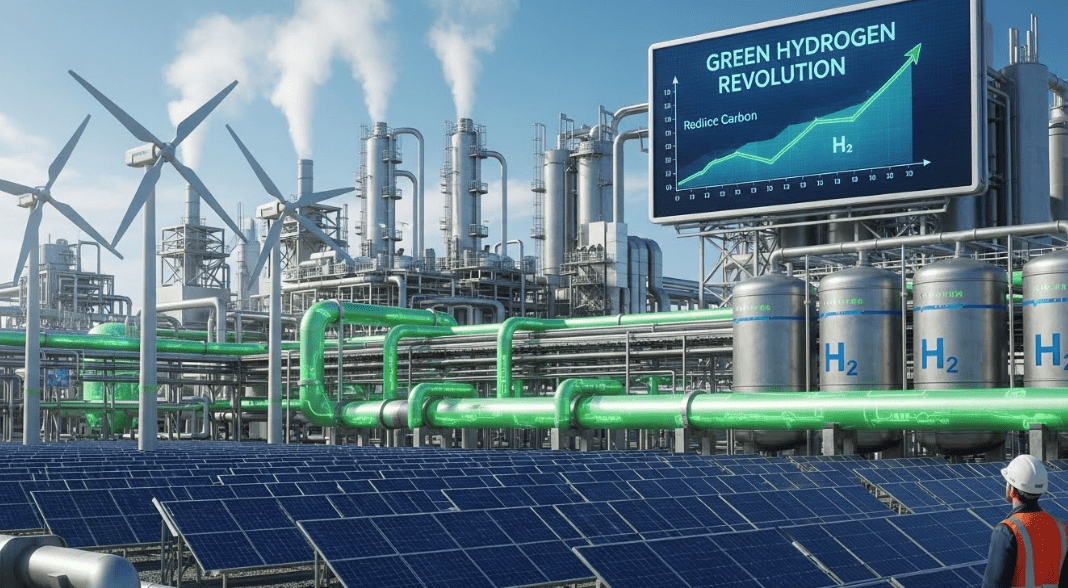
Here’s the hydrogen reality: 90M tons produced annually, 99% from fossil fuels (“gray hydrogen”). Produces 900M tons CO₂ (2%+ of global emissions). Green hydrogen (from renewable electricity) costs $5-7/kg today vs $1.50/kg gray. But costs dropping fast to $1.50-2.50/kg by 2030 = competitive. $11 trillion market by 2050.
The transformation:
- Gray hydrogen: $1.50/kg, high emissions (phasing out)
- Blue hydrogen: $2-3/kg, CCS (bridge, controversial)
- Green hydrogen: $5→$1.50/kg (2030), zero emissions (future)
Investment opportunity: Green hydrogen infrastructure scaling 30-50% annually. Early investors capturing 15-35% returns.
The Value Proposition: Green Hydrogen = Industrial Decarbonization
The Hydrogen Color Spectrum
Gray Hydrogen (Current 99%):
- Process: Steam methane reforming (natural gas + steam → H₂ + CO₂)
- Cost: $1.50-2.00/kg
- Emissions: 10kg CO₂ per kg H₂ (very dirty!)
- Share: 99% of current production
Blue Hydrogen (Bridge Fuel):
- Process: Gray hydrogen + carbon capture (CCS)
- Cost: $2.00-3.00/kg
- Emissions: 1-3kg CO₂ per kg H₂ (80-90% reduction)
- Controversy: Still uses fossil gas, CCS not 100%, methane leaks
- Share: <1% currently, could grow to 20-30% by 2030s as bridge
Green Hydrogen (Ultimate Goal):
- Process: Electrolysis (renewable electricity → split water → H₂ + O₂)
- Cost: $5-7/kg (2025) → $1.50-2.50/kg (2030) → $1-1.50/kg (2050)
- Emissions: Zero (if renewable electricity)
- Share: <1% currently → 10-30% (2030) → 60-80% (2050)
Investment thesis: Green hydrogen costs dropping 15-20% annually. Reaching parity 2030-2035. Massive scaling follows. Early investors capture premium returns.
Green Hydrogen Cost Trajectory
Why costs dropping:
1. Electrolyzer Costs Falling:
- 2020: $800-1,200/kW
- 2025: $400-600/kW
- 2030: $200-300/kW (60-70% reduction!)
- Technology: PEM and alkaline electrolyzers improving, scaling
2. Renewable Electricity Costs Falling:
- Solar/wind: $30-40/MWh (and dropping)
- Electrolysis uses 50-55 kWh per kg H₂
- Electricity cost: $1.50-2.20 per kg at $30-40/MWh
3. Scale Efficiencies:
- Current: Small demonstration plants
- 2030: GW-scale plants (10x larger)
- Economies of scale: 20-30% cost reduction
4. Utilization Improvement:
- Current: 30-50% capacity factor (intermittent renewables)
- Future: 70-90% (cheap renewables run electrolyzers continuously)
- Higher utilization = lower cost per kg
Result:
- 2025: $5-7/kg (uncompetitive vs gray $1.50-2/kg)
- 2030: $1.50-2.50/kg (COMPETITIVE!)
- 2040: $1-1.50/kg (cheaper than gray if carbon priced)
Market size at parity: $11 trillion by 2050
Investment returns: 15-30% capturing this transformation
Where Green Hydrogen Wins
Hard-to-Electrify Sectors:
1. Steel Production (50M tons H₂ potential by 2050):
- Current: Coal-fired blast furnaces (7% of global CO₂)
- Green: Direct reduction with hydrogen (zero emissions)
- Economics: Green steel premium 10-30% currently, closing to 0-10% by 2030
- Leaders: SSAB (Sweden), Thyssenkrupp (Germany), ArcelorMittal
2. Fertilizer (Ammonia) Production (20M tons H₂):
- Current: Gray hydrogen for Haber-Bosch process
- Green: Substitute green hydrogen (drop-in replacement)
- Economics: Competitive at $2/kg H₂
- Timeline: Scaling 2025-2035
3. Oil Refining (30M tons H₂):
- Current: Hydrogen for desulfurization, hydrocracking
- Transition: Phase out as oil demand declines, but refineries will exist for decades
- Green hydrogen: Drop-in, reduces refinery emissions
4. Heavy Transport (10-20M tons H₂ by 2050):
- Long-haul trucking: Hydrogen fuel cells (500+ km range)
- Buses: Already deploying (1,000s in China, Europe)
- Trains: Replacing diesel on non-electrified lines
- Ships: Hydrogen or ammonia fuel
5. Aviation (5-10M tons H₂ by 2050+):
- Liquid hydrogen aircraft: Under development (Airbus, others)
- Timeline: 2035-2045 for short/medium-haul
- Challenge: Cryogenic storage (-253°C), but solvable
6. Seasonal Energy Storage (50-100M tons H₂):
- Problem: Batteries good for hours/days, not weeks/months
- Solution: Produce hydrogen in summer, store, burn in winter for electricity/heat
- Economics: Competitive vs alternatives for 100+ hour storage
Total potential demand: 500-700 million tons by 2050 (5-7x current)
ACTIVITY 2: The Green Hydrogen Investment Calculator
Evaluate hydrogen investment options:
Option 1: Electrolyzer Manufacturers (25-40% returns)
Companies making electrolysis equipment:
- Nel Hydrogen (Norway): Leading electrolyzer manufacturer
- ITM Power (UK): PEM electrolyzers
- Plug Power (US): Fuel cells + electrolyzers
- Bloom Energy (US): Solid oxide electrolyzers
Investment: €10,000 Historical returns: 25-40% annually (volatile) 10-year projection @ 30%: €137,858
Risk: High volatility, early-stage market
Option 2: Green Hydrogen Producers (15-30% returns)
Companies producing and selling green H₂:
- Ørsted (Denmark): Offshore wind + electrolysis
- NextEra Energy (US): Renewable energy + hydrogen
- Various startups: Many private, watch for IPOs
Investment: €10,000 Expected returns: 15-30% annually 10-year projection @ 20%: €61,917
Risk: Moderate, depends on cost parity timing
Option 3: Hydrogen Infrastructure (12-20% returns)
Pipelines, storage, fueling stations:
- Air Products (US): Industrial gas + hydrogen
- Linde (Germany/US): Similar to Air Products
- Infrastructure funds: Some exist, more coming
Investment: €10,000 Expected returns: 12-20% annually 10-year projection @ 15%: €40,456
Risk: Lower, infrastructure stable once built
Option 4: Fuel Cell Companies (18-35% returns)
Using hydrogen for electricity:
- Ballard Power (Canada): Fuel cells for vehicles
- Plug Power (US): Fuel cells + infrastructure
- Bloom Energy (US): Stationary fuel cells
Investment: €10,000 Expected returns: 18-35% annually (high volatility) 10-year projection @ 25%: €93,132
Risk: High, market timing uncertain
Sample Portfolio:
- 35%: Electrolyzer manufacturers (highest growth)
- 30%: Green hydrogen producers (core thesis)
- 20%: Infrastructure (stability)
- 15%: Fuel cells (application layer)
Total investment: €10,000 Blended return: ~23% annually 10-year value: €75,398
Time to complete: 30 minutes
Action: Allocate 5-15% portfolio to hydrogen
Expected return: 15-35% annually
The Technology Revolution: Electrolyzer Innovations
PEM Electrolyzers (Proton Exchange Membrane)
How it works:
- Pure water + DC electricity
- Protons pass through membrane
- H₂ produced at cathode, O₂ at anode
Advantages:
- Fast response (good for intermittent renewables)
- Compact
- High purity hydrogen
Disadvantages:
- Expensive (platinum catalysts)
- Lower efficiency than alkaline
Cost: $600-1,000/kW (2025) → $250-400/kW (2030)
Leaders: Nel, ITM Power, Siemens
Alkaline Electrolyzers
How it works:
- Alkaline solution (KOH) + DC electricity
- Ions pass through separator
- H₂ and O₂ produced
Advantages:
- Cheaper (no precious metals)
- Higher efficiency
- Proven technology (100+ years)
Disadvantages:
- Slower response
- Larger size
Cost: $400-700/kW (2025) → $200-300/kW (2030)
Leaders: Nel, Thyssen Krupp, John Cockerill
Solid Oxide Electrolyzers (SOECs)
How it works:
- High temperature (700-900°C)
- Steam electrolysis
- Ceramic membrane
Advantages:
- Highest efficiency (80-90%!)
- Can run in reverse (fuel cell mode)
- Uses waste heat
Disadvantages:
- High temperature challenges
- Less mature technology
Cost: $800-1,200/kW (2025) → $300-500/kW (2030)
Leaders: Bloom Energy, Sunfire, Haldor Topsoe
Future: SOECs could be most cost-effective if challenges solved
Breakthrough: Anion Exchange Membrane (AEM)
Emerging technology combining PEM + alkaline advantages:
- No precious metals (cheap)
- Fast response
- Compact
Status: Early stage, commercializing 2025-2030
Could be game-changer if successful
ACTIVITY 3: The 30-Day Hydrogen Awareness Challenge
Learn about hydrogen economy:
Week 1: Education
- Day 1-3: Research hydrogen basics (gray, blue, green)
- Day 4-5: Understand applications (steel, ammonia, transport)
- Day 6-7: Learn about electrolyzers, fuel cells
Week 2: Identify Local Hydrogen
- Day 8-10: Find hydrogen fueling stations near you (if any)
- Day 11-13: Research local hydrogen projects
- Day 14: Map hydrogen infrastructure development
Week 3: Investment Research
- Day 15-17: Analyze electrolyzer companies
- Day 18-20: Evaluate hydrogen producers
- Day 21: Complete Activity 2 (investment calculator)
Week 4: Action
- Day 22-24: Invest €1,000-10,000 in hydrogen sector
- Day 25-27: Advocate for hydrogen infrastructure
- Day 28-30: Share learning #HydrogenEconomy
Expected Results:
- Understanding: Expert-level hydrogen knowledge
- Investment: €___ positioned for hydrogen boom
- Network: Connected to hydrogen community
- Advocacy: Supporting infrastructure development
Share: #HydrogenChallenge
Time commitment: 30-60 min daily
Financial benefit: Investment returns 15-35%
Impact: Support $11T transformation
The Crisis Reality: Industrial Emissions Need Hydrogen
Hard-to-Abate Sectors: 30% of Emissions
Sectors that can’t easily electrify:
- Steel: 7-9% of global CO₂
- Cement: 8% (separate issue, not hydrogen)
- Chemicals: 3-5%
- Heavy transport: 5-7%
- Aviation: 2-3%
- Shipping: 3%
Total: ~30% of emissions
Battery electrification: Solves 70% (power, light transport, buildings)
Hydrogen: Essential for remaining 30%
Without green hydrogen: Can’t reach net-zero
Current Hydrogen Emissions: 900M Tons CO₂
Gray hydrogen production:
- 90 million tons H₂ annually
- Produces ~10kg CO₂ per kg H₂
- Total: 900 million tons CO₂ (2%+ of global)
This MUST be eliminated for net-zero
Solution: Replace with green hydrogen
Market: Just replacing current gray hydrogen = €135-180B annually at $1.50-2/kg
Plus new applications: Total $11T market through 2050
The Chicken-and-Egg Problem
Problem:
- Green hydrogen expensive → No demand
- No demand → No infrastructure built
- No infrastructure → Can’t scale → Stays expensive
Solution: Government intervention:
- Subsidies: US IRA provides $3/kg subsidy (makes green competitive!)
- Mandates: EU requiring % green hydrogen in industry
- Public procurement: Governments buying green steel, etc.
- R&D funding: Billions for electrolyzer development
Result: Breaking chicken-and-egg, market taking off 2025-2030
ACTIVITY 4: The Hydrogen Investment Strategy
Complete hydrogen portfolio:
Investment Allocation:
Conservative (60% capital preservation, 40% growth):
- 40%: Established industrial gas companies (Air Products, Linde)
- 30%: Renewable energy companies with H₂ (Ørsted, NextEra)
- 20%: Infrastructure (pipelines, storage)
- 10%: Electrolyzer manufacturers
Expected return: 12-18% annually
Moderate (40% preservation, 60% growth):
- 35%: Electrolyzer manufacturers
- 30%: Green hydrogen producers
- 20%: Fuel cell companies
- 15%: Industrial gas companies
Expected return: 18-25% annually
Aggressive (100% growth):
- 40%: Electrolyzer manufacturers
- 30%: Early-stage H₂ producers
- 20%: Fuel cell startups
- 10%: Hydrogen infrastructure startups
Expected return: 25-40% annually (high volatility)
My Hydrogen Investment Plan:
- Risk tolerance: Conservative/Moderate/Aggressive
- Allocation: __% of portfolio
- Total investment: €___
- Target return: __% annually
- 10-year goal: €___ → €___
Time to complete: 30 minutes
Action: Execute investment plan this quarter
Expected outcome: Capture hydrogen boom returns
ACTIVITY 5: The Green Hydrogen Commitment
Commit to hydrogen economy:
I, _____________, commit to supporting green hydrogen.
My Understanding:
- Hydrogen types: Gray, blue, green
- Applications: Steel, ammonia, transport, storage
- Economics: Reaching parity 2030-2035
- Market: $11T through 2050
My Investment:
- Allocate €___ to hydrogen sector
- Target allocation: __% of portfolio
- Expected return: __% annually
- 10-year goal: €___ value
My Advocacy:
- Support hydrogen infrastructure funding
- Advocate for green steel, green ammonia
- Educate others about hydrogen economy
My Timeline:
- Year 1: Invest €___, learn deeply
- Year 2-3: Increase allocation as market develops
- Year 4-10: Capture returns as hydrogen scales
My Accountability: Partner: _______________ Annual: Review portfolio, adjust allocation
Why this matters: [Write reason – industrial decarbonization, investment opportunity, energy transition]
Expected Impact:
- Investment returns: 15-35% annually
- Industrial decarbonization: Support essential transformation
- Energy system: Enable 100% clean energy
Date: ______ Signature: ______
Time to complete: 15 minutes
Impact: Position for $11T hydrogen revolution
The Bottom Line: Green Hydrogen = Industrial Revolution 2.0
Hydrogen is the missing piece for net-zero. Can’t decarbonize steel, ammonia, heavy transport without it. Green hydrogen costs dropping 15-20% annually. Reaching parity 2030-2035. $11 trillion market follows.
The value propositions:
- Market: $11 trillion through 2050
- Cost: $5/kg → $1.50/kg (2030) = competitive
- Growth: 30-50% annually in infrastructure
- Investment returns: 15-35% for early positioning
- Essential: 30% of emissions need hydrogen
The crisis is real:
- Current hydrogen: 900M tons CO₂ (must eliminate)
- Industrial emissions: 30% of total, can’t electrify
- Without hydrogen: Cannot reach net-zero
- Timing: Need to scale 2025-2035
The solution:
- Scale green hydrogen: From <1% to 60-80% of production
- Deploy electrolyzers: GW-scale plants globally
- Build infrastructure: Pipelines, storage, fueling stations
- Policy support: Subsidies, mandates accelerate adoption
- Invest: Capital flowing to hydrogen, returns available
Green hydrogen completes the energy transition. Final piece enabling 100% decarbonization. Essential investment theme.
💧⚡🏭