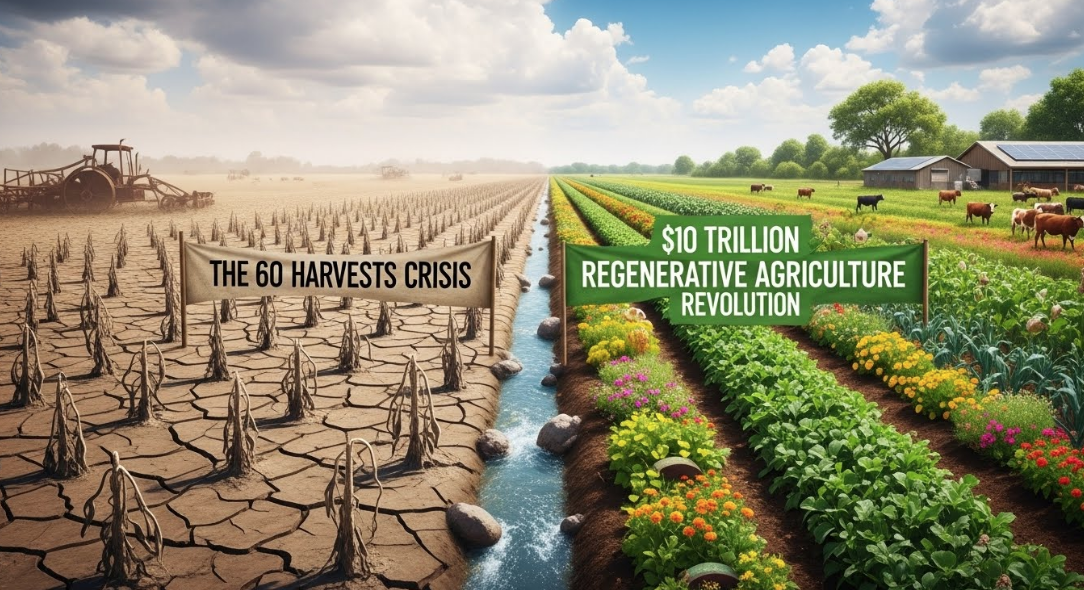
Why Industrial Agriculture Is Destroying Soil While Regenerative Farming Creates Wealth
ACTIVITY 1: The Food System Awareness Test
Trace your last meal back to its origins:
What You Ate: _______________
The Supply Chain:
- Farm: Where grown? _______________ (probably don’t know)
- Soil: What condition? _______________ (definitely don’t know)
- Inputs: Fertilizer? Pesticides? _______________ (unknown)
- Water: How much used? _______________ (unknown)
- Processing: How many steps? _______________ (unknown)
- Transport: How far traveled? ___ km (usually 1,000-3,000 km)
- Packaging: How much? _______________ (lots)
Reality: Most people have zero idea where food comes from or how it’s produced.
Now the crisis:
- The soil producing that food is degrading 10-100x faster than forming
- Industrial agriculture has 60 harvests left before soil too degraded
- That means 60 years until current food system collapses unless we change
Time to complete: 10 minutes
Cost: Free
What you learned: Your food depends on soil that’s dying
Here’s the agricultural reality: Industrial farming is strip-mining soil. Degradation so severe we have 60 harvests remaining. Meanwhile, regenerative agriculture rebuilds soil while being more profitable. But only 1-2% of farmland is regenerative.
The economics: Regenerative farms are 15-25% more profitable than conventional after 3-5 year transition. Plus they sequester carbon (potential carbon credit income), improve water retention (drought resilience), and build soil value (capital appreciation).
Industrial agriculture is economic suicide. Regenerative agriculture is prosperity. Transition is urgent and profitable.
The Value Proposition: Regenerative Farming = Higher Profits
The Profitability Comparison
Conventional Industrial Farm (10-Year Economics):
- Revenue: €1,000/hectare annually (commodity prices)
- Costs: €750/hectare (fertilizer, pesticides, fuel, equipment)
- Net profit: €250/hectare annually
- Soil condition: Degrading (organic matter declining, erosion increasing)
- Resilience: Low (drought vulnerable, pest outbreaks)
- Subsidies: Required for survival
Regenerative Farm (10-Year Economics):
- Years 1-3 (Transition):
- Revenue: €900/hectare (slightly lower during transition)
- Costs: €700/hectare (reducing inputs gradually)
- Net profit: €200/hectare (temporary reduction)
- Years 4-10 (Mature System):
- Revenue: €1,100/hectare (premium prices + higher yields)
- Costs: €600/hectare (minimal inputs needed, nature provides)
- Net profit: €500/hectare annually (2x conventional!)
- Soil condition: Improving (organic matter rising, erosion stopped)
- Resilience: High (drought resistant, pest balanced)
- Carbon credits: €50-150/hectare additional income
- Total: €550-650/hectare (2.5x conventional!)
Why Regenerative More Profitable:
- Lower input costs: Less fertilizer, pesticides, irrigation (€150/hectare savings)
- Higher yields: Better soil = better crops (10-20% increase after 5 years)
- Premium prices: Organic, regenerative labels command 20-50% premiums
- Carbon credits: €50-150/hectare from soil carbon sequestration
- Drought resilience: Better water retention = stable yields (€100-200/hectare value)
Pattern: Nature provides what industrial farming buys. Regenerative farming is simply cheaper.
ACTIVITY 2: The Soil Health Audit
Test soil where you can access it (yard, garden, park):
Visual Inspection:
- Color: Dark brown/black (good) vs light brown/gray (depleted): ___
- Structure: Crumbly with visible life vs compacted and dead: ___
- Smell: Earthy and rich vs no smell or chemical: ___
- Life: Worms, insects visible vs sterile: ___
Simple Tests: Infiltration Test:
- Pour 1 liter water on soil patch
- Time how long to absorb: ___ seconds
- Under 30 seconds: Excellent
- 30-60 seconds: Good
- 60-120 seconds: Poor
- Over 120 seconds: Severely degraded
Jar Test:
- Put soil sample in jar with water
- Shake and let settle 24 hours
- Observe layers:
- Sand (bottom), silt (middle), clay (top)
- Organic matter floats
- Healthy soil: 5-8% organic matter
- Degraded soil: Under 2% organic matter
Your Soil Score: ___/10
If testing farmland:
- Above 7: Regeneratively managed or naturally healthy
- 4-6: Conventional farming, declining
- Below 4: Severely degraded
Time to complete: 30 minutes
Cost: Free
Insight: Visual assessment of soil health
The Technology Revolution: Regenerative Ag Going Mainstream
Regenerative Practices That Rebuild Soil
1. No-Till Farming
Traditional: Plow/till soil every year
- Breaks up soil structure
- Kills beneficial organisms
- Releases carbon (oxidation)
- Increases erosion
Regenerative: Never till
- Preserves soil structure
- Builds soil life
- Sequesters carbon
- Eliminates erosion
Economics: Saves €50-100/hectare in fuel + labor. Yields equal or better after transition.
2. Cover Cropping
Traditional: Bare soil between cash crops (months of erosion, no growth)
Regenerative: Plant cover crops during off-season
- Prevents erosion
- Feeds soil organisms
- Fixes nitrogen (free fertilizer)
- Suppresses weeds
Economics: Costs €50-100/hectare, saves €100-200 in fertilizer + erosion prevention. Net benefit.
3. Diverse Crop Rotation
Traditional: Monoculture (same crop every year, depletes specific nutrients)
Regenerative: Rotate 4-8 crops
- Different nutrient needs
- Breaks pest cycles
- Improves soil structure
- Spreads risk
Economics: More complex management but higher total revenue + lower pest/disease losses.
4. Integrated Livestock
Traditional: Separate crop and animal farms (waste management problems both sides)
Regenerative: Animals on crop land in rotation
- Manure fertilizes crops (free)
- Animals control weeds/pests (free)
- Diversified revenue streams
- Mimics natural ecosystems
Economics: Additional revenue from livestock + eliminated fertilizer costs = significant profit increase.
5. Agroforestry
Traditional: Clear land completely for crops
Regenerative: Integrate trees with crops
- Trees provide shade, windbreak, habitat
- Deep tree roots access nutrients, bring to surface
- Diversified income (crops + timber + fruit)
- Carbon sequestration
Economics: Long-term investment (10-20 years for trees) but very profitable when mature.
ACTIVITY 3: The Regenerative Food ROI Calculator
Calculate financial benefits of supporting regenerative agriculture:
As Consumer:
Conventional Food Budget:
- Monthly spending: €___
- Quality: Variable
- Nutrition: Declining over decades
- Environmental cost: High (soil depletion, emissions)
Regenerative Food Budget:
- Monthly spending: €___ (20-40% higher initially)
- Quality: Higher (better taste, more nutrients)
- Health benefits: €50-200/month saved (fewer health problems from better nutrition)
- Environmental benefit: Carbon negative, soil building
Net Cost After Health Savings:
- Conventional: €___ + €100-300 health costs = €___
- Regenerative: €___ – €50-200 health benefits = €___
- Often comparable or cheaper when health included
As Farmer/Landowner:
Convert 1 Hectare Conventional → Regenerative:
- Current profit: €250/hectare
- Years 1-3: €200/hectare (transition)
- Years 4-10: €550-650/hectare
- 10-year total: €4,700 vs €2,500 conventional (88% more profit!)
As Investor:
Regenerative Agriculture Funds:
- Expected return: 8-15% annually
- Impact: Soil regeneration, carbon sequestration
- Market: $10 trillion opportunity as agriculture transitions
- Risk: Lower than conventional (resilient to climate change)
Time to complete: 20 minutes
Insight: Regenerative ag is financially superior + environmentally necessary
Action: Support regenerative food system with purchases/investments
The Crisis Reality: 60 Harvests Until Collapse
Soil Degradation at Crisis Levels
UN FAO Warning (2015): “Soil is being degraded 10 to 100 times faster than it is forming. At current rates, the world has enough soil for only 60 more harvests.”
What this means:
- Topsoil erosion: 24 billion tons lost annually
- Organic matter decline: Dropping 1-5% per decade (needs to be 5-8% for healthy soil)
- Soil compaction: Heavy machinery crushing soil structure
- Salinization: Irrigation depositing salts, rendering land infertile
- Contamination: Pesticide residues killing soil life
Current status:
- 33% of global soils degraded
- 12 million hectares lost annually (area of Pennsylvania)
- 50-70% loss of soil organic carbon since agriculture began
Result: If we continue current practices, industrial agriculture collapses mid-century as soil becomes too degraded to support crops even with heavy inputs.
The Industrial Agriculture Trap
How industrial farming destroys soil:
Step 1: Till soil (kills organisms, releases carbon, increases erosion)
Step 2: Plant monoculture (one crop depletes specific nutrients)
Step 3: Synthetic fertilizer (provides nutrients but kills soil organisms, salts build up)
Step 4: Pesticides/herbicides (kill beneficial insects, weeds developing resistance)
Step 5: Harvest and till again (repeat cycle)
Result after decades:
- Dead soil (no organisms)
- Compacted (no structure)
- Eroding (no protection)
- Dependent on inputs (can’t grow without chemicals)
- Declining yields despite increasing inputs
This is strip-mining soil. It destroys the resource while extracting from it.
Climate Change Amplifying Crisis
Climate change making soil degradation worse:
- Drought: Reduces organic matter, increases wind erosion
- Extreme rainfall: Accelerates water erosion
- Temperature rise: Speeds decomposition (loses organic matter faster)
- Weather volatility: Disrupts growing seasons
Meanwhile: Healthy soil with high organic matter is resilient to climate impacts (holds more water, stable structure, diverse organisms adapt).
Result: Climate change makes conventional agriculture increasingly unviable while making regenerative agriculture increasingly necessary.
ACTIVITY 4: The 30-Day Food System Transformation Challenge
Change how you eat to support regenerative agriculture:
Week 1: Awareness
- Day 1-3: Track all food purchases, note sources
- Day 4-5: Research regenerative farms/products in your area
- Day 6-7: Calculate current food budget and impacts
Week 2: Local and Seasonal
- Day 8-10: Shop farmers market, buy from local producers
- Day 11-13: Choose seasonal produce (lower environmental impact)
- Day 14: Calculate % of food now local
Week 3: Regenerative Products
- Day 15-17: Switch to regenerative meat/dairy (grass-fed, pasture-raised)
- Day 18-20: Buy regenerative grains/produce (certified regenerative organic)
- Day 21: Track premium paid (if any)
Week 4: System Change
- Day 22-24: Join CSA (Community Supported Agriculture) or co-op
- Day 25-27: Grow some food yourself (herbs, vegetables, even indoors)
- Day 28-30: Calculate total transformation, commit long-term
Expected Results:
- Food quality: Significantly improved
- Nutrition: Higher (regenerative food more nutrient-dense)
- Cost: 0-20% higher but often offset by health benefits
- Environmental impact: Shifted from extractive to regenerative
- Connection: Understand food sources
Share: #RegenerativeFoodChallenge
Time commitment: 30-60 min daily
Financial impact: €0-100 monthly increase, potentially offset by health savings
System impact: Support regenerative agriculture transition
ACTIVITY 5: The Regenerative Agriculture Commitment
Commit to regenerative food system:
I, _____________, commit to supporting regenerative agriculture.
My Current Situation:
- Food budget: €___ monthly
- Regenerative food: ___%
- Food waste: ___%
- Garden/growing: Yes/No
My 1-Year Goals:
- Increase regenerative food to: ___%
- Reduce food waste: 50%
- Start growing: ___ items
- Educate ___ people
My Actions:
- Weekly: Farmers market or local food purchasing
- Monthly: Support regenerative farms/products
- Seasonally: CSA membership or direct farm purchases
- Annually: Calculate impact, increase commitment
My Accountability: Partner: _______________ Monthly: Track % regenerative purchases Annually: Review and increase commitment
Why this matters: [Write reason – health, soil, climate, future, values]
Expected Impact:
- Personal health: Improved nutrition
- Farm economics: Support profitable regenerative transition
- Soil regeneration: Every purchase rebuilds soil
- Climate: Carbon sequestration through better farming
- System change: Vote with dollars for regenerative future
Date: ______ Signature: ______
Time to complete: 15 minutes
Impact: Personal + systemic transformation
The Bottom Line: Regenerate Soil or Face Collapse
We have 60 harvests left with industrial agriculture. But regenerative agriculture can rebuild soil while being more profitable.
The value propositions:
- Regenerative farms: 2-2.5x more profitable than conventional after transition
- Carbon credits: €50-150/hectare additional income
- Soil as asset: Regenerated soil increases land value 20-50%
- Market opportunity: $10 trillion as agriculture transitions
- Investment returns: 8-15% annually in regenerative ag funds
- Consumer health: Better nutrition from nutrient-dense food
The crisis is real:
- 60 harvests remaining with current practices
- 33% of soils already degraded
- 24 billion tons topsoil lost annually
- Climate change accelerating degradation
- Industrial model economically and ecologically failing
The solution:
- Farmers: Transition to regenerative practices (higher profits + resilience)
- Consumers: Buy regenerative food (votes with dollars)
- Investors: Fund regenerative agriculture (strong returns + impact)
- Policy: Support regenerative transition (subsidies, research, education)
Regenerative agriculture is not idealistic fantasy. It’s hard-nosed economics. More profitable. More resilient. More sustainable. Only question is: How fast can we transition before soil collapses?
🌾🌱⛏️