The $200 Billion Industry Transforming Trash into Treasure
ACTIVITY 1: The Recycling Reality Check
Go to your recycling bin right now. Pull out the last 10 items you put in there.
For each item, answer:
- Do you know if this actually gets recycled in your area? (Check your local recycling guidelines)
- Is it clean and uncontaminated? (Food residue = contamination = rejected)
- Is it the right material? (That “recyclable” symbol doesn’t mean your city recycles it)
Most people discover: 30-50% of what they put in recycling bins doesn’t actually get recycled.
Common mistakes:
- Pizza boxes (grease contamination = trash)
- Plastic bags (clog sorting machines = trash)
- Styrofoam (most cities don’t recycle it)
- “Compostable” plastics (need industrial composting, contaminate regular recycling)
- Wish-cycling (putting items you hope are recyclable but aren’t)
The Truth: Contamination causes 25-40% of recycling to be rejected and sent to landfill anyway.
Time to complete: 10 minutes
Cost: Free
What you learned: You’re probably recycling wrong (and it’s not your fault – the system is confusing!)
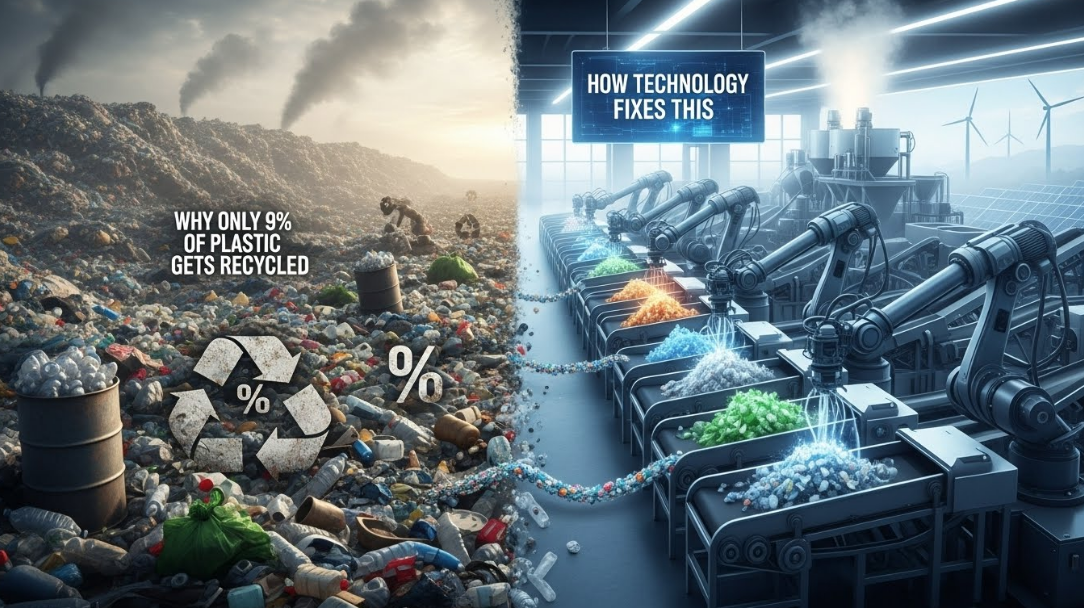
Here’s the recycling reality: Only 9% of all plastic ever produced has been recycled. Paper is 66% recycled. Glass 27%. Aluminum 75% (best performer). The system is broken. But technology is fixing it.
The recycling crisis has three causes: Contamination (dirty or mixed materials can’t be recycled), Economics (virgin materials often cheaper than recycled), and Complexity (7 types of plastic, different rules in every city, confusing symbols).
But here’s the opportunity: Advanced recycling technologies are solving these problems. AI-powered sorting achieves 95%+ purity. Chemical recycling handles contaminated plastics. And recycling industry is $200+ billion globally, growing 5-7% annually, employing 1.5+ million people.
Recycling done right = environmental benefit + economic opportunity.
The Value Proposition: Good Recycling = Big Savings
Material Recovery Value: $100-500 Per Ton
Different materials have different recycling values:
Aluminum: $1,500-2,000 per ton
- Most valuable recyclable
- Recycling saves 95% energy versus virgin aluminum
- Infinitely recyclable (no quality loss)
- Recycling rate: 75% globally (economic incentive works!)
- One aluminum can recycled saves energy to power TV for 3 hours
Steel/Iron: $200-400 per ton
- Highly recyclable, saves 74% energy
- Used in construction, cars, appliances
- Magnetic sorting makes recovery easy
- Recycling rate: 70-90% depending on application
Paper/Cardboard: $50-150 per ton
- Recyclable 5-7 times before fibers degrade
- Saves 60% energy, 70% water versus virgin paper
- Contamination major problem (food, grease ruins batches)
- Recycling rate: 66% globally
Glass: $40-80 per ton
- Infinitely recyclable (no quality loss)
- Saves 30% energy versus virgin glass
- Heavy (transport costs hurt economics)
- Recycling rate: 27% (surprisingly low despite being infinitely recyclable)
Plastic: Varies hugely by type
- PET (#1 – bottles): $200-400/ton – 29% recycled
- HDPE (#2 – milk jugs): $300-500/ton – 31% recycled
- PVC (#3): Rarely recycled (toxic additives)
- LDPE (#4 – bags): Rarely recycled (clogs machinery)
- PP (#5): $200-300/ton – 3% recycled
- PS (#6 – styrofoam): Rarely recycled
- Other (#7): Not recyclable
- Overall plastic recycling: 9% (catastrophically low)
The Pattern: Materials with clear economic value get recycled. Materials with low value or high contamination don’t.
ACTIVITY 2: The Contamination Audit
Test if you’re contaminating recycling (most people are without knowing):
Get 5 items from your recycling bin. Check each:
Item 1: _______
- Clean? (No food/liquid residue): Yes/No
- Dry? (Wet paper can’t be recycled): Yes/No
- Correct material for your area?: Yes/No
- Contamination risk: High/Medium/Low
Item 2-5: Repeat
Scoring:
- 5/5 perfect: You’re in top 10% of recyclers!
- 3-4 good: Better than average
- 1-2 poor: Probably contaminating batches
- 0 failing: “Wish-cycling” hurting recycling
Common Contamination Sources:
- Greasy pizza boxes (separate clean parts)
- Bottles with liquid inside (empty completely)
- Wet paper (trash if wet)
- Mixed materials (separate if possible)
- Non-recyclables (when in doubt, throw it out)
The 3-Second Rule: If you can’t verify an item is clean, empty, and accepted in 3 seconds, it’s contaminating recycling. Better in trash than contaminating batch of recyclables.
Time to complete: 10 minutes
Cost: Free
Impact: Stop contaminating (your clean recycling helps entire batch get recycled)
The Technology Revolution: Making Recycling Actually Work
AI-Powered Robotic Sorting: 95%+ Accuracy
Traditional recycling sorting: Humans standing on conveyor belt manually pulling recyclables. Problems: Slow (40-60 items/minute per person), expensive (€30-50K annually per worker), error-prone (10-20% error rate), dangerous (injuries common).
AI robotic sorting: Robots using computer vision identify and pick materials. Advantages:
- Speed: 80-100 items/minute per robot (2x faster)
- Accuracy: 95-98% (versus 80-90% human)
- 24/7 operation: No breaks, no fatigue
- Lower cost: Robot costs €100-200K upfront, lasts 10 years, cheaper than humans over lifetime
- Better sorting: Identifies specific plastic types humans can’t distinguish
Companies leading: AMP Robotics (US), ZenRobotics (Finland), Tomra (Norway). Systems deployed in hundreds of facilities globally. Result: Recycling becomes profitable (not subsidized) due to higher material purity and lower labor costs.
Chemical Recycling: Handling Contaminated Plastics
Traditional mechanical recycling: Melt plastic, remold. Problems: Contamination ruins batches, quality degrades each cycle, mixed plastics can’t be separated.
Chemical recycling: Break plastic down to molecular building blocks, rebuild virgin-quality plastic. Advantages:
- Handles contamination: Food residue burned off in process
- Handles mixed plastics: Break all types down to same molecules
- Infinite recycling: No quality degradation
- Creates virgin-equivalent plastic: Same performance as new plastic
Companies developing: Loop Industries, Eastman Chemical, Plastic Energy, Agilyx. Still expensive (€800-1,500/ton versus €400-800 for mechanical) but costs dropping 10-20% annually. Chemical recycling could recycle the currently un-recyclable 91% of plastic.
Blockchain Material Tracking
Problem: Hard to verify recycled content claims (greenwashing common). Blockchain solution: Track materials from source through entire lifecycle cryptographically.
Benefits:
- Verify recycled content: Companies can’t lie about using recycled materials
- Quality assurance: Track material quality through recycling loops
- Enable deposits/incentives: Automated payments when materials recovered
- Regulatory compliance: Prove compliance with recycled content mandates
Early deployment but growing rapidly as regulations require verified recycled content.
Deposit Return Systems: 90% Recovery Rates
Simple but effective: Charge deposit on containers (€0.10-0.25), refund when returned. Results: 90%+ recovery rates versus 30-50% without deposits.
Successful in: Germany, Netherlands, Scandinavia, some US states, Australia. Expanding globally as plastic pollution worsens.
Economics work: Beverage companies hate it (complexity), but society saves money (less litter cleanup, more materials recovered, lower waste management costs).
ACTIVITY 3: The 30-Day Perfect Recycling Challenge
Master recycling in 30 days:
Week 1: Learn Your Local Rules
- Day 1-2: Research what your city actually recycles (check official website)
- Day 3-4: Print list, post by recycling bin
- Day 5-7: Practice sorting, verify every item
Week 2: Eliminate Contamination
- Day 8-10: Rinse everything before recycling
- Day 11-13: Remove caps/lids (often different plastic type)
- Day 14: Audit week’s recycling (100% clean goal)
Week 3: Maximize Recovery
- Day 15-17: Set up specialized recycling (batteries, electronics, textiles)
- Day 18-20: Find drop-off locations for hard-to-recycle items
- Day 21: Track recycling rate (target: 40-50% of waste)
Week 4: Spread the Knowledge
- Day 22-24: Teach family/roommates/neighbors proper recycling
- Day 25-27: Calculate environmental impact (CO₂, energy, water saved)
- Day 28-30: Share journey on social media (#PerfectRecyclingChallenge)
Expected Results:
- Recycling rate: 40-50% of waste (versus 20-30% typical)
- Contamination: Under 5% (versus 25-40% typical)
- Environmental impact:
- CO₂ saved: 500-1,000 kg annually
- Energy saved: 2,000-4,000 kWh annually
- Water saved: 10,000-20,000 liters annually
Share results: #PerfectRecyclingChallenge
Time commitment: 20-30 min daily for 30 days
Cost: Free (potentially saves money reducing trash service)
Impact: Your clean recycling actually gets recycled (not rejected due to contamination)
The Crisis Reality: Recycling Is Failing
Only 9% of Plastic Recycled
Of 8.3 billion tons of plastic produced since 1950:
- 9% recycled (most only once, then landfilled)
- 12% incinerated (energy recovery but air pollution)
- 79% in landfills or environment (will persist for 400+ years)
Current trajectory: 12 billion tons of plastic in landfills/environment by 2050. That’s more plastic than fish in ocean by weight.
Why so low?
- Economic: Virgin plastic often cheaper (oil subsidies)
- Technical: 7 plastic types, hard to sort, quality degrades
- Contamination: Food residue ruins batches
- Complexity: Every city has different rules
Result: We’re drowning in plastic waste while barely recycling any of it.
40% Contamination Rate Ruins Everything
When contaminated recycling enters facility:
- Entire batch rejected: One dirty item contaminates 100 clean items
- Sent to landfill: Defeats purpose of recycling
- Increased costs: Facilities spend €millions manually sorting out contamination
- Worker safety: Sharp/hazardous items hidden in recycling injure workers
Common contaminants:
- Food residue (biggest problem)
- Plastic bags (clog sorting equipment)
- Diapers, needles, batteries (dangerous!)
- Non-recyclables (hoping they’re recyclable)
The contamination problem costs recycling industry €billions annually while sending materials to landfill anyway.
Economic Challenges: Virgin Often Cheaper
Recycling economics difficult:
- Collection costs: Picking up recycling from every home expensive
- Sorting costs: Separating mixed recyclables expensive
- Processing costs: Cleaning and processing materials
- Transport costs: Shipping materials to reprocessing facilities
- Versus: Virgin materials subsidized (mining, oil extraction subsidies), economies of scale (virgin production is massive scale)
Result: Many recyclables only economical when virgin material prices high or when government mandates/subsidizes recycling.
Recycling needs better economics to succeed at scale. Technology (AI sorting, chemical recycling) improving economics.
ACTIVITY 4: The Recycling ROI Calculator
Calculate value recovered from your recycling:
Annual Recycling Volume: Aluminum cans: ___ kg × €1.50/kg = €___ Plastic bottles: ___ kg × €0.30/kg = €___ Paper/cardboard: ___ kg × €0.10/kg = €___ Glass: ___ kg × €0.05/kg = €___ Steel/tin: ___ kg × €0.30/kg = €___
Total Material Value: €___
Environmental Value Saved: CO₂ reduction: ___ kg × €80/ton = €___ Energy saved: ___ kWh × €0.20/kWh = €___ Water saved: ___ liters × €0.003/liter = €___
Total Value Created: €___
Plus Avoided Costs: Landfill fees saved: ___ kg × €100/ton = €___ Future cleanup costs avoided: Priceless
Typical Household Results: Material value: €50-150 annually Environmental value: €200-400 annually Landfill fees avoided: €100-300 annually Total: €350-850 annual value from recycling
Time to complete: 15 minutes
Insight: Your recycling creates €350-850 value annually
Action: Recycle more and contaminate less to maximize value
The Business Opportunity: $200 Billion Recycling Industry
Where the Money Flows
Recycling Technology: $50 Billion Market
AI sorting robots, chemical recycling plants, material processing equipment all growing rapidly. Companies: AMP Robotics ($100M+ raised), Tomra ($1B+ revenue), Eastman Chemical (investing $1B+ in chemical recycling).
Investment opportunities: Public recycling companies, recycling technology ETFs, private recycling startups.
Material Recovery: $150 Billion Annually
Actual value of recovered materials:
- Aluminum: $40B annually
- Steel: $60B annually
- Paper: $30B annually
- Plastic: $10B annually
- Glass: $5B annually
- Other: $5B annually
Large waste management companies (Waste Management Inc, Republic Services, Veolia) generate significant revenue from material recovery.
Recycling Jobs: 1.5 Million (EU + US)
Job types and salaries:
- Recycling sorters: €25-35K (entry-level, physical)
- Equipment operators: €35-50K (technical skills)
- Recycling facility managers: €50-80K (management)
- Recycling engineers: €60-100K (design systems, optimize processes)
- Sustainability consultants: €55-90K (help companies improve recycling)
Growing 3-5% annually as recycling expands.
ACTIVITY 5: The Recycling Commitment Contract
Commit to perfect recycling:
I, _____________, commit to recycling correctly starting today.
My Current Stats:
- Items recycled monthly: ___
- Contamination rate: ___% (estimate)
- Recycling knowledge: Low/Medium/High
My 30-Day Goals:
- Increase recycling: +___%
- Reduce contamination: Under 5%
- Learn local rules: 100%
- Teach others: ___ people
My Actions:
- Weekly: Review recycling, ensure zero contamination
- Monthly: Audit overall waste, calculate recycling rate
- Ongoing: Stay updated on local recycling rules
My Accountability: Partner: _______________ Public commitment: Share #PerfectRecyclingChallenge
Why this matters: [Your reason – environment, community, future, cost savings]
Date: ______ Signature: ______
Time to complete: 5 minutes
Impact: Perfect recycling means materials actually get recycled
The Bottom Line: Recycling Works When Done Right
Current recycling: 9% plastic, 66% paper, 75% aluminum. Unacceptable. But fixable.
The value propositions:
- Material recovery: $200B industry globally
- Jobs: 1.5M in recycling sector
- Energy savings: 30-95% depending on material
- Emissions reduction: 1-3 tons CO₂ per household annually
- Household value created: €350-850 annually
- Technology advancing: AI sorting, chemical recycling making it profitable
The challenges:
- Contamination: 40% of recycling rejected
- Economics: Virgin materials often cheaper
- Complexity: Confusing rules, 7 plastic types
- Low rates: Only 9% plastic recycled
The solution:
- Individual: Learn your local rules, eliminate contamination, recycle correctly
- Technology: AI sorting, chemical recycling, deposit systems
- Policy: Mandated recycled content, extended producer responsibility, deposit laws
- Business: Invest in recycling technology, circular business models
Recycling is part of circular economy. Not the whole solution, but critical component. Done right = environmental benefit + economic value.
♻️🔄🌍