Why Thinking Will Replace Typing by 2040
ACTIVITY: The Typing Speed Test
Right now, think of a sentence. Any sentence. “I want to learn about brain-computer interfaces.” Got it?
Now, how long did that thought take? A fraction of a second. Your brain formed that complete sentence instantly.
Now type that same sentence. How long did it take? 3-5 seconds? Maybe 10 if you’re not a fast typist? And you had to look at the keyboard, move your fingers, correct typos, look at the screen to verify.
Your brain thinks 10-100 times faster than you can type or speak.
Now imagine typing at the speed of thought. Imagine controlling your computer, wheelchair, prosthetic limb, or smart home just by thinking. Imagine learning languages or skills by downloading them directly to your brain. Imagine communicating brain-to-brain without words.
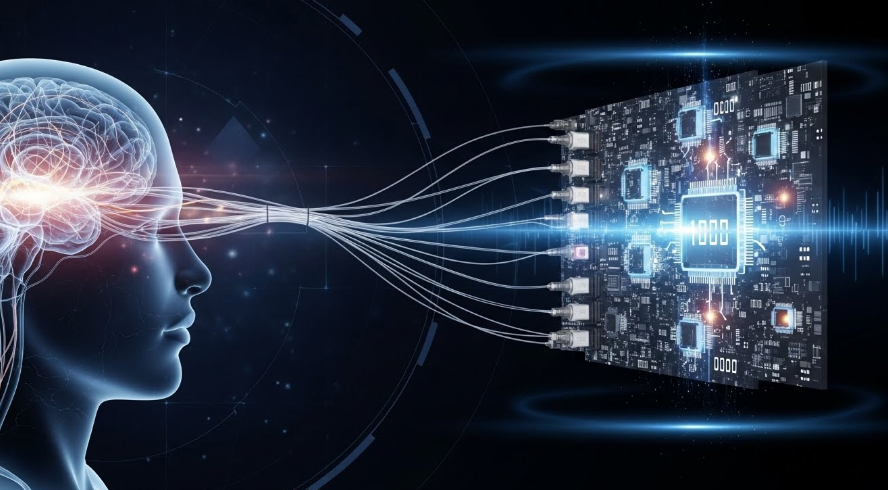
That’s not science fiction. That’s brain-computer interfaces (BCI). And it’s happening right now in 2026 with human trials from Neuralink, Synchron, Blackrock Neurotech, and others.
Time to complete: 2 minutes
Cost: Free (but BCI will cost €10,000-50,000 initially, dropping to €1,000-5,000 by 2040)
What you learned: The interface between human and computer is about to disappear entirely
Here’s what makes BCI revolutionary: It eliminates the bottleneck between your brain and the digital world.
Humans think in rich, complex thoughts. We reduce those thoughts to words (already losing nuance). We type or speak those words slowly (bottleneck). Computer processes and responds. We read or hear response (another bottleneck). We think about it and repeat the cycle.
Brain-computer interfaces remove all the middlemen. Brain thinks. Computer responds. Instantly. No typing. No speaking. No reading. Just pure thought-to-action at the speed of neural firing.
The implications are staggering: Paralyzed people walking again. Blind people seeing. Deaf people hearing. Humans communicating at thought-speed. Memory augmentation. Learning acceleration. And eventually, human-AI merger creating intelligence beyond either alone.
The BCI Reality: What Exists Today (2026)
Medical BCI (Already Changing Lives)
Neuralink Human Trials:
Elon Musk’s Neuralink implanted first human patient in January 2024. Patient with paralysis from spinal injury can now control computer cursor, type messages, play games, and browse internet using only thoughts. No hands needed. This isn’t vaporware—it’s working in humans right now.
Neuralink’s device has 1,024 electrodes reading neural signals from motor cortex (brain area controlling movement). AI learns which neural patterns correspond to intended movements. Within hours of calibration, patient can control cursor as naturally as moving their hand. Within weeks, they’re typing at 40+ words per minute—significantly faster than many people type with hands.
Synchron Stentrode:
Australian company Synchron took different approach: Instead of invasive brain surgery, their device enters through blood vessels like cardiac stent. Stentrode sits in blood vessel against motor cortex reading signals through vessel wall. Less invasive than Neuralink (no brain surgery) but also reads fewer electrodes (16 versus 1,024).
Synchron has multiple patients in US and Australia with implants. They control computers, send messages, and operate smart homes using thoughts. One patient uses BCI to control Amazon Alexa managing his entire home environment independently despite severe paralysis.
Blackrock Neurotech Utah Array:
One of the longest-running BCI systems. Utah Array has been implanted in research participants for over 15 years (some implants functioning 10+ years). These arrays enable paralyzed patients to control robotic arms with near-natural dexterity, type messages, and even feel sensations through bidirectional BCI (sending signals back to brain creating touch sensation).
Most impressive demonstration: Patient with robotic arm controlled by BCI could pick up grape without crushing it, drink from cup, feed themselves—tasks requiring fine motor control previously impossible for people with paralysis.
Visual Prostheses:
Companies like Second Sight developed Argus II retinal implant restoring limited vision to blind patients. Camera mounted on glasses sends signals to electrode array in retina bypassing damaged photoreceptors. Users perceive patterns of light allowing navigation, object recognition, and facial recognition.
Newer approaches bypass retina entirely stimulating visual cortex (brain’s vision processing area). This helps blindness caused by any eye problem or optic nerve damage. While current systems provide only low-resolution vision (detecting shapes, movement, obstacles), technology improving rapidly.
Cochlear Implants (The BCI You Didn’t Know About):
Over 1 million people worldwide have cochlear implants—electrode arrays in cochlea (inner ear) converting sound to neural signals. These are technically BCIs that have been mainstream medical devices for decades proving BCI concept works at scale. Modern cochlear implants provide remarkably good hearing to profoundly deaf individuals.
Non-Invasive BCI (No Surgery Required)
EEG Headsets:
Electroencephalography (EEG) measures brain activity through skull using electrodes on scalp. Non-invasive but much lower resolution than implanted electrodes (skull and scalp block and scatter signals). Still useful for many applications.
Companies like Emotiv, NeuroSky, and Muse sell consumer EEG headsets for €200-500. Applications include meditation training (neurofeedback showing when brain enters calm states), focus tracking (detecting when attention wavers), basic computer control (limited), and research.
fNIRS and fMRI:
Functional near-infrared spectroscopy (fNIRS) and functional magnetic resonance imaging (fMRI) measure brain activity through blood flow changes. fNIRS is portable and affordable but low resolution. fMRI is extremely high resolution but requires massive expensive machines limiting it to research settings. Neither practical for everyday BCI but useful for understanding brain function.
The Technology Breakthrough: Why BCI Works Now
Three Technical Advances Making BCI Practical
1. Miniaturized High-Density Electrode Arrays
Early BCI research used few electrodes (4-16) providing crude signal. Modern arrays have 1,000+ electrodes in stamp-sized area. More electrodes equals more information equals better control. Neuralink’s threads are 1/20th width of human hair yet carry multiple electrodes. This miniaturization allows reading thousands of neurons simultaneously providing rich signal for AI to decode.
Manufacturing advances from semiconductor industry enable mass production of complex electrode arrays at decreasing costs. What cost €1+ million in research prototypes now costs €10,000-50,000 and dropping toward €1,000-5,000 with scale.
2. AI Signal Decoding
Reading neural signals is one challenge. Understanding what they mean is another. This is where AI shines. Machine learning algorithms train on neural signals correlated with movements, thoughts, or perceptions learning to decode complex brain patterns.
Early BCI required extensive training periods (weeks or months) for crude control. Modern AI-powered BCI learns in hours achieving sophisticated control in days. And it continues learning improving over time as it sees more examples of your neural patterns.
This AI advancement is crucial: Without it, even high-electrode-count arrays would be useless raw data. With AI, they become natural extensions of thought.
3. Wireless and Implantable Computing
Early BCI systems had wires passing through skull—infection risk and inconvenience. Modern systems like Neuralink are fully implantable with wireless data transmission. Device sits under skull (no external parts visible) and charges inductively like electric toothbrush (no battery replacement needed).
Implantable computing becoming powerful enough to process signals locally before transmitting, reducing bandwidth needs and enabling real-time low-latency control crucial for applications like prosthetic limbs.
The Applications Revolution: What BCI Enables
Medical Applications (The Current Focus)
Restoring Movement:
10+ million people globally paralyzed from spinal cord injuries, stroke, or neurological diseases. BCI bypasses damaged nerves allowing brain to directly control prosthetics, wheelchairs, or computers. This transforms lives: Independent mobility, communication, employment, and dignity restored to people who thought they’d lost them forever.
Beyond prosthetics: Brain signals can stimulate muscles directly through functional electrical stimulation (FES) bypassing spinal cord entirely. Paralyzed patients with BCI controlling FES systems walking again using their own legs. Still experimental but improving rapidly.
Restoring Senses:
Vision, hearing, and touch can be restored through BCI stimulating relevant brain areas. Visual prostheses improving from crude light perception to useful vision. Auditory prostheses (cochlear implants) already mainstream. Tactile prostheses allowing prosthetic limb users to feel what they touch closing feedback loop making artificial limbs truly useful.
Treating Neurological Disorders:
Deep brain stimulation (electrodes in specific brain regions) treats Parkinson’s disease, essential tremor, epilepsy, and depression. Over 200,000 people worldwide have implanted neurostimulators. Future BCIs will both read and stimulate enabling closed-loop systems: Detect seizure starting and stimulate to prevent it. Detect depression signals and stimulate mood-regulating regions. Detect tremor onset and counter-stimulate.
Communication Applications (The Near-Term Opportunity)
Thought-to-Text:
Current keyboard/touchscreen typing maxes around 40-80 words per minute for fast typists. Speech-to-text reaches 150-200 words per minute. Thought-to-text could reach 200-300+ words per minute—thinking speed.
This transforms productivity for knowledge workers. Imagine writing reports, emails, code at thinking speed. Hours of work completed in minutes. Creative flow uninterrupted by typing lag. This isn’t decades away—early demonstrations already achieving 90 words per minute with more invasive BCIs, non-invasive approaching this within years.
Language Translation:
BCI could read intent before language formation and output in any language. Think in English, BCI outputs in Mandarin. Think in Arabic, outputs in Spanish. This eliminates language barriers completely enabling truly universal communication.
Brain-to-Brain Communication:
Ultimate evolution: One person’s thoughts transmitted directly to another person’s brain bypassing language entirely. Experiments demonstrated simple brain-to-brain communication (thinking “move hand,” other person’s hand moves involuntarily). Crude now but proof of concept exists.
This could enable experience sharing beyond current language: Sharing emotion, sensation, memory, skill. Imagine learning piano by experiencing expert pianist’s neural patterns. Or therapist directly feeling patient’s emotional state. Or team collaborating with shared thought-space.
Enhancement Applications (The Future)
Memory Augmentation:
BCI could record neural patterns during experiences allowing perfect recall later. Never forget name, face, conversation, or fact. Search your own memories like searching internet. This addresses one of brain’s key limitations: unreliable memory.
Hippocampus prosthetics under development: Artificial hippocampus (brain structure crucial for memory formation) replaces or augments damaged one. Successfully tested in rats and monkeys, human trials approaching.
Learning Acceleration:
BCI could stimulate learning by presenting information directly to brain or putting brain in optimal learning states. Studies show transcranial direct current stimulation (tDCS, weak electrical current through skull) enhances learning and memory in some contexts. Future BCIs could provide much more targeted stimulation accelerating skill acquisition dramatically.
“Download” new skills Matrix-style remains science fiction, but accelerating learning 2-10x is plausible trajectory.
Cognitive Enhancement:
BCI monitoring brain states and providing neurofeedback or stimulation could enable sustained focus, enhanced creativity, better decision-making. Professional gamers, traders, surgeons, pilots, and others in high-stakes cognitive domains will adopt BCI enhancement for competitive advantage.
Questions of fairness arise: Should students use BCI to enhance test performance? Should athletes use BCI to improve reaction time? Society will grapple with cognitive enhancement ethics like we currently debate performance-enhancing drugs in sports.
What You Can Do: The BCI Strategy
For Medical Conditions:
If you or loved one has paralysis, sensory loss, or neurological disorder, research BCI clinical trials. Neuralink, Synchron, Blackrock, and others actively recruiting patients. Being early participant provides access to potentially life-transforming technology while helping advance the field.
For Non-Medical Use:
Near-Term (2026-2030): Experiment with consumer EEG headsets (€200-500) for meditation, focus training, basic computer control. These provide taste of BCI without surgery and have real if limited utility for productivity and wellness.
Medium-Term (2030-2035): As non-invasive BCI improves, early consumer versions for productivity (thought-to-text) will emerge. Early adopters will gain significant productivity advantage. Monitor companies like Neuralink, Synchron, and startups for consumer product launches.
Long-Term (2035-2050): As invasive BCI costs drop below €5,000 and risks decline with millions of implants proving safety, consider adoption for cognitive enhancement if you’re in cognitively demanding field. Competitive pressure will drive adoption in high-stakes careers.
Career Opportunities:
Neuroscientists working on BCI earn €70,000-140,000+ researching brain function and BCI applications. BCI engineers designing hardware and software earn €80,000-160,000+. Neurosurgeons performing BCI implantations earn €150,000-400,000+. AI specialists developing decoding algorithms earn €90,000-180,000+. BCI regulatory specialists navigating approvals earn €70,000-130,000+.
Investment Opportunities:
Private companies: Neuralink, Synchron, Blackrock Neurotech, Paradromics, and dozens of startups. Many will go public 2027-2035. Public companies: Medical device companies like Medtronic have BCI divisions. Component manufacturers (electrodes, chips, wireless systems). Service providers (implantation, monitoring, support).
BCI market projected to grow from €2 billion (2026) to €10+ billion (2035) to €50+ billion (2050) as technology moves from medical niche to broader enhancement adoption.
The Timeline: When BCI Goes Mainstream
2026-2030: Medical Breakthroughs
Neuralink, Synchron, others expand human trials to hundreds of patients. FDA and other regulators approve BCI for paralysis, blindness, and other conditions. Thousands receive implants annually. Costs remain high (€50,000-100,000) limiting adoption to medical necessity and wealthy early adopters. Non-invasive BCI improves significantly but still far behind invasive systems.
2031-2035: Early Commercial Adoption
Medical BCIs fully approved and reimbursed by insurance globally. Tens of thousands of implants annually. Costs drop to €10,000-30,000. First non-medical applications emerge for productivity (thought-to-text for knowledge workers). Non-invasive BCI reaches useful performance for consumer applications launching products under €1,000.
2036-2045: Expansion Phase
BCI costs drop below €5,000 for invasive systems, below €500 for non-invasive. Hundreds of thousands adopting invasive BCI annually for cognitive enhancement in addition to medical uses. Millions using non-invasive BCI for productivity, gaming, and communication. Society adapts to some people having cognitive enhancement creating equity debates.
2046-2050: Integration Phase
BCI common in developed countries with millions using enhancement systems. Integration with AI creates cyborg intelligence exceeding baseline human capability significantly. Educational, professional, and social adaptations to BCI-enhanced versus non-enhanced populations. Costs drop to €1,000-2,000 for invasive, €100-300 for non-invasive making technology accessible globally.
The Bottom Line: BCI Is the Ultimate Human-AI Interface
Brain-computer interfaces represent the merger of human and artificial intelligence creating something greater than either alone.
The value propositions are profound: Restoring function to millions with paralysis, blindness, and neurological conditions. Enabling communication at thought-speed. Augmenting memory preventing forgetfulness. Accelerating learning enabling rapid skill acquisition. Enhancing cognition for competitive advantage in cognitively demanding careers.
The trajectory is clear: Medical applications proving safety and efficacy now. Consumer applications emerging 2030s. Mass adoption 2040s as costs drop and benefits become undeniable. By 2050, BCI will be common like smartphones today with hundreds of millions or billions of users globally.
The opportunity is massive: €50+ billion annual market by 2050. Revolutionary improvement in human capability. Millions of lives transformed by medical applications. And competitive advantage for those who adopt early as cognitive enhancement becomes available.
The 2050 world will have humans and AI directly connected. The question is: Will you embrace cognitive enhancement or remain baseline human while others upgrade?