Why Everyone Will Wear AI by 2030
ACTIVITY: The Wearable Reality Check
Look at your wrist right now. Are you wearing a smartwatch or fitness tracker?
If yes: You’re already wearing AI. That device tracks your heart rate, predicts your health issues, answers your questions, navigates you places, and learns your patterns. You’re already a cyborg—you just don’t think of it that way.
If no: Pull out your smartphone. How many hours do you hold it daily? 3 hours? 5 hours? More? Now imagine all that capability on your wrist, your glasses, your clothing, always accessible without pulling anything out. That’s wearable AI.
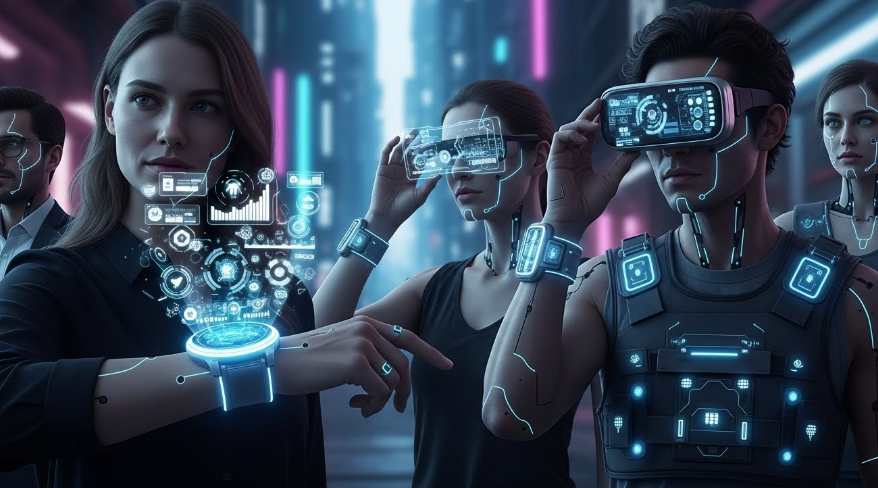
Now imagine 2030. You wake up and your smart ring already knows you slept poorly (tracked your sleep stages). Your smart glasses overlay your calendar on your vision as you get ready. Your AI earbuds translate the Portuguese conversation on the news in real-time. Your fitness clothing monitors your workout form and gives you coaching. Your continuous glucose monitor warns you that pastry will spike your blood sugar. All of this without touching a phone once.
Time to complete: 2 minutes
Cost: Free (but the wearables cost €200-2,000 and could save your life)
What you learned: Wearable AI isn’t coming—it’s already here and about to become universal
Here’s the wearable AI revolution in one sentence: The computer moved from room-sized to desk-sized to pocket-sized, and now it’s becoming body-sized.
The global wearable AI market already exceeds 500 million devices in 2026. By 2030, that becomes 1+ billion devices. By 2050, wearable AI will be as universal as smartphones today with 5+ billion people wearing smart devices continuously.
But here’s what makes wearables different from smartphones: They’re always on, always sensing, always learning. Your phone sits in your pocket. Your wearable AI is monitoring your heart, tracking your movement, listening to your environment, analyzing your health, and predicting your needs 24/7. It knows you better than you know yourself.
This creates the most intimate human-AI relationship in history. And it’s about to transform healthcare, productivity, communication, and human capability itself.
The Wearable Reality: What Exists Today (2026)
Smartwatches and Fitness Trackers (The Gateway Drug)
Apple Watch:
Over 200 million units sold globally. Tracks heart rate continuously, detects irregular rhythms (atrial fibrillation) and alerts users potentially saving thousands of lives annually. Fall detection calls emergency services automatically if you fall and don’t respond. ECG function provides medical-grade heart monitoring. Blood oxygen monitoring tracks respiratory health. Sleep tracking analyzes sleep quality. And AI assistant (Siri) answers questions, sends messages, and controls smart home via voice.
Apple Watch doesn’t just track health—it predicts it. Irregular heart rhythm detection finds problems months before symptoms appear. Users get medical treatment preventing strokes and heart attacks. Multiple documented cases of Apple Watch literally saving lives by detecting health issues early.
Samsung Galaxy Watch:
Similar capabilities with Android ecosystem integration. Body composition analysis measures body fat percentage, muscle mass, and hydration without separate scales. Advanced sleep tracking includes snoring detection and blood oxygen levels during sleep. And AI assistant (Bixby) provides voice control and information access.
Fitbit and Garmin:
Focused on fitness and health tracking. Garmin particularly strong in GPS and sports-specific metrics for runners, cyclists, swimmers. Fitbit (owned by Google) integrating deeper AI for health insights and predictions. Both companies have hundreds of millions of users globally generating massive health datasets that improve AI predictions.
The Pattern: Smartwatches evolved from simple notification devices to sophisticated health monitors with AI predicting and preventing medical emergencies.
Smart Glasses (The Vision Revolution)
Ray-Ban Meta Smart Glasses:
Facebook (Meta) partnered with Ray-Ban creating stylish glasses with cameras and AI assistant. Users ask questions and get answers via audio, take photos hands-free, make calls, listen to music. Early adopter product (not mainstream yet) but demonstrates where glasses are heading: augmented reality overlays coming in next generation.
Xiaomi Smart Glasses:
China’s Xiaomi demonstrated glasses with microLED displays overlaying information on vision. Navigation arrows appear on streets, translations appear over foreign text, notifications appear in vision. Not widely available yet but technology proven and scaling.
Other Players:
Google Glass failed commercially but enterprise versions work in warehouses and factories. Microsoft HoloLens targets enterprise augmented reality. Snap Spectacles for social media. Multiple startups developing smart glasses for specific uses (cycling, running, enterprise, military).
The Timeline: Smart glasses mainstream by 2028-2030 as technology miniaturizes and costs drop below €300-500.
Health Monitoring Wearables (The Medical Revolution)
Continuous Glucose Monitors (CGM):
Diabetes patients wear small sensors monitoring blood glucose continuously. Data syncs to smartphones showing real-time glucose levels and trends. AI predicts dangerous highs or lows hours before they occur allowing preventive action. Companies like Dexcom and Abbott FreeStyle Libre serve millions globally.
Non-diabetics increasingly using CGM to understand how food affects their glucose and optimize diet and performance. Athletes use CGM to maximize energy. Biohackers use CGM to extend healthspan. Market expanding from medical necessity to performance optimization.
Biosensors and Patches:
Adhesive patches monitor heart rate, respiration, temperature, and activity continuously for days or weeks. Hospitals use these for remote patient monitoring allowing patients to go home while remaining monitored. Future versions will monitor blood chemistry, hydration, inflammation markers, and more providing comprehensive health picture continuously.
Smart Rings:
Oura Ring and competitors track sleep, activity, heart rate, body temperature, and recovery in small ring form factor. Less obtrusive than watches. Popular with athletes and health enthusiasts. Shows wearables don’t need to be obvious—they can be jewelry.
AI Earbuds (The Audio Revolution)
AirPods and Competitors:
Apple’s AirPods and competitors from Samsung, Sony, Bose evolved from simple wireless headphones to sophisticated AI devices. Noise cancellation uses AI to analyze and cancel ambient sound in real-time. Spatial audio creates immersive sound experiences. And Siri integration provides voice-controlled AI assistant in your ears constantly.
Translation Earbuds:
Google Pixel Buds and others offer real-time translation. Someone speaks Spanish, you hear English in your ears instantly. This eliminates language barriers enabling conversation across languages. Technology still imperfect but improving rapidly.
Hearing Health:
AI-powered hearing aids from companies like Starkey blend hearing assistance with smart earbud features. Future blurs line between “hearing aids” and “hearing enhancement” as everyone benefits from AI-optimized audio regardless of hearing loss.
The Technology Breakthrough: Why Wearables Work Now
Three Technical Leaps Making Wearables Practical
1. Miniaturization and Power Efficiency
Moore’s Law continues in sensor and processor technology. Sensors that required desktop computers to process now work with chip smaller than fingernail consuming milliwatts of power. Battery technology improved (smartwatches last 1-2 days, some devices last weeks). And energy harvesting emerging (kinetic energy from movement, thermal energy from body heat, solar cells) potentially enabling perpetually-powered wearables.
This miniaturization allows packing sophisticated AI capabilities into devices small enough to wear comfortably all day. And improving power efficiency means wearables run longer between charges approaching “charge weekly” rather than “charge daily.”
2. AI at the Edge
Early wearables needed to send all data to cloud for processing. Latency issues and privacy concerns. Now, edge AI allows processing directly on device. Your smartwatch’s AI analyzes your heart rhythm locally without sending data anywhere. Your smart glasses’ AI recognizes objects without cloud connection. This enables real-time responses and preserves privacy.
Edge AI chips from companies like Qualcomm, Apple, and others specifically designed for wearables now rival smartphone processors from few years ago. This trend accelerates: wearables getting smarter while remaining smaller.
3. Multimodal Sensing and Sensor Fusion
Modern wearables pack 10+ sensors: accelerometer, gyroscope, heart rate monitor, GPS, barometer, thermometer, blood oxygen sensor, microphones, and more. AI fuses all these sensor streams creating comprehensive understanding of user’s state impossible from any single sensor.
Example: Smartwatch detects elevated heart rate (sensor 1), rapid breathing (accelerometer detecting chest movement), and high skin temperature (thermometer). AI fuses these signals recognizing panic attack or medical emergency rather than exercise. This contextual understanding from sensor fusion enables wearables to understand not just what you’re doing but what’s happening to you.
The Applications Revolution: What Wearables Enable
Healthcare Transformation (The Killer Application)
From Reactive to Predictive:
Traditional healthcare is reactive: you feel symptoms, see doctor, get diagnosed, receive treatment. Wearable AI enables predictive healthcare: AI detects problems before symptoms, alerts you or doctor, treatment happens before emergency, outcomes dramatically better.
Heart attacks often preceded by subtle changes in heart rhythm days or weeks before. Smartwatch AI detects these changes and alerts user: “Irregular heart rhythm detected, see cardiologist.” User gets treatment preventing heart attack. This saves lives and saves healthcare systems billions by preventing expensive emergency treatments.
Infections often preceded by elevated resting heart rate and body temperature before fever appears. Wearables detect this combination alerting user: “Possible infection developing, monitor symptoms.” Early treatment prevents serious illness. Studies show wearables can detect COVID-19 infection 2-3 days before symptoms appear.
Chronic Disease Management:
Diabetes management transformed by CGM. Instead of finger pricks multiple times daily, continuous monitoring with AI predicting dangerous glucose levels hours ahead. This dramatically improves outcomes and quality of life for 400+ million diabetics globally.
Hypertension (high blood pressure) affects billions globally. Continuous blood pressure monitoring through wearables (emerging technology, not yet mainstream) will enable much better management. Heart failure patients monitored remotely detecting problems early avoiding hospitalizations.
Mental Health:
Wearables track sleep quality, heart rate variability, activity levels, and other markers correlating with mental health. AI detects patterns indicating depression, anxiety, or other conditions alerting user or therapist. This provides objective data augmenting subjective reports making mental healthcare more effective.
Stress management through real-time biofeedback: wearable detects elevated stress (heart rate, breathing, skin conductance) and prompts breathing exercises or alerts you to take break. This helps prevent burnout and improves wellbeing.
Productivity Enhancement (The Professional Application)
Cognitive Augmentation:
Smart glasses overlaying information on vision eliminates need to look at screens. Warehouse workers see picking instructions overlaid on shelves. Surgeons see patient data overlaid on surgical field. Technicians see repair instructions overlaid on equipment. This hands-free information access increases productivity 20-40% in many applications.
AI earbuds provide instant information access via voice. Instead of stopping work to look up information, ask question and get answer in seconds. This eliminates cognitive friction accelerating workflow.
Focus and Flow:
Wearables track physiological markers of focus and flow states. AI learns when you’re most productive and protects that time from interruptions. Or alerts you when focus is declining suggesting break. This optimization improves knowledge work productivity measurably.
Brain-sensing headbands (like Muse) track brain activity providing neurofeedback for meditation and focus training. Future wearables will integrate this capability helping users enter and maintain high-performance cognitive states.
Meeting Assistance:
AI earbuds transcribe meetings in real-time, summarize key points, and remind you of action items. Smart glasses display relevant information during presentations. This augmentation makes professionals more effective in collaborative settings.
Communication Revolution (The Social Application)
Language Translation:
Real-time translation earbuds break language barriers. This enables business, travel, and personal connections previously limited by language. As technology improves from 80% accurate to 95%+ accurate (next few years), adoption will explode enabling truly global communication.
Accessibility:
Deaf individuals use smart glasses with captions appearing for spoken conversation. Blind individuals use smart glasses with AI describing visual scenes via audio. Wearable AI dramatically improves accessibility transforming lives of hundreds of millions with disabilities globally.
Social Enhancement:
Smart glasses recognizing faces and displaying names and context helps those with poor facial recognition or memory. AI assistant whispers reminders about people you’re meeting: “This is John from sales, you worked together on the Anderson project last year.” This social augmentation helps networking and relationship building.
What You Can Do: The Wearable AI Strategy
Adoption Roadmap:
Phase 1 (Now-2027): Start with Smartwatch
Begin with quality smartwatch or fitness tracker (€200-500). Track health metrics establishing baseline. Use AI assistant for productivity (reminders, timers, quick questions). Enable fall detection and irregular rhythm alerts potentially saving your life. Expected ROI: Health monitoring worth thousands if it detects problem early.
Phase 2 (2027-2030): Add Smart Glasses
When smart glasses reach €300-500 price point and mainstream designs available (2027-2028), adopt for augmented reality and hands-free information access. Use for navigation, translation, productivity. Expected ROI: 20-30% productivity boost in information-intensive work worth thousands annually.
Phase 3 (2030-2035): Comprehensive Wearable Ecosystem
Multiple wearables covering different needs: smartwatch for health, smart glasses for vision, AI earbuds for audio, smart clothing for fitness, CGM for metabolic optimization. These wearables share data creating comprehensive AI understanding of your state enabling maximum optimization.
Phase 4 (2035+): Neural Interfaces
As brain-computer interfaces miniaturize into wearable form factors (headbands, earbuds with neural sensing), adopt for direct thought-to-text and cognitive enhancement. This represents next level of human-AI integration.
Career Opportunities:
Wearable hardware engineers earn €60,000-120,000+ designing devices. AI health specialists analyzing wearable data earn €70,000-130,000+. Wearable app developers creating specialized applications earn €50,000-100,000. Clinical specialists integrating wearables into healthcare earn €80,000-150,000. Wearable UX designers creating intuitive interfaces earn €60,000-110,000.
Investment Opportunities:
Public companies: Apple (dominant player), Samsung, Garmin, Fitbit/Google, Qualcomm (chips), Dexcom (CGM). Emerging: Hundreds of wearable startups in health, fitness, enterprise, AR/VR. Market growing 15-20% annually reaching €200+ billion by 2030.
The Timeline: When Wearables Become Universal
2026-2028: Mainstream Adoption Accelerates
Smartwatches reach 800 million users globally. Smart glasses from Apple and others launch creating mainstream AR category. Health monitoring wearables expand beyond medical necessity to wellness optimization. Prices drop making wearables accessible globally.
2029-2035: Ubiquity Phase
Wearable AI becomes expected like smartphones today. 1+ billion smartwatch users. 500+ million smart glasses users. Comprehensive health monitoring standard. Wearables integrated into clothing, jewelry, and accessories becoming invisible. Society adapts to always-on AI assistance as normal.
2036-2045: Integration Phase
Multiple wearables per person standard. Brain-computer interfaces in wearable form factors emerge. Wearable AI knows users so intimately it predicts needs before conscious awareness. Healthcare shifted fundamentally from reactive treatment to predictive prevention. Productivity augmented dramatically by seamless AI assistance.
2046-2050: Augmented Humanity
Line between human and AI blurs. Wearables provide cognitive enhancement, perfect memory recall, instant language translation, augmented vision and hearing, predictive health monitoring. Humans without wearable augmentation at significant disadvantage in work and life. “Baseline” human capability becomes augmented human capability.
The Bottom Line: Wearables Are Inevitable
Wearable AI is following the same adoption curve as smartphones: From luxury to necessity in 10-15 years.
The value propositions are overwhelming: Health monitoring potentially saving your life by detecting problems early. Productivity enhancement worth thousands annually. Communication breaking language barriers globally. Accessibility transforming lives of people with disabilities. Cognitive augmentation making everyone smarter and more capable.
The economics favor wearables: Prices dropping from €500 to €200 to eventually €50-100 for basic devices. Health savings from early detection vastly exceed device costs. Productivity gains pay for devices many times over. And competitive pressure drives adoption (those with wearable augmentation outperform those without).
The timeline is now: 500+ million wearable AI devices already in use globally. 1+ billion by 2030. Universal adoption by 2040. The wearable revolution isn’t coming—it’s here and accelerating.
The 2050 world will have everyone wearing AI. The question is: Will you adopt early and capture the advantages, or late and play catch-up?