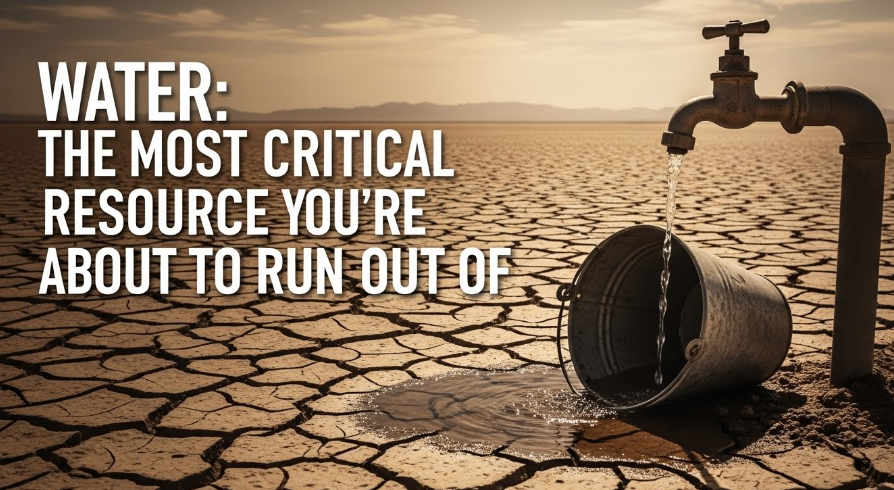
Why the Next 25 Years Will Redefine Everything About Water
ACTIVITY: The 60-Second Water Reality Check
Right now, before you read another word, do this: Go to your kitchen. Turn on the faucet. Fill a glass with water. Drink it.
Done? Congratulations. You just did something that 2.2 billion people can’t do safely today. And by 2050, that number becomes 5 billion.
Now here’s the uncomfortable part: Look at your water bill from last month. Take that number and multiply it by 5. That’s what you might be paying by 2040 if you don’t act now. Water scarcity isn’t coming—it’s here. And it’s about to get expensive.
Time to complete: 60 seconds
Cost: Free
What you learned: Water you take for granted is becoming the most valuable commodity on Earth
Here’s a number that should terrify you: By 2050, 5 billion people will face water scarcity at least one month per year.
That’s not in some distant future. That’s when today’s teenagers will be having kids. That’s when today’s 40-year-olds will be retiring. That’s basically tomorrow.
And here’s the kicker: Water isn’t like oil. You can’t invent a substitute. You can’t live without it for more than 3 days.
Right now, while you’re reading this, water is becoming the most valuable commodity on Earth. Not gold. Not lithium. Not even oil. Water.
The Scarcity Reality: Numbers That Matter
How Scarce Is Water Actually?
The Big Picture:
Here’s the reality: 97.5% of Earth’s water is saltwater, unusable without expensive desalination. Another 2.5% is freshwater, but nearly 70% of that is locked in glaciers and ice caps. That leaves only 1% of Earth’s water as accessible freshwater. And that 1% has to serve 8 billion people, all agriculture, and all industry.
Translation: We’re all fighting over 1% of the planet’s water.
The Scarcity Timeline:
RIGHT NOW (2026):
Currently, 2.2 billion people lack safe drinking water while 4.2 billion lack safely managed sanitation. Agriculture alone uses 70% of available freshwater, and industrial use is growing 50% faster than population growth. Meanwhile, groundwater is being pumped faster than nature can recharge it across every continent.
Major cities worldwide have faced “Day Zero” water crises. Cape Town nearly ran out of water in 2018. Chennai’s reservoirs ran dry in 2019. São Paulo faced severe shortages in 2014-2015. Mexico City sinks as aquifers are depleted. And these aren’t isolated incidents, they’re the new normal.
BY 2030:
Within four years, global water demand will exceed supply by 40%. Half the world’s population will live in water-stressed areas. Water-related disasters will displace 700 million people. And conflicts over water resources will intensify from the Nile Basin to the Mekong Delta to Central Asia.
BY 2050:
Within 25 years, 5 billion people will face water scarcity. Urban water demand will increase 80%, agricultural demand will rise 50% to feed more people, and industrial demand will surge 400% due to economic growth. The available supply? Not increasing at all.
The Math Doesn’t Work.
The Value Proposition: Why Water Is Your Best Investment
Water Scarcity = Water Value = Opportunity
Real Estate:
Properties with water rights or reliable water access are worth 30-50% more than properties without. In water-scarce regions from Australia to Southern Spain to India, water access determines property value more than any other factor. Cities with water security attract population and business investment while water-stressed cities face exodus.
Agriculture:
Water-efficient farming reduces costs by 30-60% while maintaining or increasing yields. Drought-resistant crops command premium prices in water-scarce markets. Precision irrigation doubles yields with half the water. And water rights themselves are tradeable assets worth fortunes in water-scarce regions.
Business:
Water efficiency means 20-40% cost savings for commercial operations. Water recycling creates new revenue streams. Water-independent operations gain massive competitive advantage in water-scarce regions. And water technology is becoming a trillion-dollar global market.
Personal:
Home water efficiency saves €200-500 annually in Europe, ₹15,000-40,000 in India, R2,000-5,000 in South Africa, or $300-700 AUD in Australia. Rainwater harvesting provides independence from unreliable municipal supplies. Greywater systems reduce consumption 30-50%. And water-smart landscaping saves thousands annually in hot climates.
The Pattern: Water scarcity makes water efficiency profitable globally.
The Technology Revolution: How We Solve This
We’re Not Helpless—Here’s What’s Happening:
1. Desalination (Making Saltwater Drinkable)
Reverse osmosis technology now costs 80% less than 20 years ago. Israel gets 80% of drinking water from desalination, proving it works at national scale. Saudi Arabia and UAE have built massive desalination capacity. Singapore uses NEWater (ultra-purified recycled water) for 40% of needs. And solar-powered desalination units now work at village scale, bringing clean water to coastal communities without grid electricity.
The market is exploding. Desalination capacity globally will reach 120 million cubic meters per day by 2030, up from 95 million today. Every coastal nation can become water-secure with this technology. The opportunity is massive: $95 billion global market by 2030.
2. Water Recycling (Using It Multiple Times)
Singapore’s NEWater proves recycled wastewater can be cleaner than tap water. Namibia has safely used recycled water for 50 years. Australia expanded water recycling dramatically during Millennium Drought. Israel recycles 90% of wastewater, world’s highest rate. And new membrane technologies make recycling economically attractive everywhere.
The economics are compelling. Recycling costs 90% less than developing new water sources, it’s available exactly where needed, and it’s drought-proof. Cities from Tokyo to London to Dubai are massively expanding water recycling infrastructure.
3. Precision Agriculture (Every Drop Counts)
Drip irrigation achieves 90% efficiency versus 40% for traditional methods. Soil sensors tell farmers exactly when to water. AI predicts water needs days in advance. Mobile apps let farmers control irrigation remotely. And farmers using these technologies achieve same yields with 40-60% less water.
Israel pioneered drip irrigation, now exporting technology worldwide. India is rapidly adopting micro-irrigation with government subsidies. Spain leads Europe in precision agriculture. And across Africa and Asia, small-scale farmers are leapfrogging to water-efficient technology.
4. Atmospheric Water Generators (Pulling Water From Air)
Devices extract moisture from air even in deserts. Solar-powered units produce 2-5 liters daily per unit, enough for drinking water. They scale from household to community to industrial levels. And they work anywhere with any humidity, providing water independence.
These systems are deployed from Australian outback to African villages to Middle Eastern military bases. Costs drop 20% annually making them increasingly accessible. For remote communities and water-insecure regions, this technology is literally life-saving.
5. Leak Detection & Smart Infrastructure
Cities worldwide lose 30-50% of water to pipe leaks. London loses 25%, Mexico City 40%, Manila 67%. That’s billions in wasted water and money. AI-powered acoustic sensors detect leaks. Satellite monitoring finds underground issues. Smart meters track usage in real-time. And predictive maintenance prevents catastrophic failures.
Water utilities investing in smart infrastructure recover 20-30% of lost water within 2-4 years. The technology pays for itself quickly while solving massive waste problem. Cities from Singapore to Copenhagen to Seoul lead the way.
What You Can Do: The Personal Water Action Plan
Make Your Home Water-Efficient (Payback: 2-3 Years Globally)
Week 1: Audit & Fix
Check for leaks in toilets, faucets, and pipes. One dripping faucet wastes 15,000 liters annually. Fix leaks with simple repairs costing €50-200 in Europe, ₹2,000-8,000 in India, R500-2,000 in South Africa. The savings immediately exceed the investment everywhere.
Week 2: Low-Hanging Fruit
Install low-flow showerheads costing €20-50 globally, saving 10,000 liters per person annually. Add faucet aerators for €5-15 each achieving 30% water reduction. Convert toilets to dual-flush for €20-40, saving 15,000 liters per year. Total investment globally: €100-200. Annual savings: €200-500 equivalent in water bills.
Week 3: Outdoor Efficiency
Smart irrigation controllers cost €100-300 anywhere, saving 30,000+ liters annually. Drip irrigation for gardens is 50% more efficient than sprinklers and costs similar globally. Mulch around plants reduces evaporation by 25%. Native plants adapted to your climate need 50-80% less water than exotic species.
Week 4: Greywater System (Optional)
Reuse shower and sink water for toilets and gardens. DIY systems cost €200-500 globally, professional installation €1,500-5,000. These systems reduce consumption 30-50% and pay for themselves in 3-5 years even faster in water-scarce regions with high water costs.
Month 2: Rainwater Harvesting
Simple barrel systems cost €100-300 globally and provide garden water. Full systems costing €2,000-10,000 can supply entire home. This free water falling from sky reduces dependence on unreliable municipal supply. In monsoon climates, rainwater harvesting provides most annual water needs.
Expected Outcomes Globally:
Reduce water consumption 40-60% regardless of location. Save €200-500 annually in Europe, ₹15,000-40,000 in India, R2,000-5,000 in South Africa, $300-700 AUD in Australia, or equivalent in your currency. Increase home value as water efficiency becomes premium feature. Gain drought resilience with less dependence on failing infrastructure.
The Regional Water Crisis Map: Where It’s Happening
High-Risk Regions (Severe Water Stress by 2030):
Middle East & North Africa:
Already the world’s most water-scarce region with per capita water availability below 1,000 cubic meters annually (water scarcity threshold). Jordan, Libya, Yemen, Saudi Arabia, UAE among most water-stressed nations. Groundwater depletion accelerating. Desalination provides partial solution but requires energy and creates brine disposal challenges. And regional conflicts increasingly tied to water access.
South Asia:
India’s 21 major cities running out of groundwater according to government think tank. Chennai’s Day Zero in 2019 affected millions. Pakistan faces severe water stress with Indus River disputes. Bangladesh vulnerable to saltwater intrusion from sea-level rise contaminating freshwater. Region home to 1.8 billion people facing mounting water crisis.
Sub-Saharan Africa:
400 million people lack basic water access. Population boom compounds scarcity. Climate change intensifying droughts in Horn of Africa and Sahel. Lake Chad shrunk 90% affecting 30 million people across four countries. Conflicts over water increasing. Yet leapfrog opportunity exists with mobile payment for water and community-scale solutions.
East Asia:
North China Plain aquifer depleting rapidly threatening wheat and vegetable production. Yellow River runs dry before reaching sea in drought years. Industrial pollution contaminates supplies. And massive South-to-North Water Transfer Project attempts to solve Beijing water crisis at huge environmental and economic cost.
Australia:
Millennium Drought (1997-2009) forced dramatic water conservation. Murray-Darling Basin struggles with over-allocation. Cities like Perth and Adelaide heavily reliant on desalination. Agricultural water allocations cut repeatedly during droughts. World leader in water efficiency technology by necessity, but climate change intensifying challenges.
Latin America:
São Paulo faced severe shortages affecting 20 million people. Lima, Peru (in desert receiving minimal rain) struggles with water supply for 10 million residents. Mexico City sinks as aquifers depleted. Glacier melt in Andes threatens water supply for millions downstream. La Paz, Bolivia faces crisis as glaciers disappear.
Southern Europe:
Spain’s reservoirs often below 50% capacity. Greece faces water stress on islands during tourist season. Italy’s Po River reaches record low levels during droughts. Portugal implements water rationing during dry years. And climate change bringing less rainfall to Mediterranean region.
The Business Opportunity: Water Tech Is Global Market
Where the Money Is Flowing:
Global Water Technology Market:
Currently $680 billion, projected to exceed $1 trillion by 2030. Growth driven by scarcity, regulation, efficiency demands, and climate change. Every region investing heavily in water infrastructure and technology.
Hot Investment Areas Globally:
Smart water networks worth $28 billion by 2028. Desalination expanding to $95 billion by 2030 with Middle East, Asia, and Australia leading. Agricultural water technology hitting $12 billion by 2030 as farmers globally adopt precision irrigation. Water treatment market reaching $250 billion by 2030 serving cities and industry worldwide. Water reuse and recycling becoming $35 billion market by 2030.
China leads global water technology investment followed by United States and European Union. Israel exports water technology globally. Singapore is water technology innovation hub. And startups from India to South Africa to Brazil developing solutions for their regions.
The Pattern: Every water problem globally is becoming business opportunity.
Your Water Action Checklist
This Month:
Calculate your household water footprint using online calculators. Fix all leaks immediately. Install water-efficient fixtures. Start tracking water consumption monthly. Research water situation in your city and country (secure or stressed?).
This Quarter:
Upgrade to smart irrigation or install rainwater harvesting. Convert landscaping to drought-tolerant native plants. Implement greywater recycling if feasible. Audit shower and toilet water use. Adopt at least 3 water-saving daily habits.
This Year:
Reduce water consumption 40%+ through efficiency measures. Consider full rainwater harvesting system for home. Join or advocate for water conservation programs locally. Educate family and community about water scarcity. Support policies and politicians prioritizing water security.
Expected First-Year Results Globally:
Water use down 40-60%. Water bills reduced by equivalent of €200-500 annually regardless of location. Home value protected or enhanced by water efficiency. Drought resilience gained through multiple water sources. And contribution to solving global water crisis.
The Bottom Line: Water Is the New Gold
The next 25 years will witness the greatest water crisis in human history. But crisis equals opportunity.
The value propositions are universal:
Water efficiency means immediate cost savings (€200-500 annually per household globally). Water technology represents $1 trillion global market creating investment and career opportunities worldwide. Properties with water security command 30-50% premiums in water-scarce regions globally. Water independence provides security regardless of failing infrastructure or climate change.
The scarcity is global and real. The timeline is now. The opportunity is massive.
What you do about water in the next 5 years will determine your quality of life in 2050, regardless of where you live.
The tap is running. The clock is ticking. The world is watching.