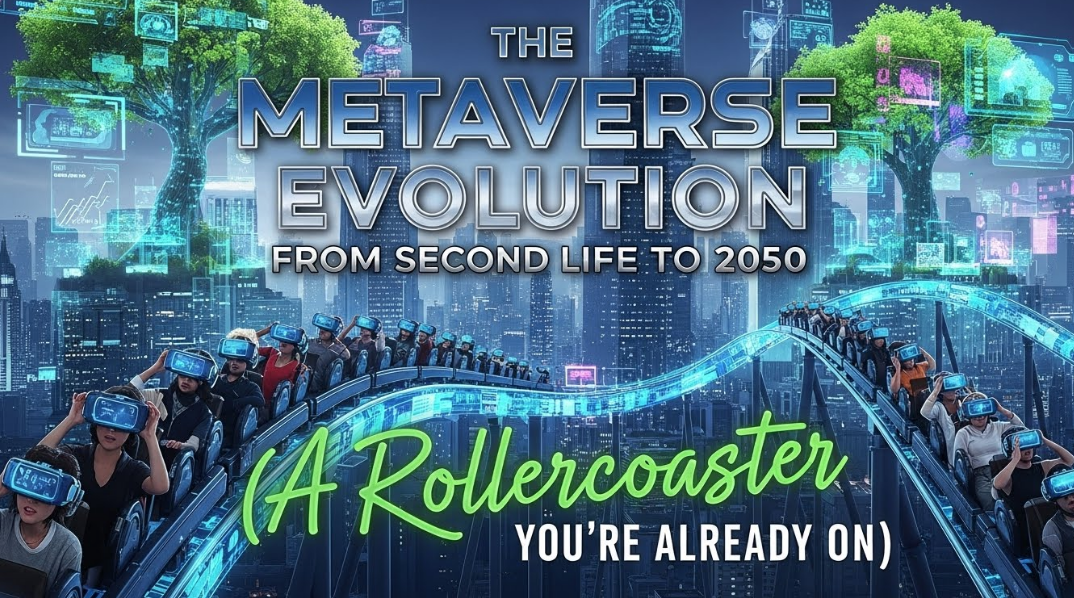
Let’s time travel. Not in some fancy VR headset—we’ll get to those—but through the actual history of the metaverse. Because here’s the thing: everyone talks about the metaverse like it’s this shiny new concept that Mark Zuckerberg invented after watching Ready Player One one too many times.
Wrong.
The metaverse has been evolving for over two decades, through spectacular failures, unexpected successes, and more corporate pivots than a presidential campaign. Buckle up. This is going to be a wild ride from 2003 to 2050.
Part 1: The OG Metaverse (2003-2010) – When Second Life Was Actually First
2003: Second Life Launches and Everyone Loses Their Minds
On June 23, 2003, Linden Lab founder Philip Rosedale unleashed Second Life on an unsuspecting world. This wasn’t a game—Linden Lab was very insistent about that. There were no goals, no quests, no princess to rescue. It was a virtual world where you could just… exist.
And people went absolutely bonkers for it.
Second Life let you create an avatar, build virtual properties, start businesses, attend concerts, gamble, have relationships, and yes, do all those other things adults do when their physical bodies aren’t involved. It had its own economy with the Linden Dollar, which you could exchange for real money. People were actually making a living in this pixelated universe.
By 2007, Second Life hit one million regular users. Major corporations rushed in. IBM held meetings there. Coca-Cola marketed there. Universities created virtual campuses. Sweden opened a virtual embassy. For a hot minute, it seemed like Second Life might actually be the future of the internet.
The media ate it up. Articles proclaimed we’d all be spending most of our time in virtual worlds by 2010. Real estate speculators bought virtual islands for tens of thousands of real dollars. Entrepreneurs sold virtual goods for real money. The excitement was palpable.
Then… nothing happened.
Well, not nothing. Second Life kept chugging along. But it didn’t revolutionize civilization. The hype died down. The corporate offices closed. The universities moved on. Second Life found its dedicated community—about 750,000 monthly active users who genuinely loved it—but it never became mainstream.
Why? A few reasons. The learning curve was brutal. The technology was clunky. Most computers couldn’t handle it well. And frankly, for most people, hanging out in a virtual world wasn’t compelling enough to replace Facebook, which was busy taking over actual social networking.
But here’s what Second Life taught us: people DO want persistent virtual worlds where they can express themselves creatively, own digital property, and build communities. They just need the technology to not feel like work.
The Lesson: Build it and they might come… but only if it’s easy to use and genuinely fun.
Part 2: The Gaming Era (2006-2015) – When “It’s Not a Metaverse, It’s a Game”
2006: Roblox Enters the Chat
While Second Life was getting all the press, something quieter but ultimately more significant launched in September 2006: Roblox.
Roblox wasn’t marketed as a metaverse. It was a game platform where users—mostly kids—could create their own games using relatively simple tools. The genius was democratizing game development. You didn’t need to be a programmer to build something cool.
And kids LOVED it. They built. They played. They socialized. They created entire worlds. By 2025, Roblox would have 190 million monthly active users. But in 2006, nobody was calling it the metaverse. It was just… Roblox.
2009: Minecraft Changes Everything
In 2009, a Swedish programmer named Markus “Notch” Persson released an alpha version of Minecraft. It looked like someone had built a world out of LEGO blocks, given it physics, and let you do whatever you wanted.
Minecraft became a phenomenon. Not because it was technically impressive—it looked intentionally blocky and basic. But because it gave players ultimate creative freedom in a persistent world they could shape however they wanted. You could build castles, recreate entire cities, create complex machines using redstone circuits, or just dig a hole and live in it. Your choice.
By the early 2010s, Minecraft was selling millions of copies. Kids played it. Adults played it. Schools used it for education. It became a cultural touchstone.
And here’s the kicker: it was way more “metaverse-like” than most things actually labeled metaverses. Persistent world? Check. User-generated content? Check. Social interaction? Check. Virtual economy? Check. But nobody called it a metaverse because it was too… fun? Too successful? Too unpretentious?
2009: Bitcoin and Blockchain Enter the Story
Meanwhile, something else happened in 2009 that would eventually become crucial to metaverse evolution: an anonymous person (or group) calling themselves Satoshi Nakamoto launched Bitcoin.
At the time, it seemed unrelated to virtual worlds. It was a cryptocurrency, a new form of digital money. But the blockchain technology underlying Bitcoin would eventually provide a way to prove ownership of digital assets across different platforms. This would become important later. Very important.
The Lesson: The best “metaverses” didn’t call themselves metaverses. They focused on being great platforms for creativity and community.
Part 3: The Foundation Years (2015-2020) – Building the Blocks
2015: The Blockchain Metaverses Begin
In 2015, a project called Decentraland started development. It was different from what came before because it used blockchain technology—specifically Ethereum, which had launched earlier that year—to manage ownership of virtual land and assets.
The promise was compelling: true digital ownership. In Second Life, if Linden Lab shut down, your virtual property disappeared. In Decentraland, you’d actually OWN your plot of land as a non-fungible token (NFT). The platform couldn’t take it away.
Decentraland officially launched in February 2020. By the 2021 crypto boom, some virtual plots were selling for over $100,000. Real money. For virtual land. Again.
This attracted speculation, investment, and a lot of eye-rolling from people who remembered the Second Life real estate bubble.
2016: Pokémon GO Makes AR Mainstream
In July 2016, Niantic released Pokémon GO, and suddenly everyone understood augmented reality. Millions of people wandered around parks and streets, phones held up, catching virtual creatures overlaid on the real world.
It wasn’t a metaverse in the traditional sense, but it proved that blending digital and physical worlds could be massively popular. It demonstrated AR could work at scale. And it showed that people would absolutely modify their physical behavior for virtual rewards.
2017-2020: Fortnite Becomes a Social Platform
Epic Games launched Fortnite in 2017 as a battle royale game. It became hugely successful. But then something interesting happened: it evolved beyond gaming.
In April 2020, Travis Scott performed a virtual concert in Fortnite. Over 12 million players attended live. They watched as a giant avatar of Travis Scott performed while reality itself bent and warped around them. It was spectacular, weird, and unlike anything that had happened before.
Fortnite wasn’t just a game anymore. It was a social platform. A place to hang out. A venue for events. Major brands started hosting experiences there. It had become a proto-metaverse without trying.
The Lesson: The metaverse would emerge from unexpected places, often from platforms that started with different goals entirely.
Part 4: The Hype Cycle (2020-2023) – When Everyone Lost Their Damn Minds
2020-2021: The Pandemic Changes Everything
COVID-19 hit and suddenly everyone was stuck at home. Video conferencing exploded. Online gaming surged. People were desperate for ways to connect virtually. The appetite for virtual spaces grew enormously.
This is when the metaverse conversation shifted from niche to mainstream. Investors took notice. Companies started metaverse divisions. Everyone wanted in.
October 2021: Facebook Becomes Meta
On October 28, 2021, Mark Zuckerberg made the announcement that would define the next few years of metaverse discussion: Facebook was rebranding to Meta.
Not just launching a metaverse product. Not just investing in VR. Literally renaming the entire company to Meta and pledging to spend $10 billion per year building the metaverse.
The tech world collectively gasped, then divided into camps:
Camp 1: “This is visionary! Zuckerberg sees the future!”
Camp 2: “This is insane! Facebook is a dying platform and he’s desperately pivoting!”
Camp 3: “Can we please just have a working product before betting the whole company?”
Meta’s flagship metaverse product was Horizon Worlds, a virtual reality social platform where users could hang out as legless avatars in various user-created worlds. They poured billions into it.
The results were… not great.
By February 2022, Horizon Worlds had about 300,000 monthly users. By October 2022, that had dropped to under 200,000. For comparison, Second Life—a platform from 2003—had more concurrent users. VRChat, a free indie platform, had more users.
Most users didn’t stick around after their first month. Of all the user-created worlds, only 9% were ever visited by more than 50 people. The vast majority sat empty and unvisited. As one internal Meta document noted: “An empty world is a sad world.”
The technology wasn’t ready. The hardware was expensive and uncomfortable. The graphics looked worse than Second Life. And crucially, people didn’t want to spend hours in VR doing things they could do more easily on their phones or computers.
But Meta kept spending. By 2023, they had lost over $46 billion on their metaverse bet. By 2025, the total losses exceeded $70 billion.
In December 2025, Meta announced they were considering cutting the metaverse division’s budget by up to 30% in 2026. Major layoffs were expected. Zuckerberg had found a new obsession: artificial intelligence.
The metaverse wasn’t dead at Meta, but it was no longer the company’s singular focus. The grand vision had collided with market reality.
2021-2022: The NFT Boom and Bust
Alongside Meta’s drama, 2021 saw the rise of NFT-based metaverse projects. The Sandbox, Decentraland, Axie Infinity, and others attracted massive investment and speculation.
Virtual real estate sold for millions. Brands rushed to establish presence. Celebrities promoted projects. For a glorious moment, it seemed like blockchain-based metaverses would be THE future.
Then the crypto market crashed in 2022. NFT values plummeted. Many projects struggled. The speculative bubble popped. Reality set in.
What remained were smaller, more dedicated communities building actual functional platforms rather than just speculation vehicles. The hype died, but the work continued.
The Lesson: Hype without substance creates bubbles. Sustainable development requires solving actual problems for real users.
Part 5: The Correction (2023-2026) – Reality Bites Back
2023-2025: The “Metaverse is Dead” Articles
By 2023, tech journalists had a new favorite genre: declaring the metaverse dead. Articles with titles like “The Metaverse Was a Fad and Now It’s Over” proliferated.
Decentraland reportedly had under 8,000 daily active users despite its multi-billion-dollar valuation. Meta’s Horizon Worlds was struggling. Major companies that had established metaverse divisions quietly shut them down or reassigned staff.
The broader public mood shifted from excitement to skepticism to outright mockery. The legless avatars. The empty worlds. The billions wasted. It all seemed absurd.
But something interesting happened: while the hype died, the actual technology kept improving. VR headsets got better. AR capabilities advanced. The underlying infrastructure matured. Game platforms like Roblox and Fortnite continued growing.
The “metaverse” as a buzzword might have died, but virtual worlds kept evolving.
2026: The Quiet Year
Here we are in 2026. The metaverse hype is over. Meta is pivoting to AI while keeping VR as a side project. The speculation has evaporated. The headlines have moved on.
But look closer and you’ll see something interesting: incremental progress everywhere.
Roblox now has over 190 million monthly users and a thriving creator economy. Minecraft remains hugely popular. Fortnite continues evolving as a social platform. VRChat has a dedicated community. Newer platforms are emerging, learning from past mistakes.
The technology is better. Headsets are lighter and cheaper. AR on smartphones is improving. 5G networks are rolling out. The infrastructure is maturing.
We’re not in the hype phase anymore. We’re in the building phase. It’s less exciting but more productive.
The Lesson: The best innovations happen after the hype dies and people focus on solving actual problems.
Part 6: The Emergence (2027-2035) – It Actually Starts Working
2027-2030: The Practical Phase
Between 2027 and 2030, something shifts. Virtual worlds stop trying to be “THE metaverse” and start focusing on specific use cases:
Education platforms develop virtual classrooms that actually enhance learning rather than being gimmicks. Universities use them for lab simulations, historical recreations, and global collaborations.
Healthcare applications move beyond pilot programs to genuine utility. Telemedicine incorporates immersive elements. Physical therapy uses gamified VR. Mental health treatments leverage virtual environments.
Enterprise tools for remote work become genuinely useful. Digital twins help factories optimize production. Virtual prototyping saves manufacturing costs. The benefits become measurable.
Gaming platforms continue evolving. The line between game and social platform blurs further. Events regularly attract millions of participants.
The common thread? These platforms stop trying to replace reality and instead focus on augmenting it or providing specific value that physical spaces can’t.
2030-2035: The Integration Era
By the early 2030s, the separate virtual platforms start developing interoperability standards. Not because of some grand unified vision, but because users demand it and companies realize fragmentation hurts everyone.
The Metaverse Standards Forum, founded way back in 2022, finally sees major fruits of its labor. Avatar portability becomes common. Virtual assets can move between certain platforms. Identity management works across ecosystems.
It’s not perfect. It’s not seamless. But it works well enough that moving between virtual worlds feels less like switching countries with different currencies and more like traveling between states.
This is also when robot integration becomes significant. Telepresence robots are affordable enough for widespread adoption. The combination of virtual presence and physical manipulation through robots creates genuinely new capabilities.
Remote surgery becomes routine. Global manufacturing expertise can be deployed anywhere. Eldercare through family-operated robots becomes practical.
The sustainability benefits start showing up in aggregate data. Travel has decreased. Physical retail has shrunk. Office space needs have reduced. The environmental impact is measurable and positive (in regions that powered their infrastructure with renewable energy, at least).
The Lesson: Success comes from evolution, not revolution. The metaverse emerges gradually from many platforms rather than one dominant world.
Part 7: The Maturation (2035-2045) – The New Normal
2035-2040: It’s Just Infrastructure Now
By the late 2030s, virtual worlds are just… part of life. Like electricity or the internet, they’re infrastructure rather than novelty.
Most people use multiple virtual platforms for different purposes:
- Gaming and social platforms for entertainment
- Professional platforms for work
- Educational platforms for learning
- Healthcare platforms for medical needs
- Retail platforms for shopping
The hardware has evolved dramatically. Lightweight AR glasses are common. VR headsets are comfortable for extended use. Haptic feedback is sophisticated. Motion sickness is largely solved.
The content ecosystem is mature. There’s a reason to be in virtual spaces that goes beyond novelty. The experiences are compelling.
Economic models have stabilized into hybrid systems:
- Gaming economies run primarily on blockchain and DeFi principles
- Professional and healthcare systems remain largely centralized for accountability
- Retail uses whatever’s convenient for the transaction
- Everything interoperates well enough that users don’t think about it
2040-2045: The Robot Revolution
This is when telepresence robotics truly transforms how virtual worlds interact with physical reality.
Manufacturing facilities operate with human expertise controlling robots globally. Construction projects use robots operated by experts from anywhere. Hazardous work is done through robotic proxies. Agricultural expertise can be deployed worldwide.
The economic implications are massive. Labor markets become truly global. A robot operator in Brazil can work in Dubai. An expert in Japan can assist with surgery in Kenya. Geographic constraints on expertise largely disappear.
This creates winners and losers. People with specialized skills have global opportunities. People whose value was based on local presence face intense competition. The political tensions around this are significant.
But the productivity gains are undeniable. The ability to deploy expertise anywhere changes everything.
The Lesson: The biggest impact comes from combining virtual and physical capabilities, not replacing one with the other.
Part 8: The Destination (2045-2050) – Living in Hybrid Reality
2045-2050: The Mature Ecosystem
By 2050, we’ve arrived at something that would seem both familiar and alien to someone from 2025.
There are dozens of major virtual worlds, hundreds of specialized platforms, and thousands of niche communities. They’re interoperable enough to feel like one ecosystem while remaining distinct enough to serve different purposes.
Second Life is still around, believe it or not, catering to its long-time community. Roblox is still massive, now with generations of users who grew up with it. Platforms that don’t exist yet in 2026 have become major players.
The hardware is nearly invisible. AR glasses look like regular glasses. VR headsets are light and comfortable. Haptic feedback is sophisticated. Brain-computer interfaces are starting to emerge but remain niche.
The sustainability impact is real but not revolutionary:
- Business travel has dropped about 60%
- Commuting has decreased 40% for knowledge workers
- Physical retail is down 35%
- But data center energy use has increased significantly
- The net effect depends entirely on energy sources
The job market has transformed. Many traditional jobs look different. New categories of work have emerged. The transition has been painful for many, requiring massive retraining efforts.
Education is genuinely global. You can attend world-class lectures from anywhere. Practical training uses sophisticated simulations. The democratization of access is real, though the digital divide persists for those without adequate infrastructure.
Healthcare has been transformed. Regular checkups often happen virtually. Specialists can treat patients anywhere through robotic telepresence. Preventative care has improved dramatically. But human touch and physical presence remain important for many situations.
Entertainment is hybrid. Physical and virtual events coexist. Concerts happen in both formats. Sports exist in both realms. People choose based on preference and circumstance rather than one being clearly superior.
The economy is complex. Virtual goods and services represent a significant portion of GDP. The line between digital and physical value has blurred. DeFi and CeFi coexist, each serving different needs. Alternative value systems have emerged in some communities.
Social dynamics are complicated. Virtual friendships can be as meaningful as physical ones. Virtual communities provide belonging. But concerns about authenticity, addiction, and mental health remain significant. We’re still figuring out the psychological implications.
The Lesson: The metaverse of 2050 is not one thing but an ecosystem of interconnected virtual spaces that augment rather than replace physical reality.
The Big Picture: What Actually Happened
Looking back from 2050 at the journey from Second Life in 2003, a few patterns emerge:
1. The vision preceded the technology by decades. We knew what we wanted long before we could build it. Second Life had the right ideas but not the hardware to deliver them at scale.
2. Gaming led the way. The successful virtual worlds started as games or game platforms. They focused on being fun first and revolutionary second. Roblox, Minecraft, Fortnite—all games that evolved into something more.
3. Hype cycles were destructive. The bubbles around Second Life (2006-2007), NFT metaverses (2021-2022), and Meta’s pivot (2021-2023) each led to unrealistic expectations followed by painful corrections. Real progress happened between the hype cycles.
4. Interoperability was harder than anyone expected. It took over 30 years from Second Life’s launch to achieve meaningful interoperability. Companies wanted walled gardens. Standards took forever. But it eventually happened because users demanded it.
5. The killer apps weren’t what we expected. In 2025, people focused on social VR and virtual meetings. By 2050, the transformative applications were in healthcare, education, accessibility, and remote robotics. The boring stuff turned out to matter most.
6. Hardware was the bottleneck for years. All the software innovation in the world couldn’t overcome uncomfortable headsets and expensive gear. Mass adoption required comfortable, affordable hardware. That took decades.
7. Sustainability required intentional choices. The metaverse didn’t automatically make things greener. It required conscious decisions about energy sources, device lifecycles, and consumption patterns. Some regions got it right. Others didn’t.
8. The socioeconomic impacts were enormous. Global labor markets, job displacement, economic inequality—the metaverse amplified existing trends rather than solving them. Addressing these required policy interventions.
9. Humans still need physicality. Even with perfect virtual experiences, people craved physical presence for certain activities. The future became hybrid rather than purely virtual.
10. It took 50 years. From 2003 to 2050, almost half a century to go from Second Life to a genuinely mature ecosystem. That’s how long it took for the technology, infrastructure, standards, and social adaptation to align.
So Where Are We Really?
If you’re reading this in 2026, here’s the truth: you’re living through the middle of this story, not the beginning or end.
The foundations were laid before you were probably born. Second Life pioneered concepts in 2003 that still matter. Roblox and Minecraft proved models that others are still copying. The successes and failures of the 2000s and 2010s taught lessons we’re still learning from.
The hype peak of 2021-2023 is already over. Meta’s metaverse bet didn’t pan out as planned. The NFT speculation bubble popped. The easy money is gone.
But the real work is happening now. Incremental improvements to hardware. Maturing software platforms. Developing interoperability standards. Building actual useful applications. This unglamorous phase is when the foundation for 2050 gets built.
You won’t notice most of it. There won’t be a singular moment when the metaverse “arrives.” It’s emerging gradually, platform by platform, use case by use case, innovation by innovation.
Twenty years from now, in 2046, when someone asks you when the metaverse happened, you’ll struggle to point to a specific moment. It’ll be like trying to pinpoint when the internet became essential or when smartphones became ubiquitous. The transition happens slowly, then suddenly, then retroactively seemed inevitable.
The metaverse of 2050 will look obvious from that vantage point. All the pieces will have fallen into place. The path will seem clear.
But right now, in 2026? We’re still figuring it out. Still making mistakes. Still trying things that won’t work. Still building on foundations that were laid in 2003 by people who had the right vision but the wrong technology.
Welcome to the middle of the revolution. It’s less glamorous than the hype cycle and more boring than the destination, but it’s where the actual work happens.
And hey, at least the avatars have legs now.
The Timeline At A Glance
2003: Second Life launches, pioneers virtual worlds 2006: Roblox arrives, democratizes game creation
2009: Minecraft and Bitcoin both launch 2015: Decentraland and Ethereum introduce blockchain metaverses 2016: Pokémon GO makes AR mainstream 2017: Fortnite begins its evolution into a social platform 2020: COVID accelerates virtual world adoption 2021: Facebook becomes Meta, the hype peaks 2022-2023: Reality check, bubble bursts, hype dies 2026: We are here, building quietly 2030: Practical applications mature, real utility emerges 2035: Interoperability finally works, integration phase 2040: Robot telepresence transforms physical-virtual interaction 2045: Mature ecosystem, new job markets, transformed industries 2050: Hybrid reality is normal, the destination is reached
The journey took 47 years from Second Life to mature metaverse. And it’s not over yet.